The prize was $15,000. It came with legal help, other business services, and a reason for three colleagues in Valdosta, Georgia, to take their idea seriously. Baha Zeidan, Douglas Swords, and Daniel Henry had entered a local business-plan competition. They won. A company that would eventually attract institutional investors began with a chamber of commerce taking a fairly modest bet.
The check is an appealing place to begin. It gives entrepreneurship something solid to stand on: a number, a town, a competition with an actual winner. But Zeidan remembers another part of the transaction. Myrna Ballard, the chamber president, kept helping after the award. She made introductions across Georgia and brought the young business into conversations it could not yet have entered on its own.
That distinction runs through his career. Money allowed things to happen. People gave them somewhere to go. Across eighteen years as Azalea Health’s CEO, Zeidan returned to hiring, listening, mentorship, and the obligations a growing company has to the place that helped produce it. In October 2026, he became chief strategy officer, with acquisitions and key relationships in his remit. The introductions still matter.
A company with a hometown
Azalea launched in 2008, in a small downtown Valdosta office. All three co-founders had attended Valdosta State University. They had worked together in a laboratory, where the frustrations of everyday software gave them material for a business. Their education and employment put them close enough to see the problem repeatedly, rather than encounter it as a promising item in a market report.
Zeidan had graduated in 2002 with a computer science degree. By the time the company opened, he had colleagues with whom to build and a community willing to provide some early assistance. The business-plan contest supplied money and practical support. Ballard supplied connections. The sequence gives the origin story its particular shape: an idea developed among co-workers, tested in public, then helped along by people nearby.
Even the name stayed local. Valdosta is known as the Azalea City. A software company could have chosen something suggesting frictionless speed or a newly discovered element. These founders chose a name already familiar in their town. It would later appear on announcements involving investors and acquisitions, carrying a small piece of South Georgia into each larger conversation.
The campus before the company
Zeidan’s own account of childhood begins on a campus in the Middle East, which he describes as run by the United Nations. He identifies as Palestinian. His mother spent forty years working for the UN as an executive; his father was a stay-at-home parent. He credits his parents with teaching him to value education, equality, and an open mind.
Those are useful details because they give his story people and places before it acquires job titles. There is a working mother with a long institutional career, a father running the home, and a child growing up around a university. Education was part of the surroundings as well as a family expectation. Later, a different university, in Valdosta, would connect him with future business partners and employees.
Educational institutions recur in his life, with each connection developing a different purpose. He grew up on a campus, earned a technical degree, founded a business with fellow alumni, and then recruited from the university that had educated them. The relationship kept changing direction.
- 2002Graduates from Valdosta State with a computer science degree.
- 2008Co-founds Azalea with Douglas Swords and Daniel Henry.
- 2014Becomes CEO of the business combined with simplifyMD.
- 2021LLR investment; dashboardMD acquisition follows.
- 2026Moves to chief strategy officer and remains a director.
Giving graduates a reason to stay
As Azalea grew, Zeidan treated the university as a place to find colleagues. An early account of the company described five Valdosta State interns working in its Valdosta office, with opportunities extending beyond computer science into finance, marketing, and public relations. A substantial share of the workforce consisted of alumni. The founders’ connection to campus had become a recruiting relationship.
There was a local obligation attached. Zeidan explained that the company depended on the university to develop talent and that keeping that talent in Valdosta was then the employer’s responsibility. It is an unusually practical way to describe loyalty to a college. The diploma can hang on a wall; the next graduate needs somewhere to work on Monday.
His management shorthand put people first, followed by processes and products. For a computer science graduate, this is a revealing order. The software still has to work. But someone has to design it, improve it, answer questions about it, and understand the person using it. Recruiting sits upstream of all those tasks. A university relationship therefore belongs in the operating story of the business.
“If we want to have the processes and products, then we have to have the right people.”
Baha Zeidan
When the room gets bigger
In July 2014, Azalea announced its merger with simplifyMD, based in Alpharetta. Zeidan would lead the combined business, which was expected to have seventy employees and offices in several cities. The company had already grown beyond its first local customers, helped by word of mouth and conference appearances. Its market had widened; its internal responsibilities were widening with it.
That change makes a founder’s job more complicated in a very ordinary way. Every additional office introduces people who did not share the original conversations. A company cannot depend forever on three colleagues remembering what they meant. The early idea has to become something other employees can understand, explain, and carry forward. The merger placed Zeidan in charge of a larger collection of people and working histories.
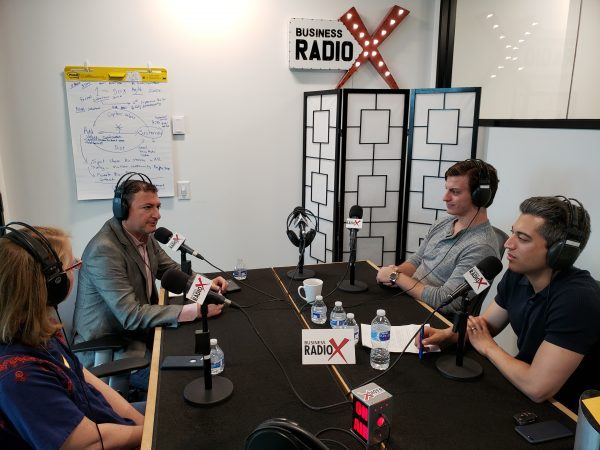
By a May 2019 radio appearance, Azalea described a workforce of more than two hundred spread across four offices. Zeidan was discussing a path that had taken him from an internship to entrepreneurship and executive responsibility. The scale had changed considerably from the downtown office. He continued to explain the business through dedication and company culture, keeping the people question in the foreground.
An apology with commercial consequences
One early customer story complicates any polished account of growth. Zeidan recalls a client who believed the company had made serious mistakes and moved toward suing. His response was to acknowledge the mistakes and ask how to repair them. When he recounted the incident in 2022, he said the client was still a customer.
A dissatisfied client, a threatened lawsuit, an acknowledgment, a continuing relationship: the episode gives substance to his stated preference for humility. Listening has little cost when the other person is offering congratulations. It becomes a management choice when the person across the table believes your company has failed them.
The outcome offers a useful measure alongside employee totals and awards. A relationship survived a moment that could have ended it. For a founder whose early progress depended partly on introductions, that is a fitting incident to remember. Someone once opened doors for his company. Here, he describes doing the uncomfortable work required to keep one from closing.
From the prize check to the boardroom
Institutional capital arrived on a very different scale from the chamber competition. LLR Partners announced its investment in Azalea in March 2021. The stated plans included product development, continued growth, and potential acquisitions. LLR partners Sasank Aleti and Scott Perricelli joined the board. Zeidan now had new partners involved in the company’s direction, alongside the management team.
That September, Azalea acquired dashboardMD. Its leader, Jose Valero, took responsibility for the analytics business as director of analytics, while Zeidan remained CEO. A transaction added a colleague with a defined role as well as technology. It is a useful detail in a career so often described through relationships: the acquisition announcement made room for the person who would lead the acquired expertise.
Recognition followed several routes. Atlanta Business Chronicle included Zeidan in its 2018 40 Under Forty group and named him among its Most Admired CEOs in 2019. In January 2023, Azalea announced his selection for the Georgia Titan 100. He thanked the company’s team. Years earlier, Leadership Lowndes had selected him as its 2013 class president, an honor decided by classmates.
A hiker with a few uphill stretches
Outside the office, Zeidan enjoys hiking. In a short filmed conversation with Michael Hainsworth, he compared the challenges of a growing business with the ups and downs of a trail. He also willingly admitted to a dad joke about organic growth. It is a brief comic interruption in a discussion of financing and acquisitions, and rather welcome company for anyone facing another graph.
The conversation also made his acquisition criteria more specific. He described assessing prospective team members against three working values: aggression, humility, and innovation. That combination leaves room for ambition and for the acknowledgment that someone else might have a useful answer. He discussed mentoring through Atlanta’s Technology Executives Roundtable, describing satisfaction in watching other people move forward.
There is a continuity here with Ballard’s help at the beginning. Having benefited from people who made introductions, he speaks about passing assistance along. The rewards he describes include seeing colleagues and other executives accomplish things in their own lives. The company’s growth gives him a larger circle in which to do that.
A different title, familiar work
The newest chapter begins with a change in position. In October 2026, after eighteen years as CEO, Zeidan transitioned to chief strategy officer at Azalea and continued serving on its board. His responsibilities now include mergers and acquisitions, along with key client and partner relationships. These are activities already visible across the earlier chapters of his career, brought together under a different title.
There is also a small family detail that resists the language of executive biographies: he and his daughter share a birthday. Beside the awards, offices, and board responsibilities, it is a pleasingly simple fact. Some dates on a founder’s calendar belong to the company. That one has a prior claim, and a second guest of honor.
The career began with three colleagues entering a competition and a chamber president making introductions. It now includes a board seat and responsibility for future combinations. Between those points sit graduates hired, businesses joined, investors welcomed, and a customer persuaded to stay. Follow those relationships and the career becomes easier to understand. The first check helped start a company. Zeidan has spent much of the time since learning how to keep people building it together.