Company AI · Automotive SaaS · Fixed Ops
The Startup That Turned 73 Million Ignored Recalls Into a Money Machine
A Marine-turned-car-dealer got stuck with 42 recall notices and no phone numbers. His fix became a platform that has booked over a million VINs and turned the auto industry's most-ignored paperwork into a service department growth engine.
Every year, American drivers get a plain white envelope in the mail. Inside is a notice that their car has an open safety recall - a defect the manufacturer will fix for free, no charge, no argument. Most people toss it. Roughly 73 million vehicles are driving around the United States right now with a recall nobody bothered to schedule. It is one of the strangest stalemates in modern commerce: a free repair that almost no one claims.
BizzyCar exists because one car dealer decided that pile of dead mail was worth something. The St. Louis-area company builds AI software that finds the owners of recalled vehicles, texts them, and books the repair directly into a dealership's schedule - then keeps those customers coming back for oil changes, brakes and, eventually, the next car. Dealers on the platform have generated more than $250 million in incremental service revenue. The recall, it turns out, was never the product. It was the doorway.
01 / The 42-recall weekendHow a frustrated dealer built a workaround
The origin story is almost too neat. Ryan Maher is a third-generation car dealer and a U.S. Marine Corps captain, raised inside a family dealership business in Missouri. One busy sales weekend, an email arrived from his manufacturer: he had 42 open recalls in his primary market area and needed to get them fixed. Attached was a list of VINs - vehicle identification numbers - and nothing else. No names. No phone numbers. No way to reach a single one of those drivers.
We were sitting in our conference room when I received an email from my OEM, instructing me to address 42 open recalls in my PMA. All I received was a VIN list with no straightforward method to contact the vehicle owners. Ryan Maher, Founder and CEO
Instead of shrugging, Maher started digging. During the COVID-19 pandemic, with showrooms quiet, he built a scrappy prototype: a manual 25-mile online search that hunted down recalled vehicles listed around his market and matched them to owners he could actually contact. It worked. Cars came in. The free repair became a reason to reconnect with drivers who had drifted away. That improvised search - equal parts stubbornness and spreadsheet - became the seed of BizzyCar.
02 / The reframeCompliance is a cost center. Until it isn't.
Here is the insight that makes BizzyCar interesting. Manufacturers are legally required to fix safety recalls, and they reimburse dealers for the labor and parts. Non-compliance can cost a manufacturer nine figures in penalties. So the money to fix these cars already exists - it is just sitting there, unclaimed, because the mail-based process that connects a defect to a driver is broken.
Most of the industry treats recall work as an annoying obligation. Maher treats it as the cheapest customer-acquisition channel in retail auto. By his account, roughly half to 60% of a typical dealership's customer base has an active, unaddressed recall. Get those people into the service drive for the free fix, and a chunk of them stay for paid work - and a chunk of those eventually buy their next vehicle from you.
The recall may be the hook, but the real value lies in what happens once the customer walks in. Ryan Maher, Founder and CEO
The numbers back the reframe. About a third of the appointments BizzyCar books come from customers who had not visited the dealership in two or more years - lapsed relationships, reactivated by a safety notice. That is the retention flywheel most dealer CRMs have never managed to spin.
03 / Under the hoodWhat the software actually does
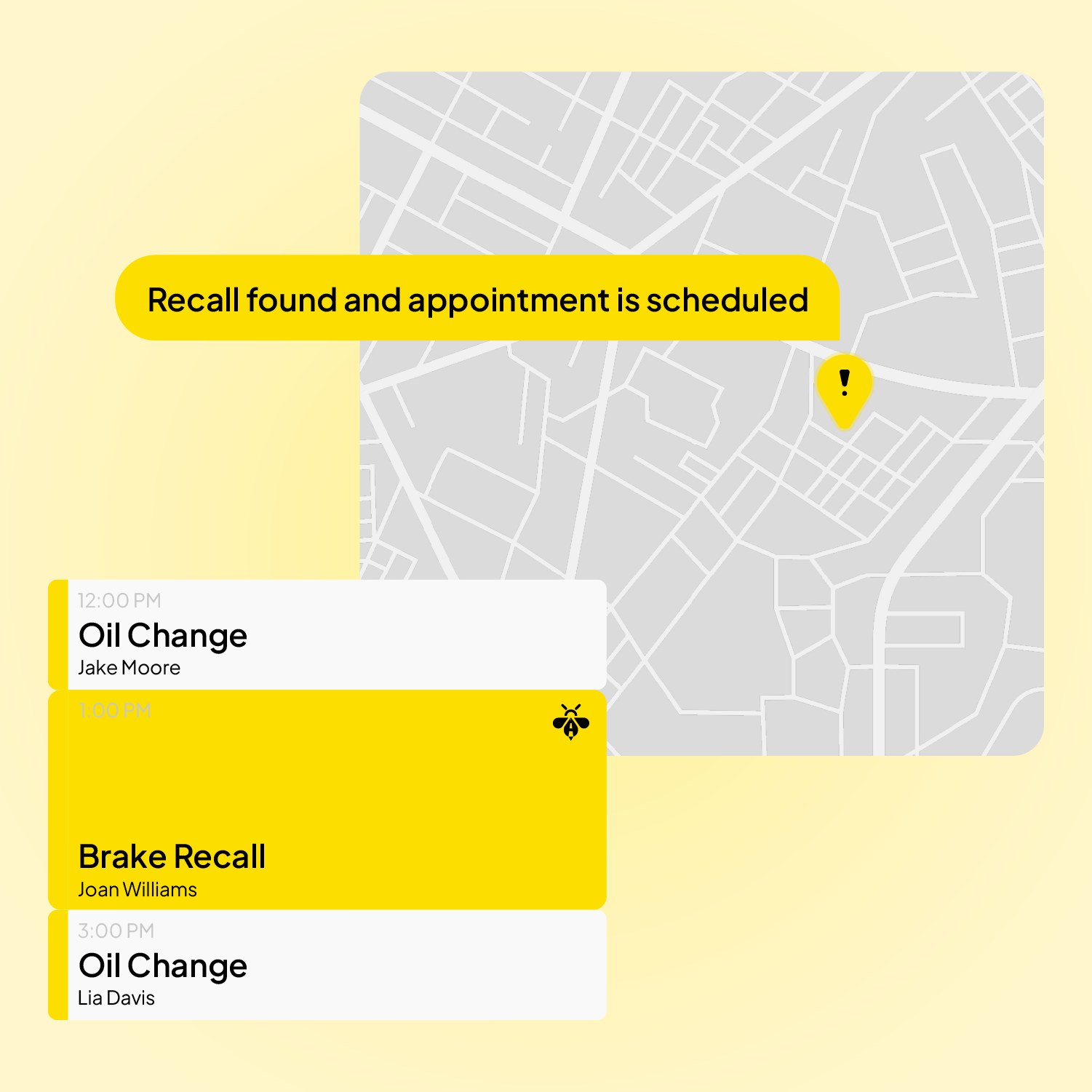
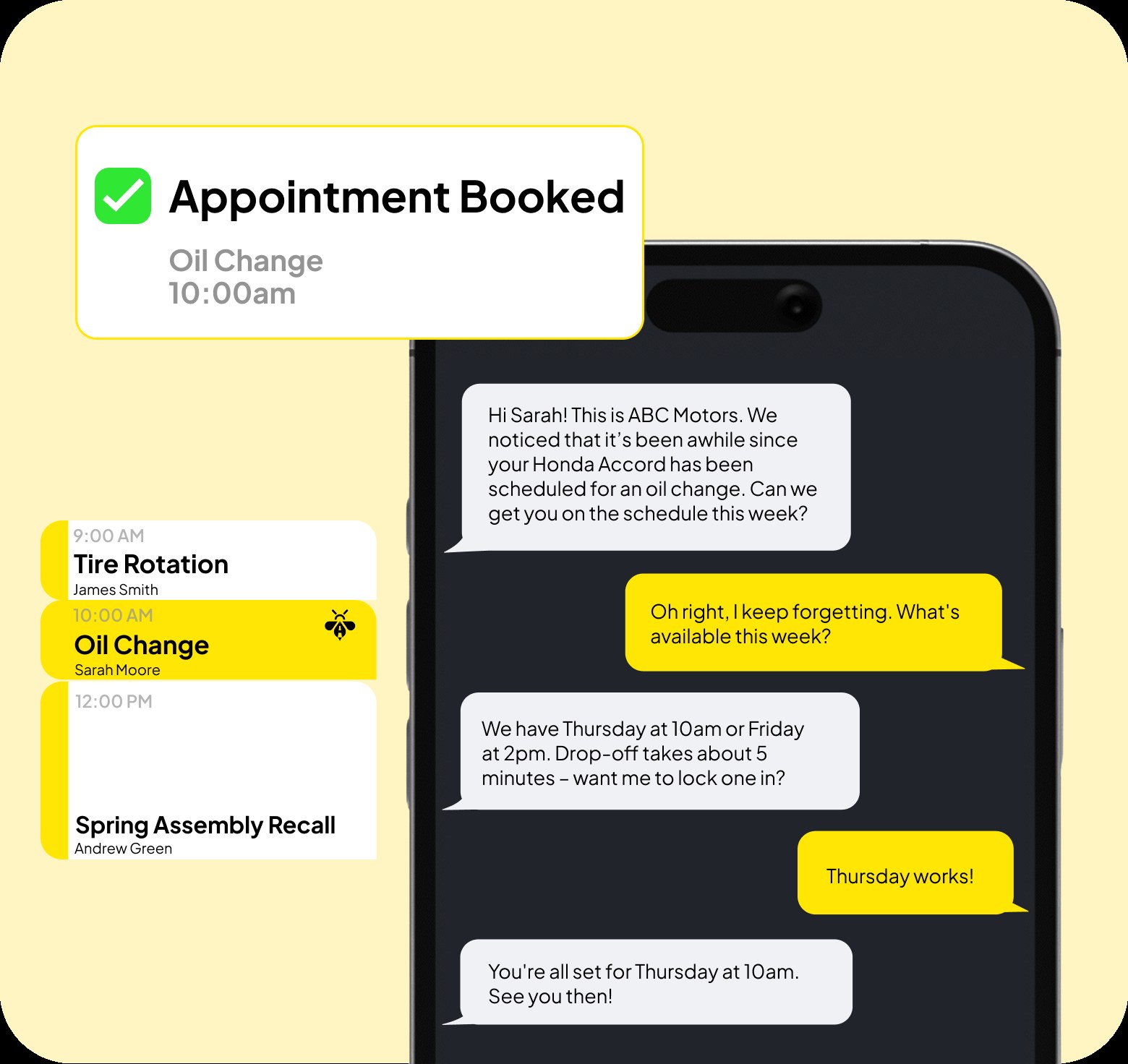
BizzyCar plugs into the systems a dealership already runs - the DMS (dealer management system), CRM and scheduling tools - and syncs the data securely. From there, an AI agent identifies which vehicles in the dealer's market have open recalls, reaches out to the owners by text message, and books the appointment straight into the schedule. No extra staff, no call center marathon, no envelopes.
How a recall becomes an appointment
AI scans VIN and recall data to find open recalls in the dealer's market.
→Owners get an automated text - no action required to start the conversation.
→The free repair is scheduled directly into the dealership's system.
→Upsells, retention and mobile service turn one visit into a relationship.
Around that core loop sits a product suite. Recall Scout scans a dealer's upcoming appointments for recalls the advisor can add before the customer even arrives. Service Engine converts routine maintenance milestones and lapsed-customer data into booked appointments. Fleet IQ brings the same recall and service tooling to fleet operators. And Mobile Service - the piece that turns a screen into a wrench - sends technicians to the customer.
04 / The driveway playBringing the service bay to you
Mobile service is where BizzyCar stops looking like a marketing tool and starts looking like a bet on how car maintenance gets delivered. Its technicians can perform roughly 71% of routine maintenance at a customer's home, with valet, pickup and delivery options layered on top. The recall pulls a driver in; the convenience of never visiting a dealership is what keeps them.
We've tried to make this easy and convenient to get your recall repair. Ryan Maher, Founder and CEO
By the end of 2025, the company expects nearly 1,000 dealers on its mobile service platform. That is a lot of vans, and a quiet unbundling of the fixed-ops department that has anchored dealership economics for decades.
05 / The moneyTwo rounds and an investor who keeps coming back
Investors have noticed. In May 2025, BizzyCar secured a $15 million growth round led by Dealer Tire, one of the largest distributors in the aftermarket. In September 2025, Dealer Tire led again - a $20 million follow-on to the Series B, with new investor FM Capital joining - pushing total funding past $50 million. When your existing lead writes the next check, the signal is hard to miss.
BizzyCar funding, 2025
Cumulative funding surpassed $50M after two 2025 rounds. Bars show announced round size.
Recalls have long been one of the most painful, outdated processes in automotive. BizzyCar is reinventing that experience. Chase Fraser, FM Capital
The business model is straightforward B2B SaaS: franchise dealers and dealer groups pay for the platform and profit from manufacturer-reimbursed repairs plus the retention and upsell revenue that follows. Customers report a 4:1 return, and top performers - names like Tasca Automotive and Penske Automotive Group have been cited among heavy users - clear six figures a month from recall-driven work. The company says it has grown revenue more than 300% year over year for multiple years while adding 100-plus dealer rooftops a month.
06 / Where it fitsA boring dataset, a growing moat
BizzyCar's real competition is not another slick startup - it is the status quo. Mailed notices. Manual call lists. Generic dealer CRMs that were never built to hunt open recalls. By specializing in the least glamorous corner of the service department and connecting to roughly 19 global manufacturers - covering more than 90% of major domestic, Japanese, Korean and German automakers - the company has turned a compliance headache into defensible infrastructure. It is SOC 2 Type 2 certified, which matters when you are syncing millions of VINs.
What can a reader steal from all this? The pattern. Find a process everyone finds annoying, where the money already exists but the plumbing is broken - and build the plumbing. BizzyCar did not invent recalls or convince manufacturers to pay for repairs. It just made sure the car actually shows up.
The obvious caveat: this works because a specific structural quirk exists - a free, funded repair that goes unclaimed. Shrink that pool of 73 million open recalls, or change how manufacturers reimburse, and the hook loses some pull. For now, the pool is enormous, the mail still gets tossed, and a bee-with-a-highway logo keeps showing up in dealer service drives across the country.