Ujj Nath went to his local Honda dealership for an oil change. He brought a coupon. In his telling, he expected the car back in an hour. Three hours passed without an update. When he called, the person who answered needed his name, vehicle model, and even its color. His service advisor was at lunch. The promised callback never arrived. By the time Nath returned to the store, the invoice had acquired a final indignity: no coupon discount.
This is myKaarma’s origin account, set in 2012. The revealing detail is how ordinary the disappointment sounds. No spectacular mechanical disaster. Just a succession of small gaps, each with someone else on the other side.
- The buyer: franchise dealerships; the daily work happens in service departments.
- The offer: connected scheduling, conversations, inspections, approvals, and payments.
- The bet: better handoffs can make the customer’s visit easier and the shop’s work more productive.
- The lesson: follow one customer all the way through your business. Department charts conceal a great deal.
Nath’s response was to build software for the service advisor and the customer together. The resulting company began with an apparently odd pairing: communications and payments. From a customer’s seat, however, both belong to the same question: how difficult will it be to get my car back?
The repair is only half the journey
myKaarma operates in what dealerships call fixed operations, the service and parts side of automotive retail. Its software is used by service managers, advisors, technicians, business development staff, and accounting teams. The customer encounters its effects through a booking, a message, an inspection video, or a payment link. The dealership buys the machinery behind those interactions.
The company describes its integrated platform as mKOS, the myKaarma Operating System. The name is ambitious; the underlying proposition is concrete. A vehicle arrives with an appointment and a history. Someone inspects it. Someone explains what needs doing. The owner decides. Someone collects the money. At every transition, information has an opportunity to go missing.
- 01BookTime + symptoms
- 02InspectVideo + findings
- 03ApproveEvidence + price
- 04PayInvoice + record
The product connects these steps. The customer experiences one trip.
Communications gives staff a shared thread for calls, texts, emails, and internal conversation. It includes recorded and transcribed calls, templates, translation, and AI message categories such as Action Required. The attraction is context: the next person responding should be able to see the conversation already underway.
Scheduler+ handles website and staff bookings, capacity management, vehicle details, recall prompts, and maintenance menus. Payments brings remote invoices, in-person terminals, digital wallets, and reconciliation into the picture. Sending a payment request by text or email gives the customer a way to settle the bill before returning to the cashier. Accounting, meanwhile, needs the transaction to find its proper record.
These are useful features individually. Their connection is the more interesting sales argument. A graceful payment screen cannot recover an afternoon spent chasing an approval. An excellent booking tool cannot explain an unexpected repair.
A camera enters the negotiation
ServiceCart Premium Video MPI turns a multipoint inspection into something the customer can examine. Technicians record what they find; advisors share recommendations; customers can approve work from their devices. The product supports configurable inspection workflows and aims to reduce duplicate entry into the dealer management system, or DMS.
Consider the asymmetry in a repair conversation. The technician can see the vehicle. The owner often cannot. A video gives the recommendation a visible object. It also gives the customer something to pause, replay, or question. That changes the conversation’s available evidence, even if it does not settle every disagreement.
“It was me talking for 45 seconds”
Dave Bernardini, #1 Cochran, describing a video that helped sell an $800 repair in a myKaarma testimonial
There is an incentive to keep in view. The dealership wants more repair recommendations accepted. The owner wants to understand which repairs deserve approval. Good explanations can serve both interests. Poor explanations, merely delivered faster, leave the original trust problem intact.
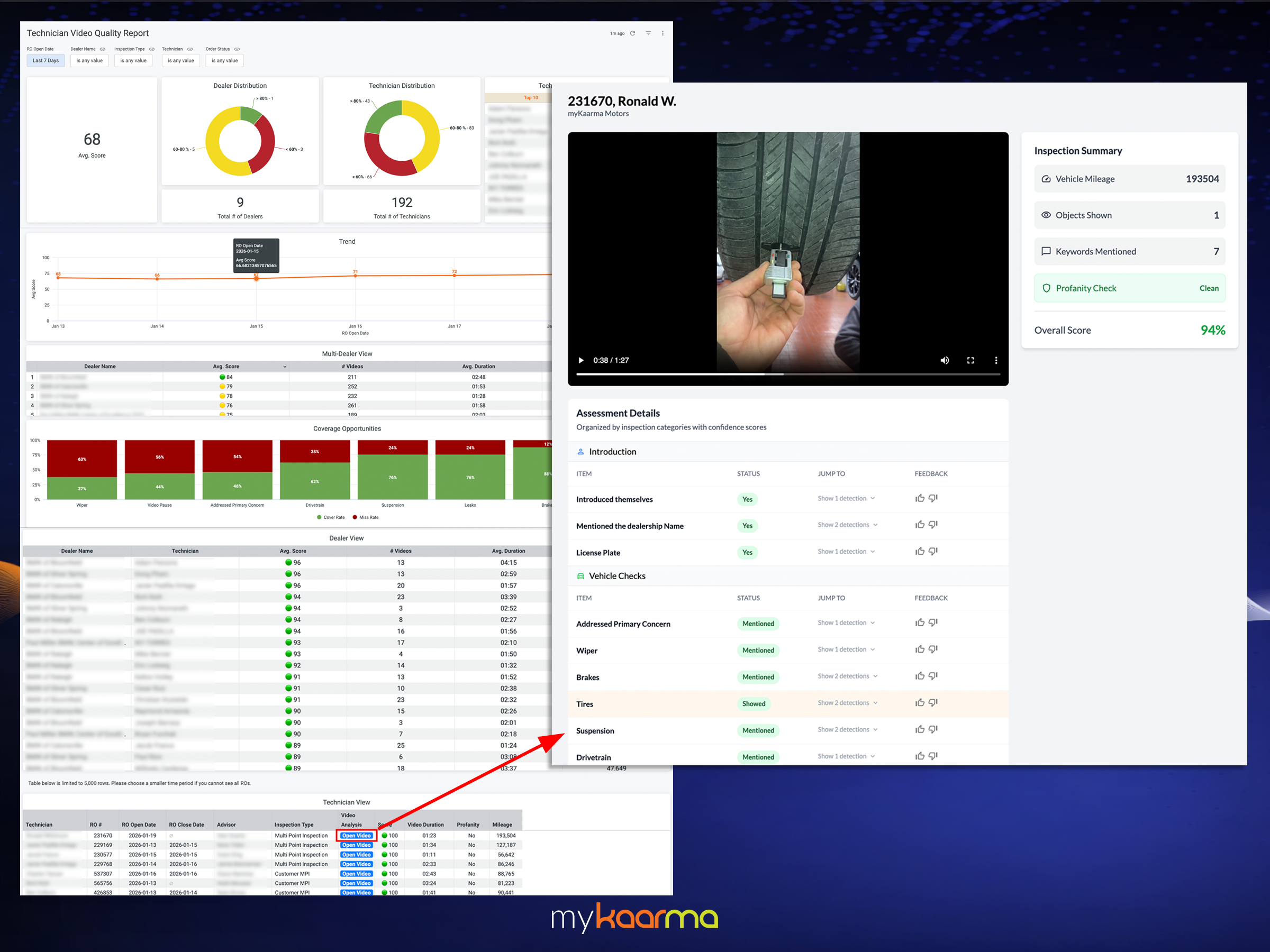
In January 2026, myKaarma launched Tech Video Grader, an AI tool for assessing technician videos and coaching quality. Its announcement reported pilot results of up to $90 more per repair order for high-quality videos. That is a company-reported pilot claim, a sensible prompt for a dealer’s own experiment rather than a guaranteed return.
A useful trial would track whether customers watch, whether they understand, how quickly they respond, and which recommendations they accept. Repair-order value matters, but it cannot tell the whole story by itself. A bigger bill and a clearer explanation are different observations.
Go and see the service drive
myKaarma’s stated culture includes Genchi Genbutsu, the Toyota-influenced practice of going to see the work firsthand. The company says its team must observe dealerships and live in their processes. Its co-founders include Nath, Gaurav Sharma, and Bill Fletcher; Sharma now serves as Chief Product and Strategy Officer.
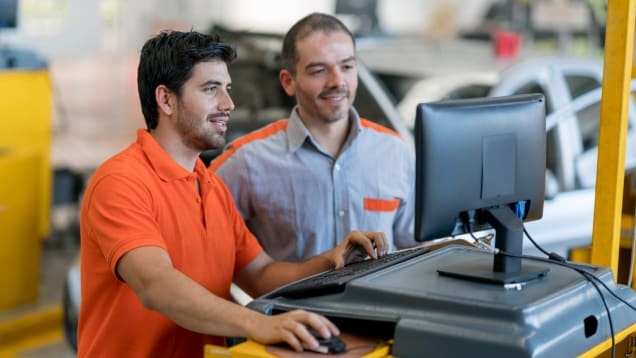
The principle is easy to borrow. Sit beside the person receiving a call. Follow the recommendation to the owner. Watch what happens when the advisor is occupied. Then follow the payment to accounting. A business may have a satisfactory tool at every desk and still make the customer repeat the same story.
Integration is part of myKaarma’s answer. Its UVeye partnership, announced in July 2024, connects automated inspection information to customer communications. Reporting on that collaboration described dealers asking the vendors to work together. Sunbit adds financing for approved repair customers through the payment flow. These partnerships extend the platform without pretending every necessary product must come from one vendor.
In May 2026, myKaarma launched a Partner Portal with sandbox testing and self-service API controls for approved partners. That makes its integration philosophy more tangible: another company can build against the workflow. For a buyer, the useful question is whether the particular connection needed in their store works as expected.


Capital follows the handoffs
The commercial model packages cloud software for dealerships. Essentials includes communications, payments, and video tools; Advanced adds ServiceCart and other capabilities; Ultimate extends into check-in, pickup and delivery, and outreach. Optional additions let buyers adjust the bundle. Pricing is discussed through a sales consultation.
The purchase decision therefore needs a store-specific calculation. A dealer should compare the proposed package and payment terms with advisor time, duplicate entry, approval delays, and existing software commitments. Buying the longest feature list is a peculiar way to solve a short list of expensive problems.
$15 million
Kayne Partners-led investment
550 dealerships
PocketExpert’s customer base at acquisition
Warburg Pincus
Strategic investment announced January 14
Kayne Partners led a $15 million investment in 2018. myKaarma acquired PocketExpert in 2021, bringing in a communications, payments, and inspection platform serving 550 dealerships. H.I.G. Growth Partners invested in 2022. In January 2026, Warburg Pincus joined, with the transaction including a partial sale by H.I.G.
The company said it had more than tripled in size since 2022. The announcement did not define that measure, so it should not be quietly translated into revenue growth. Its 2026 releases describe thousands of dealer users. The customer names displayed on its website include Sonic Automotive, Holman, #1 Cochran, MileOne, Morgan Automotive Group, and Lithia.
Competition includes Xtime’s automotive service platform and combinations of separate tools. myKaarma’s distinguishing emphasis is the connected conversation, inspection, approval, and payment journey. Overlapping features make a practical demonstration more revealing than a slogan. Follow a real repair order and see where staff still have to copy information.
The next waiting room is your driveway
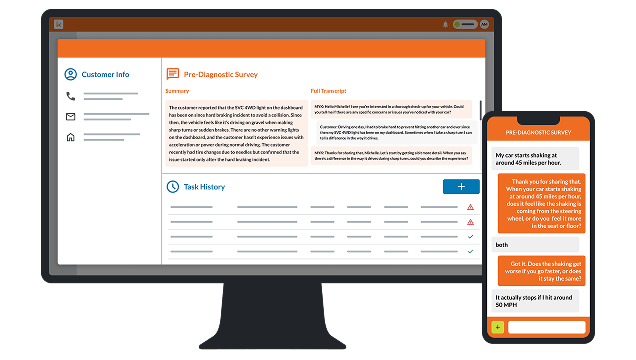
The company’s newer work reaches earlier into the visit. ServiceConcierge and Service Pre-Diag help handle appointment requests and collect symptoms before the vehicle reaches a technician. In April 2026, Ford selected myKaarma as a preferred technology partner for video inspection capability. The service lane is becoming a chain of digital exchanges before, during, and after the physical work.
In an August 2026 opinion piece, myKaarma explored mobile mechanics and the coordination required when service happens at home or work. Moving routine jobs outside the dealership adds a third location to the conversation: customer, mobile technician, and store. The software’s original concern with keeping people informed travels rather well.
There are limits to the idea. Connected information cannot create a free service bay, make an unsuitable repair portable, or persuade a customer who cannot afford the work. Its value depends on accurate records, useful integrations, and staff acting on the messages they receive. Those are operating conditions, not decorative implementation details.
The transferable lesson is modest enough to use tomorrow. Look for the point where your customer becomes someone else’s responsibility. Ask what information follows them. Then ask what happens when that person goes to lunch. Somewhere between the two answers, there may be an afternoon worth giving back.