Somewhere beyond the new-car shine and the bright promise of a showroom sits a less theatrical room. It may be a small office. It may resemble a broom closet with ambitions. For years, Jim Roche kept encountering versions of it as he traveled among automobile dealerships: desks, files and repair orders stacked upward in the patient architecture of unfinished work.
Roche had visited roughly 2,000 dealerships, and the paper had become familiar scenery. Then a service leader gave the scenery a price tag. The pile, he told Roche, was a stack of uncashed checks. A repair had been made under a manufacturer's warranty, but the claim still had to survive a thicket of codes, documents, eligibility rules and data entry before the dealership could be paid.
The phrase stayed with him because it converted clutter into trapped value. Roche has described his entrepreneurial impulse plainly: “The catalyst for me has always been just to find a problem that needs to be solved and see if we can apply technology to it.” Here was a problem with paper edges, hiding in the least photogenic corner of the building.
“That’s a stack of uncashed checks.”The observation that reframed a warranty office
A career behind the showroom
Roche did not arrive at that door as a tourist. His career had unfolded inside the operational machinery of automotive retail. At Newgen Results, he was senior vice president of operations while the company grew past 5,000 dealerships and went public in 1999. At Autobytel, he oversaw product management and helped develop a customer-relationship platform. He later led Ocentrix, which worked on dealership-management software.
In 2003, he founded AutoPoint. The company built a multi-channel marketing platform for dealership service departments, where retention matters because a customer buys a vehicle occasionally but returns for maintenance many times. AutoPoint was acquired by Service Repair Solutions in 2010, then became part of Solera in 2014. Roche went on to Xtime and Cox Automotive, where he became a fixed-operations specialist with a habit of translating service-lane details into boardroom economics.
He also put those ideas into books. Fast Lane, published in 2017, examined service loyalty and its profit potential. Fast Break argued for a customer-centered operating philosophy in dealership service. The second book was produced for the benefit of the industry, with neither Roche nor Cox Automotive receiving proceeds from its sales. It is a small detail, but an instructive one: Roche was not merely selling a thesis. He wanted the thesis used.
The long road to one stubborn problem
Newgen Results scales to more than 5,000 dealerships and completes its public offering.
AutoPoint begins building digital tools for dealership service operations.
Service Repair Solutions acquires AutoPoint.
Work begins on the warranty-processing problem that becomes WarrCloud.
WarrCloud's automated platform reaches the market.
A $20 million Series B funds further AI development and customer success.
By the time Roche confronted warranty claims, he had spent three decades watching dealership technology evolve. Scheduling had moved online. Marketing had become measurable. Customer communication had become multi-channel. Yet warranty administration still depended heavily on people reading repair orders, looking up manufacturer rules, entering codes and chasing missing information.
The one-year fix that took seven
The idea sounded almost courteous in its simplicity: extract the relevant repair order from the dealership-management system, check it against the manufacturer's policies, assemble a valid claim and submit it quickly. Roche and his team began working on it in 2015. They thought they might need a year.
They needed about seven.
Warranty rules vary by manufacturer. Claims carry labor operations, parts, diagnostic time, technician notes and supporting documents. A valid repair can become an invalid submission through an omitted code or a mismatch between the story and the data. The apparently dull job had resisted automation because it contained judgment, exceptions and scattered information. Its complexity was not a footnote. It was the product specification.
WarrCloud eventually came to market in 2021, joining software with warranty-administration expertise. The platform extracts repair orders, applies manufacturer-specific rules and submits validated claims. Machine learning and natural-language processing are meant to increase how much of the work can be automated while preserving the accuracy that determines whether a dealer gets paid.
The company reports that its dealership customers see a 15.1 percent increase in warranty billings and a 60 percent reduction in processing costs. Earlier, Roche told Automotive Ventures that customers in 2022 had increased warranty revenue by 12.4 percent while cutting processing costs by 60 percent. These are company figures, but they clarify the wager: speed matters, cost matters and completeness matters. A claim overlooked or delayed is money marooned between the service bay and the ledger.
What WarrCloud says changes after automation
Company-reported outcomes. Bar lengths are illustrative and use different baselines.
The plumber's advantage
Fundraising offered Roche another useful metaphor. After hearing the WarrCloud pitch, one prospective investor said he understood the business: plumbing. Roche replied that it was not quite the glamorous description he had been seeking. The investor clarified. If Roche was the only plumber in the country, the position could be valuable. He invested.
Roche tells the story with the good humor of someone willing to let usefulness win the argument. “At the end of the day, people want their problems solved and there is always opportunity in that,” he said. WarrCloud is infrastructure in that sense. A dealership customer need not admire every pipe. It wants a correct claim to move through the system and cash to move back.
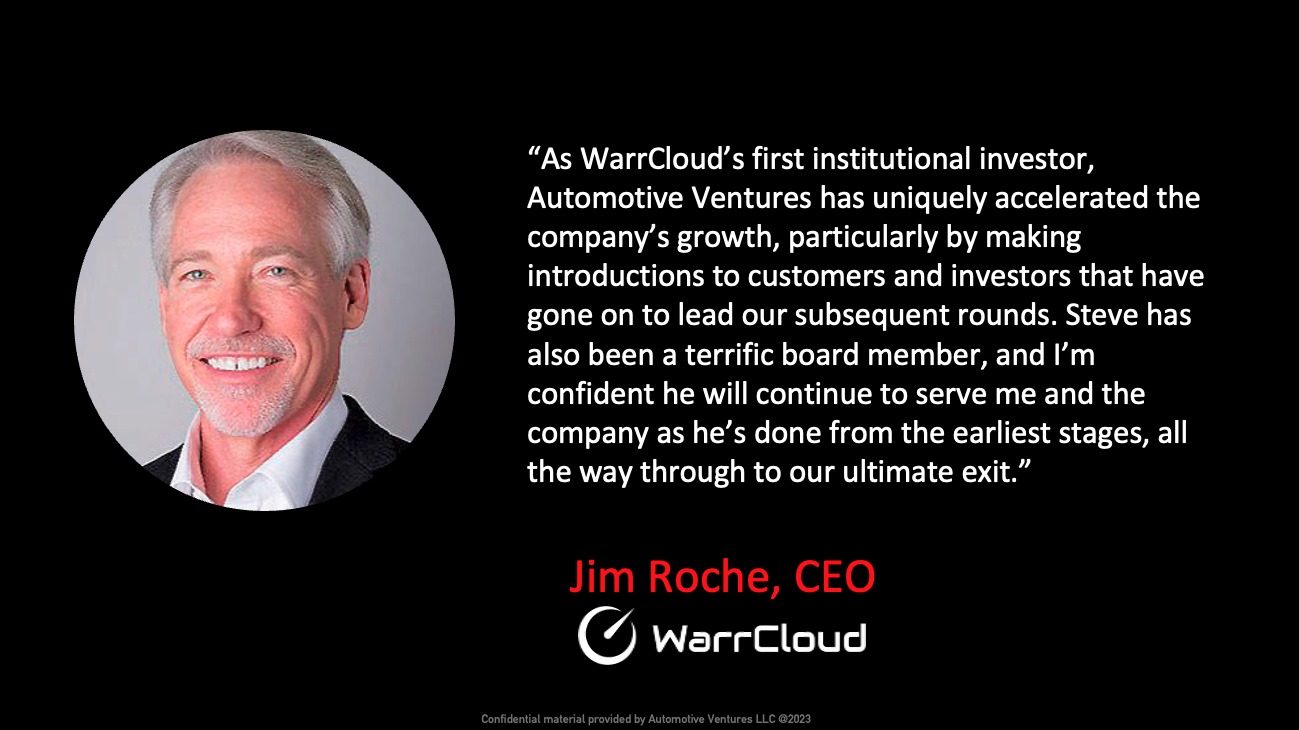
That practical story found capital. In October 2024, WarrCloud announced a $20 million Series B led by Centana Growth Partners, with returning investors Argentum and Automotive Ventures. The stated purpose was to deepen the platform's artificial intelligence, including machine learning and natural-language processing, and strengthen customer success.
Recognition followed. WarrCloud won a 2025 Automotive News PACE Award after a review that included a written application and an in-person site visit. It entered the 2025 Inc. 5000 at No. 182. The following year it appeared again at No. 469, with Inc. reporting 729 percent three-year growth. WarrCloud says it now serves more than 1,000 enrolled dealerships nationwide.
Those milestones altered the scale, but not the pitch. When Roche spoke about the company in 2023, it had sold its 400th dealership customer and was approaching $10 million in annual recurring revenue. The language was already about cash flow, processing cost and finding every legitimate allowance permitted by an automaker's policy. Three years later, the customer count had more than doubled. The argument remained disarmingly prosaic: work already performed ought to become a correct claim, and a correct claim ought to become payment without unnecessary delay.
Roche has also been precise about the limits of software theater. The attraction of AI is not that a dealership can say it uses AI. It is that a complicated repair narrative can be read, checked against policy and converted into useful action. His 2024 funding announcement directed new capital toward machine learning, natural-language processing and customer success. The sequence matters. A model alone does not file the claim; it has to live inside a process that dealership staff and manufacturers can trust.
The second system
Roche's ambitions extend beyond faster paperwork. Warranty claims are a record of what goes wrong with vehicles, which parts fail, what technicians find and what repairs cost. Clean, timely claim data can help manufacturers see quality patterns sooner. In 2025, WarrCloud formed an OEM advisory board to guide that side of the business, linking the dealership's need for payment with the automaker's need for visibility.
He has paired that technical agenda with a human one. The St. Louis Titan 100 profile describes a leadership philosophy built around adaptability, continuous improvement and mentoring younger professionals. Saint Louis University's Chaifetz Center for Entrepreneurship named him the 2025 D. Graeme Thomas Mentor of the Year. The recognition suits a founder whose career has involved explaining neglected systems, first to dealers, then to employees and investors.
There is a quiet consistency here. AutoPoint focused on what happened after a vehicle sale. His books focused on service, loyalty and retention. WarrCloud focuses on the claim after the repair. Roche has repeatedly chosen the stage after the obvious stage, where customer relationships become operations and operations become economics.
“At the end of the day, people want their problems solved and there is always opportunity in that.”Jim Roche
Entrepreneurship is often narrated as a lightning strike. Roche's version is closer to fieldwork: thousands of visits, repeated observations, one well-aimed remark and seven years of discovering why the easy-looking problem was hard. The glamour, if it exists, arrived late. First came the closet.
That is the useful tension in his story. The pile of paper looked old-fashioned, but the solution required AI. The process looked administrative, but it affected revenue, cash flow and product-quality data. The investor called it plumbing, and the plumber kept building. Roche did not invent the warranty claim. He simply declined to accept that it must always move at the speed of paper.