A homecare visit can finish long before the work does. Someone still has to turn observations into records, check the medication log, update a plan and reconcile the time with an invoice. Birdie has built a business around that administrative afterlife. Its latest bet is that an assessment conversation should produce the beginnings of its own paperwork.
The London company sells software to homecare providers: the organisations dispatching professionals to help people in their own homes. Its platform connects care planning, staff schedules, medication records, billing and family updates. In June 2026, Birdie said more than 1,200 providers used it to support over 68 million visits annually. Those are company-reported activity figures.
Birdie operates in the space between an agency office and a front door. Its work is largely coordination: making sure the person arriving knows what to do, the office can see what happened, and relatives can follow the care being delivered. For a technology company with a cheerful bird mascot, it has chosen a decidedly unglamorous place to be useful.
Annual care visits supported, Birdie reported in June 2026.
1,200+ PROVIDERS · ONE CONNECTED PLATFORMThe first customer was the wrong customer
Max Parmentier’s motivation was personal. In a published account of Birdie’s origins, he described watching his grandfather dislike the care home where he spent his final days. The question was how older people could stay at home with better support. Founded in 2017, Birdie brought together Parmentier, Abeed Mohamed, Rajiv Tanna and Gwen Lecalvez.
The initial answer involved sensors and connectivity sold to families. In a Bae HQ interview, Tanna recalled an early business without traction, spending money while its founders were still learning the sector. He proposed changing to software sold to care agencies. The attractive gap, in his telling, was a modern, integrated system that those agencies could actually use.
That account identifies the first commercial problem without turning it into a hardware disaster story. The family proposition had not found customers. An agency had recurring operational work and a reason to pay for help. The lesson for another founder is specific: identify who encounters the problem every working day and controls a budget for solving it. A worthy beneficiary and a workable buyer can be different people.
“We’re very early, we haven’t got any traction, we are burning some money here.”Rajiv Tanna · recalling Birdie’s early consumer proposition, Bae HQ
One visit, several jobs
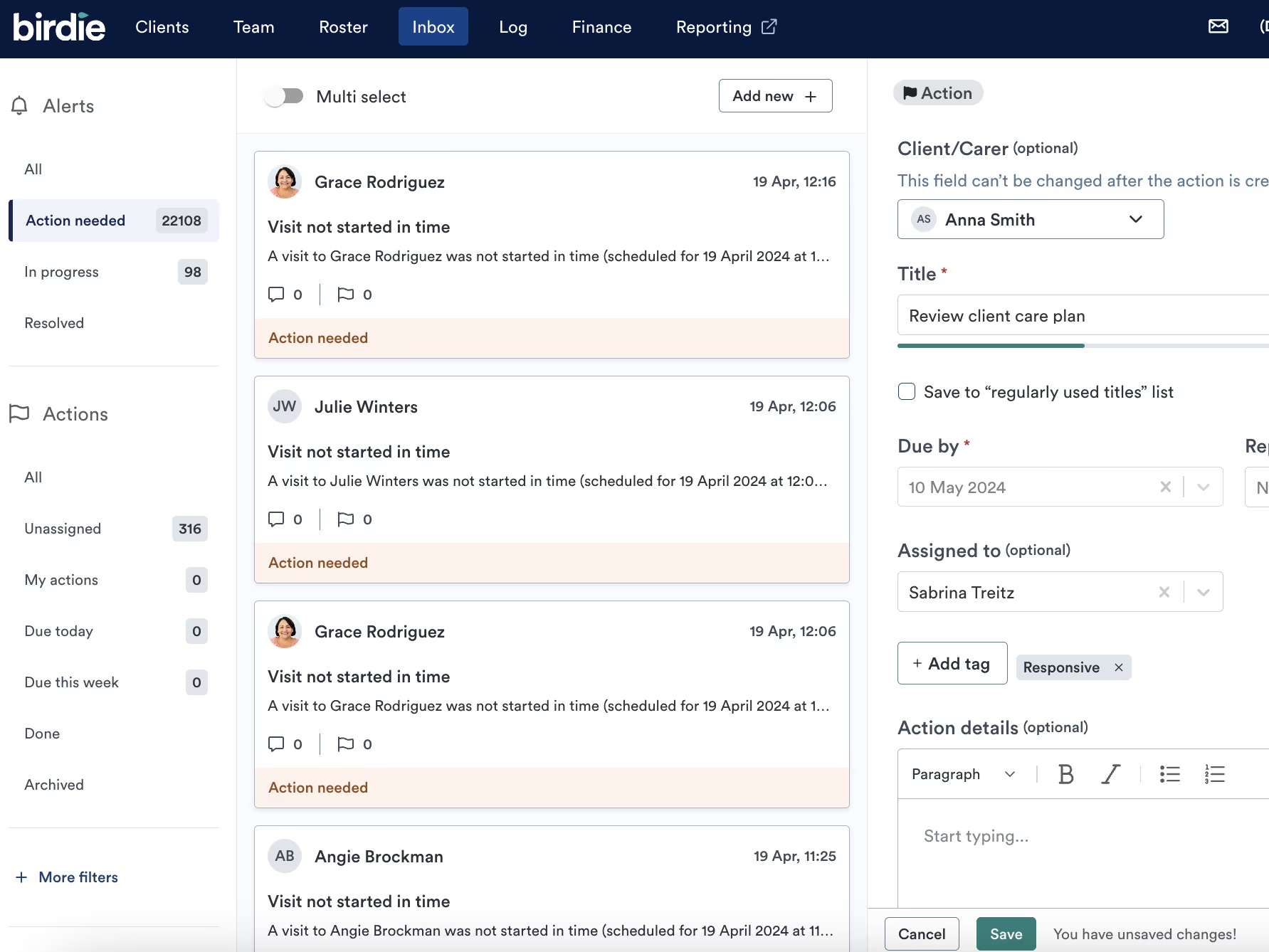
Birdie’s product divides the work across three interfaces. Office staff use the Agency Hub; care professionals carry the Carer App; relatives get the Family App. Care plans can include personal preferences as well as tasks. Electronic medication administration records, usually shortened to eMAR, document medication activity. Digital body maps add a visual record where a paragraph alone may be ambiguous.
That structure gives different people different views of the same care operation. A carer can check a schedule, record a visit and flag a concern. A manager can review it. An authorised relative can see updates without phoning the office for every detail. Permissioned third-party access also lets agencies share relevant information with other professionals.
The financial side extends the chain. Birdie offers rate configuration, invoice generation and pay-run preparation, including handling travel and mileage. Its finance tools connect delivered care to the calculations behind payment. This is payroll preparation and operational finance inside a care platform; buyers should still check how the output fits their accounting arrangements.
The company’s own product chronology shows that breadth arriving in stages. Care management came first in May 2018, followed by the family app in July 2019. Rostering, analytics and finance arrived during 2022. The sequence is revealing: Birdie built outward from the care record into the machinery needed to run the business around it.
A schematic of Birdie’s connected workflow, not a claim that every step is automatic.
The bill starts at £200. The calculation starts earlier.
Birdie advertises subscriptions from £200 a month excluding VAT, with four plans: Starter, Core, Advanced and Plus. Its pricing page describes charges based on scheduled care hours. That ties the bill to the amount of care an agency plans, rather than simply counting staff logins. Training materials and live chat are included.
There is a wrinkle worth reading before signing. Birdie’s contractual terms allow subscriptions calculated by scheduled hours or care recipients, and its help centre describes active-client billing for relevant customers. An order form determines the actual commercial arrangement. The headline starting price is therefore a reference point, not a universal quote for an agency of any size.
A useful purchasing exercise is to follow a real week’s work through the proposed system. Count time spent on rotas, checking records, preparing pay and fixing invoices. Then compare the recurring bill and implementation effort with the work that could disappear. A saving promised in a demonstration only becomes a saving when staff can repeat it on a busy Tuesday.
AI meets the assessment form
On June 9, 2026, Birdie launched SmartPlans, its first AI product. An assessor records a client conversation; the tool transcribes it and proposes answers within Birdie’s assessment fields. Suggestions point back to the relevant transcript passage. It is a more narrowly defined task than asking a general chatbot to write an entire care plan from a pile of notes.
The boundaries are part of the product. Birdie says high-risk clinical questions receive transcript extracts instead of AI-written answers. Other suggestions require human sign-off. The assessor remains responsible for turning an account of a conversation into an appropriate record. Speed is useful here only if checking remains meaningful.
SmartPlans is an add-on for Birdie customers, with three free recording hours. Published pay-as-you-go pricing is £3.50 per recorded hour; subscriptions start at £2.75 per hour. A one-hour recording at the pay-as-you-go rate therefore adds £3.50 before considering any applicable tax or the underlying platform subscription. That is a recording charge, not an hourly price for delivering care.
The practical dependency is easy to overlook: somebody must still review the result. An agency that treats suggested text as finished work would be discarding the human check the product explicitly requires. The appropriate comparison is total assessment time, including correction and approval, rather than transcription speed alone.
A recording becomes a draft.
A person makes it a record.
For high-risk clinical questions, Birdie says it supplies transcript extracts instead of suggested answers.
The unexpected feature was listening back
Birdie’s June beta write-up offered a more interesting detail than another typing-speed claim. Agencies had started replaying assessment recordings for staff development. Assessors could hear their own questioning; less experienced colleagues could learn how a conversation unfolded without attending the visit. Birdie said it had not designed for that use.
Partners also reported that retaining clients’ own words made plans more personal. One previously sceptical partner found that ability persuasive. The product team’s surprise was that better quotations had emerged from the workflow. In this setting, detail can mean understanding why a morning routine matters, alongside recording that someone needs help with it.
These are beta observations reported by the vendor, not a controlled evaluation. They nevertheless suggest something other teams can copy: watch what customers do with the record after the headline task is complete. A saved conversation can become a teaching resource, provided its use respects the people recorded.
The responsibility carries into the small print. SmartPlans terms place responsibility for lawful recording and any required consent on the customer. Its separate privacy notice describes using information to improve the product. Agencies need to understand those arrangements as part of adopting the workflow, because a care assessment contains considerably more personal material than an ordinary meeting agenda.
A crowded market, a specific argument
Birdie competes for budgets alongside CareLineLive, Access and Nourish’s homecare products. Integration alone does not make it unique: CareLineLive also offers a broad homecare management suite. Birdie’s argument is the connection among care records, operational workflows and analytics, now extended into AI-assisted assessments. The buying decision comes down to how well those connections work for a particular provider.
Nor is the market a clean contest between sealed boxes. Birdie documents external rostering integrations, including CarePlanner/Nourish and Malinko. A competitor in one procurement discussion can supply a connected component in another. Agencies with an established scheduling system may have a different migration path from those replacing everything.
Analytics gives Birdie another route into a manager’s day: reports on care quality, staff activity and business performance. Its Q-Score is a company tool intended to help providers assess performance against care-quality criteria. It should be understood as management information, not an inspection result. Records can help demonstrate good processes; they cannot independently certify that good care occurred.
Venture money, village ambitions
Expansion required outside capital. Birdie announced $11.5 million in May 2021, led by Index Ventures with Kamet participating. In June 2022 it announced a $30 million Series B involving Sofina, OMERS Ventures and Index. At the latter announcement, the company named Alina Homecare, Medacs Healthcare and Care at Home Group among its customers.
The business also chose a public statement about how it should operate. B Lab lists Birdie Care Services Limited as certified since August 2019, with an overall impact score of 94.3. That measures a broader set of company practices. It is separate from the care quality of any agency using the software.
An early account of Birdie’s culture emphasised autonomy, transparency and direct feedback. Its current company page describes a team of more than 120. The public GitHub organisation supplies a less polished glimpse of its technical interests: reusable React components, data tools and programming exercises. There is even an archived Pokémon-style dialogue component.
Its community effort has a suitably avian name. Flock launched in February 2024, and Birdie now advertises a network of more than 3,000 peers. A July 2025 partnership with Lottie added a commercial connection: helping eligible agencies find private clients and manage enquiries through Found’s basic CRM tier. The original offer excluded franchise groups and franchisees.

The work still ends with a person
Birdie’s story contains a useful correction to the usual technology pitch. It found a business by moving closer to routine work: schedules, care notes, medication logs and invoices. Its new AI product starts at another familiar bottleneck, the assessment write-up. The ambition is large; the unit of progress is small enough to inspect.
For an agency considering it, the decisive trial is an actual workflow with actual staff. Can carers record reliably? Do managers respond to concerns? Does an assessment retain the person’s preferences after review? Do invoices reconcile? Those questions turn an attractive demonstration into something measurable.
A shared record cannot create a missing carer or supply professional judgment. It can make the next person’s job better informed. That is the standard Birdie has set itself: less time reconstructing what happened, and more time knowing what to do next.
Visit, watch, investigate
Explore the product and hear the people behind it.