At Austin Light Home Care, Kawther Salih had a task that sounds almost too ordinary to become a technology story: work out what people should be paid. The Texas agency’s administrator checked hours, added them up, and checked whether caregivers had clocked in and out. In HHAeXchange’s account of her experience, the work took two to three hours a day. After switching to its built-in payroll product, CarePay, she reported 10 to 20 minutes.
- A shared visit record connects scheduling, verification, billing, and payroll.
- The customers include homecare agencies, Medicaid programs, and managed care organizations.
- Check program requirements and product access before treating a feature list as a promise.
That is one customer’s report, published by the vendor. It is also a useful way into HHAeXchange. The company occupies the administrative space around care delivered at home: the schedules, approvals, records, and payments that make an apparently simple visit surprisingly complicated. Its business becomes easier to understand when you follow the information through the office.
01 / THE RECORDA visit with several jobs
HHAeXchange focuses on Medicaid home and community-based services, often shortened to HCBS. Think personal care, support for people with disabilities, and programs that help people live in their communities. Its users include agencies arranging care, caregivers delivering it, managed care organizations overseeing networks, and state Medicaid programs. It sells the software connecting their work.
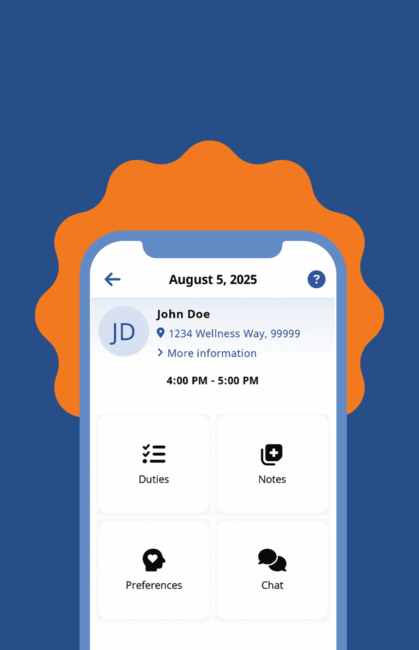
The central object is the visit. Someone schedules it. Someone performs it. Someone verifies that it occurred. The agency must reconcile that record with authorizations, prepare billing, and calculate pay. HHAeXchange’s Enterprise platform puts those activities within a connected system. Electronic visit verification, or EVV, captures attendance through methods including a GPS-enabled app and telephony.
A simplified workflow. Approval and payment rules vary by program.
CarePay, launched in August 2026, extends that connection into full-service payroll. Approved visit hours feed pay calculations, with tax filing and state-specific overtime support. Caregivers can retrieve pay information themselves. The modest appeal is obvious: information already collected at one end of the business should not need a second life as somebody’s typing assignment.
“In homecare, pay comes from visits, not time sheets.”
Jeremy Lisch · VP, Payroll Solutions · CarePay launch
02 / THE CONNECTIONSBuying the connections
The company dates its founding to 2008. Founder and former CEO Raphael Nadel later described its growth from a one-person operation to more than 300 employees before his exit. Cressey & Company’s investment was announced in 2019. Software investor Hg joined in 2021, sharing governance with Cressey. The financial terms were private.
Then came a concentrated stretch of buying: Cashé Software in June 2024, Generations Homecare System in July, and Sandata Technologies in October. These were established homecare businesses bringing software, customers, and experience with them. Sandata’s acquisition also brought a longtime visit-verification business into the group. The expansion makes the company’s position as a connector particularly relevant.
visits confirmed annually
That reach helps explain its competitive pitch. AlayaCare also offers scheduling, EVV, documentation, and billing. A long feature list alone offers little distinction. HHAeXchange’s more specific proposition combines Medicaid-focused operations with connections across providers, payers, and state programs. For a buyer, the revealing question is whether those connections match the contracts and services the agency actually handles.
03 / THE HANDOFFThe software that had to get along
VNS Health’s Personal Care team provides a telling customer example. Its published case study describes manual work and difficulty analyzing information across disconnected business systems. When it selected HHAeXchange, integration mattered alongside reporting. Senior vice president James Rolla put the requirement plainly: “We needed a solution that played well with others”.
Partner Connect addresses that requirement by linking complementary tools to the platform. The VNS Health case study discusses Caribou Rewards for staff incentives. Other documented relationships include ADP for payroll and HR, and CareConnect for caregiver tools. The business accommodates connections as well as consolidation. An agency can want fewer handoffs without wanting to discard every existing system.
04 / THE ECONOMICSThe price of typing it twice
HHAeXchange sells subscription-based enterprise software. Its buyer’s guide says pricing depends on agency size, service lines, and needs. A state-sponsored EVV portal can be available to participating providers at no cost, as in Texas. That is a particular program offering, with its own scope. Buyers still need to establish which tools and services their quote includes.
The company is also offering people to help with the financial work. Its Revenue Cycle Management Services, launched in April 2026, add expert oversight to billing and collections. CarePay addresses the outgoing paycheck; RCM addresses incoming reimbursement. Both products follow work that can consume an office after the caregiver has finished the visit.
2026 Provider Voices survey: 465 respondents from HHAeXchange’s customer base. Multiple priorities could be selected.
The company’s 2026 survey helps explain the direction. Respondents ranked compliance first among business priorities and administrative relief second. Competitive advantage ranked last. That suggests a market preoccupied with keeping daily operations working. It also makes the sales argument unusually concrete: show where staff time goes, then show what the product removes.
05 / THE PEOPLEThe software still needs people
Connected software needs careful setup. During Texas’s 2023 transition, state guidance temporarily bypassed EVV claims matching while still requiring visit records. Training documentation covers mundane exceptions: missing phone numbers, incomplete confirmations, and overlapping shifts. These details deserve attention because a record that needs correction still needs somebody to correct it.

HHAeXchange+ offers offline synchronization and 23 languages, practical accommodations for a dispersed workforce. Advanced features depend on the platform an agency uses. The lesson an operator can copy is to trace a real visit, including a mistake, through scheduling, verification, billing, and payroll. Count the repeated entries. Check who owns each correction. Then judge the software by whether that journey becomes easier for the people doing it.