At Stellar Senior Living, the awkward moment arrived with an acquisition. Two communities were changing hands. Their existing software would disappear with the old arrangement. Medication rounds, of course, could not wait for the paperwork. Stellar needed a new system while residents continued needing everything they had needed the day before.
- ECP connects medication records, care plans, sales, admissions, and billing.
- Its sweet spot is residential care, especially assisted living.
- The customer stories reward preparation as much as the software.
The company Stellar used was ECP, short for Extended Care Professional. Its proposition becomes clearer at that uncomfortable junction: keep information useful as it passes between people. A resident’s needs should survive a change of shift, a change of department, or a change of owner.
01 / The record has somewhere to go
ECP’s electronic medication administration record, or eMAR, connects with pharmacies so orders can enter the medication workflow without someone retyping everything. Staff document administration; clinical leaders can see gaps. The electronic health record handles assessments, care plans, and daily documentation. These are tools for the people doing the rounds as well as the people reviewing them.
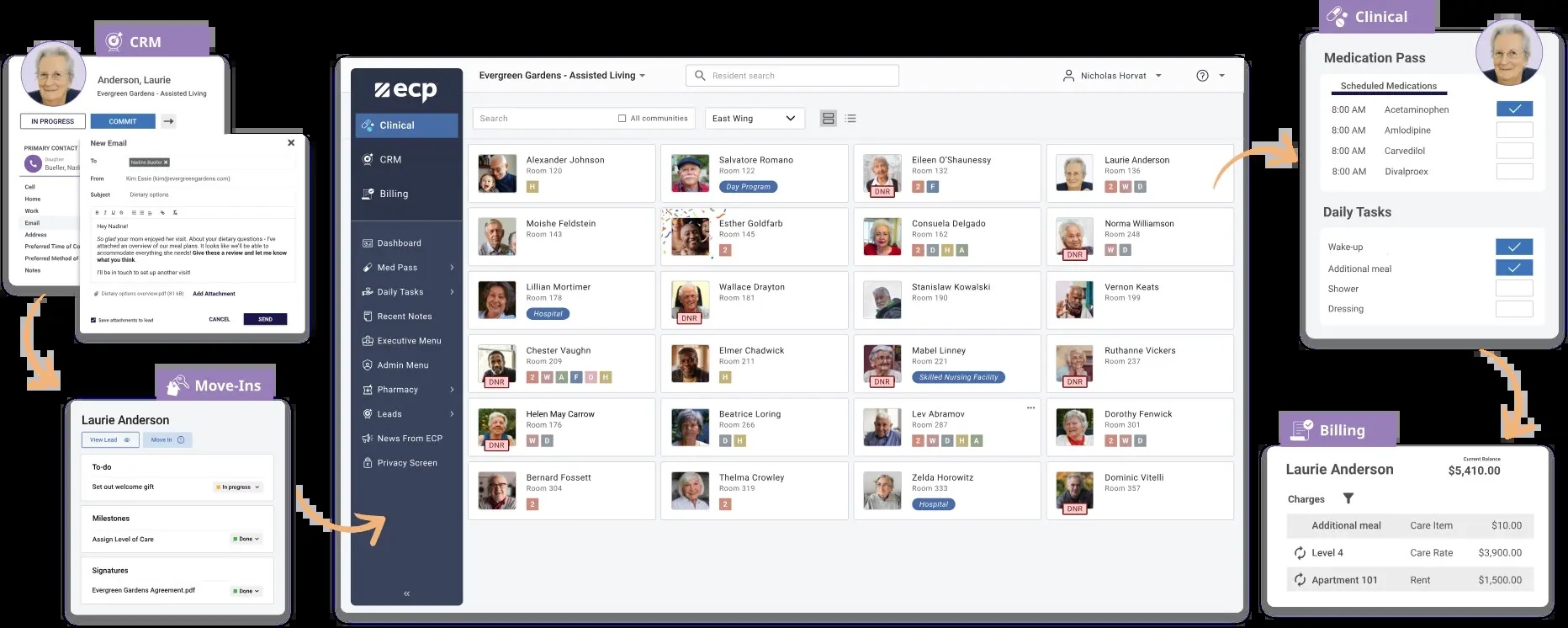
Then come the less clinical pieces. CRM follows inquiries and sales activity. Move-Ins organizes admissions documents and checklists. Billing turns recorded services into charges and manages resident invoices and payments. A prospect becomes a resident without requiring each department to start the story again. The connection is the product’s organizing idea.
- 01 Inquiry
- 02 Move-in
- 03 Care
- 04 Billing
ECP sells cloud software to operators rather than directly to residents. Its market includes memory care, independent living, and group homes serving people with intellectual and developmental disabilities. The company reports more than 8,500 communities using its platform. The buyer may oversee one home or a portfolio; the daily user may be a medication technician.
02 / The expensive part was disbelief
At SAL Management Group, a previous vendor’s implementation had stretched beyond a year. Staff stopped believing it would happen. That is a peculiar kind of software debt: people have already spent their patience before the replacement arrives.
In ECP’s published case study, SAL describes spending roughly 40 hours evaluating vendors. What helped persuade its leaders was direct involvement from ECP’s executives and implementation team. SAL chose the resident-facing suite while keeping QuickBooks Desktop. The switch required data migration, preparation, and training, not simply new logins.
“We really felt like we had a true partner in ECP.”
Brody Jardine · SAL Management Group CFO
The reported financial result was a 12.4% increase in level-of-care revenue per resident per day over a year. The mechanism matters: comparing care delivered with care assessed and billed. That figure is a customer outcome published by the vendor, rather than a forecast every buyer should put in a budget.
03 / Speed needs a backup plan
Stellar’s transition supplies the practical detail. It assembled administrators, nurses, and medication technicians, prepared checklists, and planned for paper documentation during the changeover. Medication information came first. Training used staff who could teach colleagues. Technology problems temporarily delayed assessments and care plans.
One community went live with eMAR and EHR in a day; the larger one took three. Those durations sat on top of preparation and hands-on support. An operator copying the headline number without copying the preparation would be copying the least useful part of the story.
Navion offers another version. Its ECP case study describes standardizing clinical systems across more than 50 communities in seven states and moving toward virtual implementation. Regional leaders and internal accountability supported the change. The lesson travels beyond senior care: give someone responsibility for adoption, and give that person visibility into what people actually do.
04 / An old theater, a narrower brief
Founder Len Hotz’s company began in 2004. A 2015 East Troy Chamber profile found its team inside a former opera house and theater. It is an agreeable setting for a business whose work involves very little theater: records, medication lists, and the stubborn details of daily care.
ECP’s competitive argument is specialization. Eldermark, PointClickCare, and MatrixCare are among the alternatives buyers encounter, but care settings and product scope matter. ECP concentrates on assisted living and residential care. Its billing product follows private-pay resident invoices rather than Medicare or Medicaid claims. A buyer needing skilled-nursing workflows has a different brief.
A connected suite also lives among other systems. ECP opened an Integration Hub and Developer Portal in March 2025. Its current directory includes pharmacy platforms, accounting tools, and services such as A Place for Mom. Keeping a useful neighboring system can be more sensible than replacing it merely to tidy the software inventory.
That makes the implementation conversation unusually revealing. Which pharmacy sends the orders? Which assessment rules apply in this state? Who checks a changed care level? Those questions expose the work a broad product tour can hide. They also make a sensible buying checklist for operators comparing several suppliers.
05 / The next note may be spoken
In December 2025, ECP announced growth backing led by Level Equity, described as several hundred million dollars without an exact disclosed amount. The stated priorities included AI, value-based care, and usability. Adam Aisen, CEO since 2020, is leading that next phase.

The October 16, 2026 voice-charting announcement makes the direction tangible. ECP says caregivers can speak notes in 100 languages, clean up the text, translate it into English, and review it before saving. An observation can reach the resident record while the detail is still fresh. The caregiver remains responsible for approving what it says.
For a prospective customer, the useful demonstration is wonderfully mundane: follow a changed order, an extra service, and a move-in through the system. Ask for a quote covering the required modules and rollout. Then test whether the team can complete those handoffs. A feature list is easy to admire. A record that reaches the next person is easier to use.