A customer calls a bank. Somewhere, an employee puts on a headset, opens a screen and begins the familiar work of figuring out what somebody needs. During a visit to Truist’s Orlando Care Center, Bill Rogers joined a call or two. The chief executive, whose working life also involved capital ratios and a bank assembled from two substantial predecessors, took a seat beside the people answering the phone.
Rogers described the visit publicly, thanking employees for their work. There is nothing exotic about a customer call. Its usefulness as a scene lies precisely there. A bank’s promises eventually arrive at somebody’s desk, usually accompanied by a question. The person answering has to turn the institution into something understandable.
Rogers has a phrase for the responsibility he feels toward other people: “take care of my corner.” It sounds manageable. Then you look at the career that followed, and the corner begins to acquire a rather extensive property line.
A corner, with a call center in it
In explaining his personal purpose, Rogers includes family, colleagues and the communities around him. The boundaries can change with circumstance. What matters is whether his presence has helped the people inside them. It is a modest vocabulary for a job that comes with very large numbers.
The Orlando visit offers one practical expression of that idea. He went with senior colleagues, including Care Centers leader Kimberly Dorsett, enterprise operations leader Steve Anderson and chief legal officer Scott Stengel. His account concentrated on the employees handling clients’ needs. For a moment, the organization could be understood at the scale of a conversation.
Rogers repeatedly calls employees teammates. The word is familiar enough to disappear into corporate wallpaper. In his telling, it comes with a demand: people should understand what they are trying to accomplish together. A common noun has been given quite a lot of work to do.
Forty-six years, several signs above the door
His banking career began in 1980, in commercial banking at a predecessor institution. Over time, the assignments extended across corporate finance, retail banking, mortgages and private wealth management. The résumé moves through the different ways people use a bank, from running a company to arranging the money for a home.
A North Carolina native, Rogers earned his undergraduate business degree at the University of North Carolina at Chapel Hill and an MBA at Georgia State University. His career then became closely associated with Atlanta and SunTrust. He became SunTrust’s president in 2008, chief operating officer in 2010, CEO in June 2011 and chairman in January 2012.
That sequence is worth slowing down for. This was a long apprenticeship inside an evolving institution. By the time he helped combine SunTrust and BB&T in December 2019, he had spent nearly four decades in banking. Truist gave that experience a new headquarters in Charlotte and a new set of responsibilities.
At Truist, he initially served as president and chief operating officer under Kelly King. Rogers became CEO in September 2021 and chairman in March 2022. The titles chart the handover; the harder part was making two established organizations work as one.
King later described the merger’s logic in terms of an uncomfortable middle ground. Technology was advancing, regulation was demanding more, and costs were rising. Combining resources offered capacity to respond. Their shared interest in purpose helped the two bankers find common ground, but agreement between leaders was only a beginning. Systems, employees and customers still had to make the journey.
The curious business of naming a bank
Rogers can laugh about the obvious question: where did “Truist” come from? In his television conversation with Nido Qubein, he walked through the search for a name the company could protect and use across languages. Anyone who has tried to name something will recognize the discovery that other people have already had an inconvenient number of ideas.
He found meaning in the letters, including the two Ts and the U and I. More revealing was his insistence that behavior would give the brand its significance. A sign can introduce a name. Every interaction afterward helps customers decide what the name means.
Technology belongs in this account of trust. Rogers has described the merger as a way to increase investment capacity, including protection of clients’ information. The financial relationship may move to a screen, but the obligation follows it there. Convenience gives customers one reason to stay; confidence in the institution gives them another.
A classroom for the person in charge
Rogers’s belief that leaders need training has a physical counterpart in Greensboro. Truist’s Leadership Institute works with the bank’s own people, clients and community partners. Its campus expanded in September 2024 with a new North building, bringing the combined facilities to 148,000 square feet.
The expansion included learning spaces and guest rooms, allowing participants to stay on site. That is a considerable architectural commitment to the proposition that being given authority does not finish a person’s education. There are rooms in which to reconsider how one uses it.
His civic commitments reach beyond the bank. Emory elected him a trustee in 2017. His public biography also records involvement with the Boys & Girls Clubs of America, Operation HOPE and Charlotte business and civic organizations. These relationships place education, opportunity and financial confidence alongside the commercial work.
There is continuity here with his SunTrust years. In a 2016 interview, he described volunteers helping children learn about financial decisions and middle-school students practice budgeting. The account of banking he offered began with ordinary milestones: the first car, the first job, the home, the growing business. Finance becomes easier to picture when someone has somewhere to go.
The arithmetic gets less comfortable
A philosophy of care acquires sharper edges when a chief executive starts reducing costs. In September 2023, Truist outlined a program targeting $750 million in gross savings. It included workforce reductions, changes to technology spending and a simpler organization. Jobs were part of the arithmetic, with about $300 million in annual savings expected from the reductions.
Those decisions belong in Rogers’s story alongside the community commitments. Calling employees teammates raises expectations about their treatment. Running a bank also means answering for its expenses and returns. The language of purpose leaves a leader with questions to answer when those responsibilities collide.
In May 2024, another decision changed the company’s shape. Truist completed the sale of its remaining stake in Truist Insurance Holdings, receiving approximately $10.1 billion in after-tax cash proceeds. Rogers framed the move around the capacity to invest in core banking businesses.
The bank also repositioned part of its investment portfolio, selling lower-yielding securities and recording an approximately $5.1 billion after-tax loss. The transaction paired a substantial gain from the insurance sale with a substantial cost in the securities portfolio. It was a reworking of the financial machinery behind the branch doors.
What $725 million actually means
Later that year, the question of responsibility became intensely local. Hurricane Helene had damaged Western North Carolina’s homes, businesses and infrastructure. In November, Truist announced a three-year recovery commitment totaling $725 million.
The composition matters. It included $650 million in dedicated lending capital, $50 million in loans or investments through community development financial institutions, and $25 million in foundation grants. Lending, investment and philanthropy were each assigned a place. The package also challenged employees to contribute 10,000 volunteer hours.
$650m Dedicated lending
$50m CDFI loans / investments
$25m Foundation grants
The program directed attention to small businesses, housing and public infrastructure. A damaged road, a closed shop and an uninhabitable house create different financial problems. A useful response needs more than a single kind of money.
Delivery continued after the announcement. Truist’s 2026 proxy reported that more than $250 million had been deployed through the initiative during 2025, with employees contributing nearly 5,000 volunteer hours that year. These figures give the promise a second date and a measure of activity. For the communities involved, the relevant story continues as resources reach particular projects and people.
A golf ball on top of a promise
Rogers has also used a lighter occasion to set a local test of leadership. At the August 2024 announcement of the Truist Championship sponsorship, he considered the tournament’s logo, with its golf ball above the Truist T. That particular addition, he joked, had not figured in the original logo design.
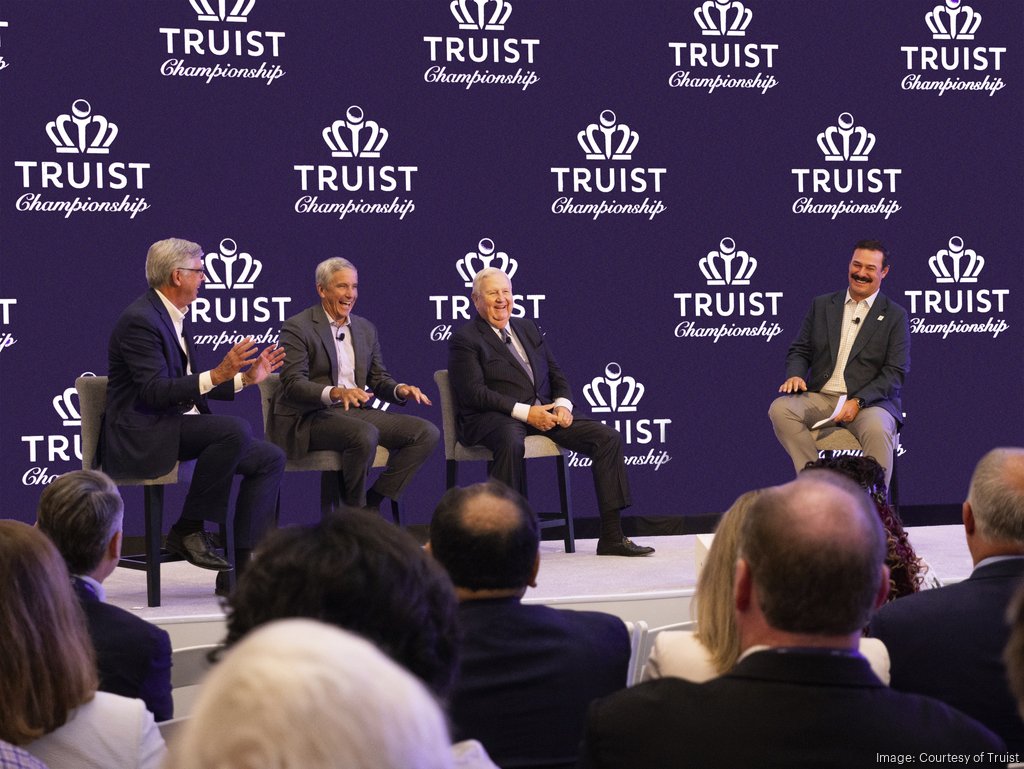
Behind the cheerful branding was a proposed standard for the partnership. Rogers wanted the surrounding community to judge whether it had made a difference. A tournament brings attention, visitors and business relationships. He connected the sponsorship to a longer relationship with the place hosting it.
“The report card will come from the community.”
Bill Rogers · Truist Championship announcement, 2024
It is a revealing choice of examiner. A community experiences a company through opportunities, services and decisions that reach beyond the event itself. The report card can arrive from several directions.
Leaving the chair, keeping the question
On September 1, 2026, Michael P. Lyons became Truist’s president and chief executive, and Rogers moved to executive chair. His retirement is planned for April 2027. The transition separates the next stage of the bank’s management from the long career of the person who helped assemble it.
There are several ways to count that career: years served, positions held, transactions completed. Rogers has supplied a more personal measure, asking whether the people within his responsibility are better off because he was there. By now, that question travels from the customer-service desk to the boardroom and out into the communities the bank serves. The corner has grown. The people in it still have calls to make.