The sales team brought a bracket to the drag strip. That detail is worth keeping. In May 2011, Robert Chambless took a group from Coca-Cola Consolidated to Roy Hill’s Drag Racing School at zMAX Dragway in Concord, North Carolina. There were ride-alongs in dragsters, races in Mustangs, and employees who had never seen a drag race before. Apparently, giving salespeople a new competition does not require much explanation.
“Our team had an absolute blast out here with Roy today,” Chambless said afterward. He described colleagues following the racing on a bracket they had made and brought along. The day offered a cheerful departure from a sales meeting. People accustomed to discussing performance had been given an unusually literal way to experience it.
Chambless was then a senior sales and marketing executive. He had already spent about a quarter of a century at the Charlotte-based bottler. His career would stretch through larger operational jobs and, in January 2026, into the role of executive vice president and senior advisor to the chairman and CEO. Retirement is planned for 2027. There is a long corporate chronology here, but the bracket supplies something the titles cannot: a glimpse of colleagues enjoying themselves.
A meeting with a louder soundtrack
The racing relationship began through an introduction. Gerry Beattie, a director in the bottler’s fleet operations, connected Hill with Chambless. In Hill’s recollection, Chambless was visiting Greensboro to tour stores before the annual Shriners’ Expo. They met for less than half an hour. Chambless later visited the racing shop, where the cars were on display and a Pro Mod was fired up for him.
Hill already had Coca-Cola logos on one of the school’s Mustangs. He had taken a chance on the association before a larger arrangement existed. The meeting helped turn that hopeful paintwork into a working relationship. By April 2011, a Coca-Cola Consolidated-backed Cobra Jet Mustang was set to appear at the NHRA 4-Wide Nationals, with corporate events and employee driving experiences part of the relationship.
For Hill, the appeal included reaching communities in the bottler’s territory. For the employees who later arrived at the school, the arrangement produced an afternoon rather more memorable than another presentation. The story has its pleasingly untidy sequence: an introduction from fleet operations, a store visit, some conspicuous logos, then an engine loud enough to make any further small talk optional.
The connection lasted beyond the debut. In September 2012, Hill announced a two-year extension of the Coca-Cola Consolidated partnership. He specifically credited Chambless for helping promote the bottler and the racing school. A brief encounter had acquired a schedule, a public presence, and another term. Sales relationships can begin in places where nobody has provided a conference table.
“Our team had an absolute blast out here with Roy today.”
Robert Chambless · May 2011
The geography of a career
Chambless first joined Coca-Cola Consolidated in 1986. By 1997, he was sales manager at the company’s Columbia, South Carolina, branch. From 2000 to 2003, he served as region sales manager for its Southern Division. The progression begins with a place, then widens to a region. Long before the advisory title, his responsibilities had a map.
In 2003, he became vice president of franchise sales. A senior vice president of sales role followed in June 2008. In August 2010, the brief expanded again to sales, field operations, and marketing. Those additions matter. A promise made to a customer has to survive the trip from a sales conversation to the place where a beverage is actually sold.
Read together, the jobs describe an expanding set of obligations around that trip. Selling, field execution, and marketing appear in the same title. A customer sees a familiar bottle or a fountain dispenser; the organization behind it has to coordinate people whose work happens in different places and at different times. Chambless’s advancement repeatedly brought more of that coordination within his remit.
There is something instructive about a career that can be followed through the same employer for forty years. Familiarity accumulates alongside responsibility. The Columbia branch and the Southern Division remain part of the story even after the titles become longer. An executive’s geographical education is easy to overlook when a biography compresses it into a few lines.
- 1986Joins the bottler
- 1997Columbia branch sales manager
- 2016Executive vice president
- 2026Senior advisor to the chairman & CEO
When the job grew upstream
On April 1, 2016, Chambless became executive vice president of franchise strategy and operations, overseeing the company’s sales, marketing, and distribution. He was promoted alongside James E. Harris and David M. Katz as the business adjusted its leadership structure during a period of growth. The appointment put the commercial and delivery sides of the operation together under his oversight.
A further change came in January 2018. His new title was executive vice president of franchise beverage operations. The remit retained sales, marketing, and distribution while adding product supply planning and manufacturing. The company had acquired distribution territory and manufacturing facilities, and its leadership responsibilities were being rearranged around that enlarged business.
The sequence offers a practical way to understand his work. Start at the customer end, where a sale is made. Follow the obligation backward through distribution, planning, and production. His 2018 assignment brought those functions into the same executive portfolio. The new wording on the business card represented a longer stretch of the journey a drink takes.
The scale of the setting helps explain the coordination involved. Coca-Cola Consolidated describes a business serving approximately 60 million consumers across 14 states and the District of Columbia, with nearly 300 brands and flavors. Its headquarters are in Charlotte, but the daily work extends across the Southeast, Midwest, and Mid-Atlantic. The reach is national; the encounters remain local.
A beverage partnership, 140 counters at a time
In October 2024, the company announced its beverage partnership with Skyline Chili across 140 locations. Chambless spoke for the franchise beverage operation. His comments paired Coca-Cola with Skyline’s familiar dishes and emphasized serving the restaurant’s customers as the local bottler. It was a customer relationship described in the vocabulary of a meal.
“Skyline Chili is beloved across the region,” he said. There is a useful specificity to that observation. A regional restaurant chain comes with its own habits and loyalties. A beverage agreement enters a place where customers already know what they order. The bottler has to become part of that routine.
The number 140 makes the announcement concrete. A partnership expressed once at the corporate level has to work repeatedly at individual restaurants. The work behind a familiar drink is seldom the most conspicuous thing at the counter. That relative invisibility is part of the assignment: the customer came for lunch, rather than an introduction to beverage distribution.
Skyline Chili locations in the beverage partnership announced in October 2024.
An email that became lunch
Another lunch provides a different view of Chambless. During her 2024 internship at Coca-Cola Consolidated, Ava Meiner was encouraged to meet people across the organization. She looked through organizational charts and emailed business leaders to request ten minutes. One of those messages led to lunch with Chambless.
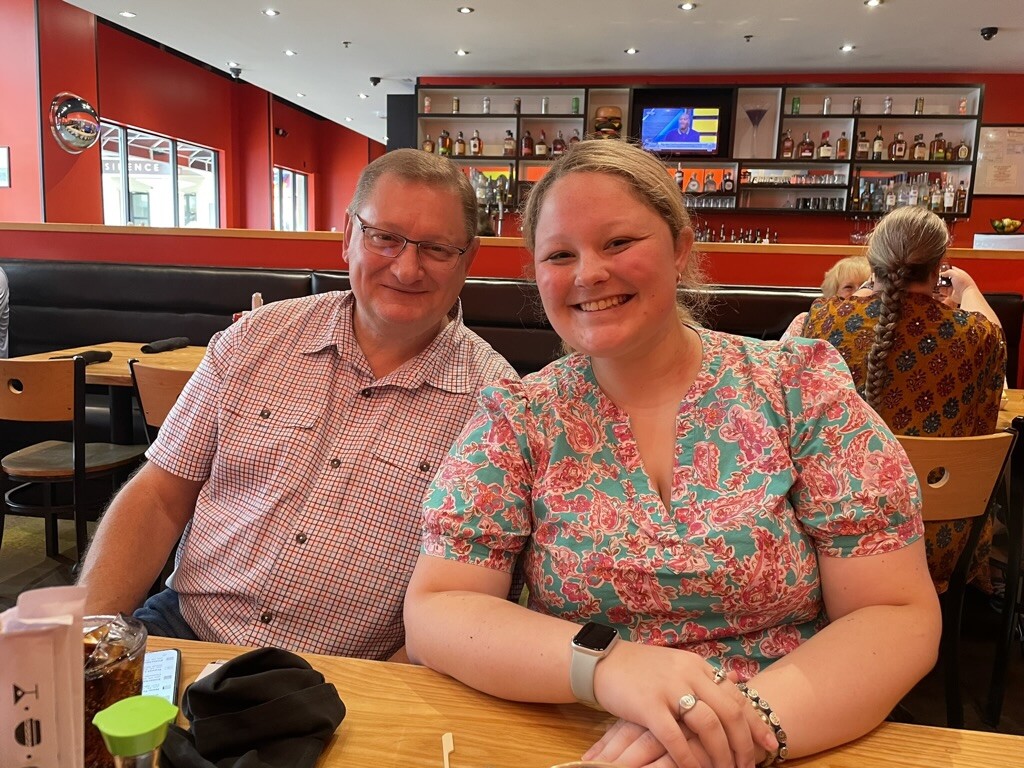
Meiner included the encounter in her account of what she learned during nine weeks with the company. The accompanying photograph shows the two seated together at a restaurant table. After decades of roles described in formal corporate language, here is an executive appearing in someone else’s account of finding her way around a workplace.
It is a small episode with a precise scale: one intern, one request, one meal. It cannot carry a sweeping verdict about a person’s character. It does show that, on this occasion, a junior colleague’s attempt to make contact reached a senior executive and became time spent together. An organizational chart had served as the beginning of a conversation.
Placed beside the racing outing, the lunch suggests a useful question about leadership: what kinds of occasions make it easier for people to connect? Sometimes the answer involves Mustangs. Sometimes a table is enough. Both episodes make room in a long operations career for the people who work inside the operation.
The work of handing it over
On August 28, 2025, Chambless notified the company of his intention to retire in 2027. His move to executive vice president and senior advisor to the chairman and CEO took effect on January 1, 2026. The assignment includes helping transition his responsibilities and advising chairman and chief executive J. Frank Harrison III.
That places him in a different relationship to the work he once oversaw. The next task involves passing responsibilities onward while remaining available for strategic advice. A transition period gives an organization time to ask questions of someone whose experience reaches back across several versions of its structure. The calendar is part of the arrangement.
His career now has a clear arc: entry in 1986, branch and regional sales management, broader commercial leadership, responsibility extending into supply and manufacturing, then an advisory role. The continuity gives the final stage its substance. There are years of decisions behind those job titles, and other people will carry the responsibilities forward.
The most appealing image from this long working life may still be that homemade racing bracket. It belongs to a day when a sales team left its usual setting and found another way to spend time together. Forty years at one company can be recorded as a succession of appointments. It can also be remembered through the afternoons and lunches that made the appointments a little less abstract.