Harry Sideris got into the electricity business through a newspaper classified ad. In 1996, the chemical engineer answered an opening at Carolina Power & Light, expecting a job spent untangling mechanical, chemical and process problems. Nearly thirty years later, he was running Duke Energy. The newspaper had delivered rather more than the job description suggested.
By the time he became chief executive on April 1, 2025, Sideris had held 20 jobs inside the company and its predecessors. That is an unusual kind of preparation: enough changes of responsibility to acquire several careers, without having to leave the business. His route to the top passed through generating plants, distribution systems, Florida politics and customer operations.
Today the scale has changed. Duke’s five-year capital plan stood at $103 billion in 2026. Sideris has to help turn that money into electricity infrastructure while persuading customers that the growing system will serve them fairly. A data center can explain its appetite in gigawatts. A household usually explains its concern by opening the bill.
A tailor’s questions
Sideris grew up in Asheville, North Carolina, the youngest of three children of Greek immigrants. His father, Gus, tailored clothes at Bell’s Traditionals in Biltmore Village, then continued working from the family basement. Among Harry’s childhood memories is sitting nearby while his father fitted Billy Graham for a suit. The workplace and the family home were hardly separate worlds.
Gus had come from a Greek village where he worked as a tailor and olive farmer. In a public tribute, his son described how he also bused tables at Charlotte’s Open Kitchen after his tailoring shift, saving to bring Harry’s mother and sisters to the United States. His education had stopped at eighth grade. His curiosity had carried on.
Once Harry worked at a power plant, his father wanted to know how everything operated. The questions kept coming. Sideris remembers that fascination alongside another lesson: philotimo, the Greek idea he connects with honor and responsibility to one’s family. His account gives integrity a practical setting: work another shift, keep asking questions, do what you have promised.
The son’s formal education took a different route. He earned a chemical engineering degree at North Carolina State University and an MBA at Campbell University, then completed the University of Chicago’s Advanced Management Program. He now lives in Charlotte with his wife, Catinna; they have two daughters. The family business became power, but the interest in how things work remained.
Learning the business sideways
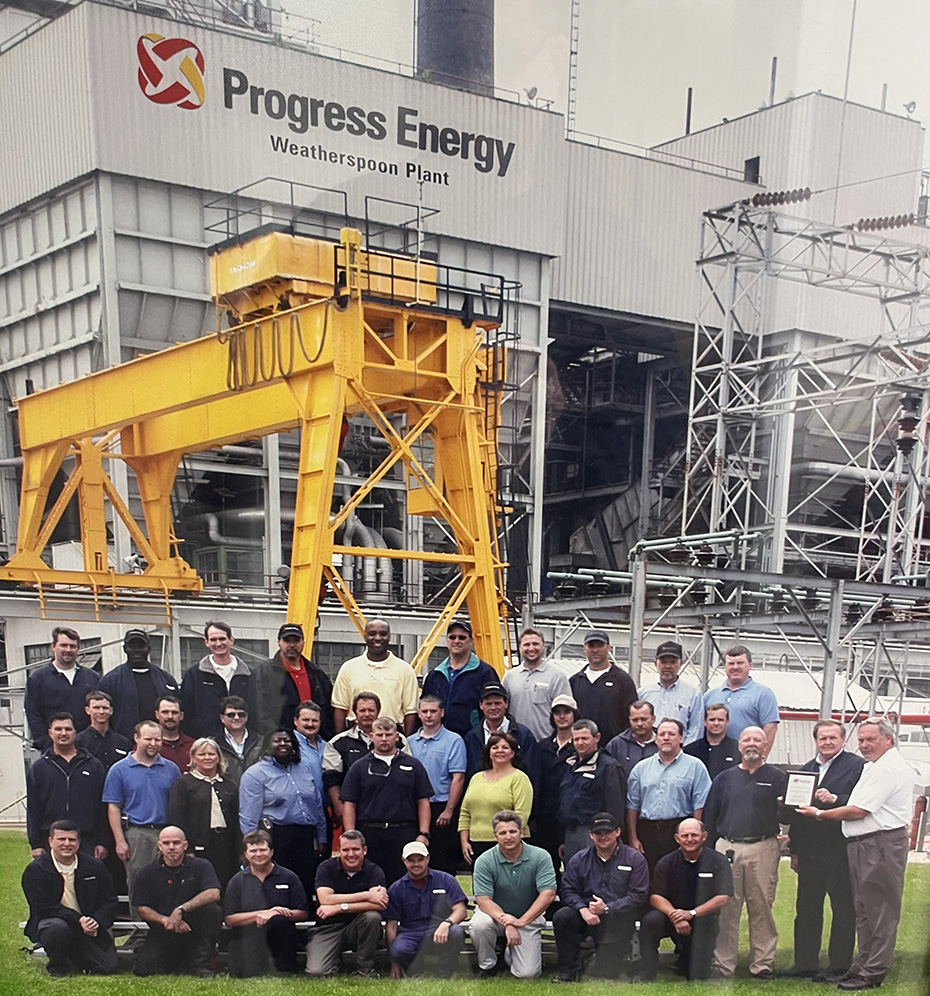
His early work ranged across operations, maintenance, technical engineering and leadership assignments in the Carolinas and Florida. In July 2012, Progress Energy merged with Duke Energy. Sideris became vice president responsible for power generation in western North Carolina and South Carolina, covering coal, hydroelectric and combustion turbine plants. The equipment differed; the obligation to make it work did not.
In January 2017, he became president of Duke Energy Florida. The job carried responsibility for financial performance, regulatory and government relations, and community affairs. For an engineer, that meant another set of systems to understand. A generating unit has operating limits. A state utility also has public hearings, local expectations and officials who want answers in ordinary language.
Florida’s electric business then served about 1.7 million customers. The appointment put Sideris in a role where technical decisions and public consequences met directly. Keeping the service dependable, getting investments approved and maintaining community relationships belonged to the same assignment. The organization chart might separate those subjects. The person responsible for the state could not afford to.
He later became chief distribution officer, overseeing electric distribution across six states. In October 2019, his responsibilities expanded into customer experience and services. That move put the receiving end of the system closer to the center of his working day: the customer who needs service, an explanation or a problem resolved. Experience accumulated across the business, rather than inside one specialty.
- 1996Carolina Power & Light
- 2012Carolinas generation
- 2017Florida president
- 2024Duke Energy president
- 2025President and CEO
By April 2024, he was president of Duke Energy, reporting to chair and CEO Lynn Good. His remit covered the electric and gas utilities, including operations and customer service. His preceding executive role had included transmission, distribution, customer operations and economic development. Becoming president assembled those experiences into a broader responsibility for how the utilities performed together.
A year later, he succeeded Good as CEO and joined the board. Ted Craver became independent chair. The distinction matters: Sideris took charge of management, while the board’s chairmanship moved to a separate leader. The succession placed an experienced insider in charge of executing the next stage of Duke’s strategy, with institutional knowledge acquired well below the executive floor.
The forecast keeps outrunning the printer
Sideris began his CEO tenure overseeing an $83 billion five-year capital plan. By February 2026, the plan had reached $103 billion. Duke reported that it had broken ground on five gigawatts of dispatchable generation during 2025. Those are projects under construction, rather than finished power supplies; the difference is important in a business where promises and completion dates can sit years apart.
The investment is spread across the physical system. In his 2025 annual-report letter, Sideris described nearly 60 percent of the five-year capital spending as adding generation, with nearly 40 percent devoted to expanding and modernizing the grid. Power plants need connections. Customers need both. An impressive generating station is of limited comfort if the electricity cannot reach the address on the account.
In June 2026, he described the difficulty of keeping up with demand: “It seems like every time we plan, we have to re-plan by the time it comes off the printer.” The observation has the ring of an engineer’s office joke, except that the revised document carries billions of dollars of consequences. Manufacturing growth, expanding communities and data centers all have to fit into the forecast.
The choices also extend beyond new construction. Duke’s strategy includes extending the lives of existing nuclear plants, adding natural gas generation, building renewables and storage, and improving the grid. Sideris serves on the boards of the Edison Electric Institute, the Institute of Nuclear Power Operations and the World Association of Nuclear Operators. His professional circle reflects the range of assets and obligations now on his desk.
Funding the work requires choices about the company itself. In March 2026, Duke completed the $2.48 billion sale of its Tennessee Piedmont Natural Gas business to Spire. It allocated about $800 million of proceeds to Piedmont debt and expected roughly $1.5 billion, net of tax, to support the capital plan. The buildout has a balance-sheet story as well as an engineering one.
The promise on the other side of the meter
In February 2026, Sideris appeared on Bloomberg Television to discuss new data-center power agreements involving Microsoft and Compass. The conversation joined two subjects that are often discussed separately: grid reliability and the terms under which large customers connect. For Sideris, winning the new business also means explaining why the existing customer should welcome it.
Duke made that argument explicit in July with its Customer Protection Plus framework. The company said long-term commitments, financial protections and planning would make data centers pay their share and produce savings for other customers. Sideris described billions of dollars in expected benefits. Those are forward-looking claims, dependent on the agreements and projects working as intended.
By August, Duke reported 7.8 gigawatts of signed data-center electric service agreements. Its plans included 15 gigawatts of new generation through 2031. It also faced criticism from advocates who questioned its demand projections and spending. Sideris was considering ways to show benefits from large-load contracts visibly on customer bills. That would give the argument a particularly direct place to be tested.
The test is straightforward to describe and difficult to pass. Build enough capacity for the customers who arrive. Avoid asking existing households to carry someone else’s costs. Keep the system dependable while construction proceeds. Sideris’s long apprenticeship supplies knowledge of the moving parts; the outcome will depend on forecasts, contracts, regulation and execution holding together.
“Calm is contagious.”
Harry Sideris’s leadership refrain
A bell, and the work after it
His preferred leadership phrase is “Calm is contagious,” which he credits to the Navy SEALs. He connects it to clear thinking under pressure and giving employees a voice in decisions. It is a sensible ambition for a utility leader: a room full of alarm can produce plenty of activity without improving the decision. Calm has to make room for useful information.
There has been room for delight, too. In February 2026, after ringing the New York Stock Exchange’s closing bell, Sideris described the occasion as a dream fulfilled. He had watched others do it on television and wanted a turn. Duke was celebrating a century of cash dividends on its common stock. For the former applicant reading the classifieds, it was quite a change of setting.
The bell offers a satisfying ending to a career story. His current assignment refuses that convenience. New customers need power; existing customers need a bill they can manage; investors expect returns on a very large construction program. Sideris has spent decades learning where those interests meet. Now the job is to make them meet in practice, month after month, at the meter.