Cowboy boots made for a pleasing piece of arithmetic. In 2011, Capitala took a minority equity position in Boot Barn at a cost of $4 a share. When the retailer went public in October 2014, the offering price was $16. A month later, Capitala was also celebrating the sale of its investment in Vita Nonwovens, a manufacturer in High Point, North Carolina. Two very different businesses had delivered good news within a day.
Joe Alala allowed himself a little dealmaker shorthand: “Nice to have a couple of four- to five-baggers happen within 24 hours.” The language was cheerful. The work behind it was less compact. Capitala had supplied Boot Barn with debt as well as minority equity while the retailer's annual earnings before interest, taxes, depreciation and amortization grew from below $10 million to $50 million.
Boots and nonwoven materials are an unlikely pairing for a founder's calling card. They make sense once you understand Alala's occupation. He looks for businesses that need money in a form their usual lender cannot readily supply. The product might be familiar. The financing problem can be surprisingly particular.
A business begins with an awkward gap
Alala founded CapitalSouth Partners in Charlotte in 1998. The firm later became Capitala. His explanation for starting it has remained plain: smaller companies had difficulty reaching the capital markets available to larger corporations. A viable business could have customers, earnings and an expansion plan, yet still struggle to assemble the financing.
“This gap is why I started Capitala in 1998.” That is a useful sentence to keep beside the grander vocabulary of private markets. It gives the enterprise a specific job. Somewhere between the owner who wants to grow and the bank that has limits on what it can finance, there is room for another participant.
The early business worked through the Small Business Investment Company program, or SBIC, with mezzanine lending and equity participation. Mezzanine finance sits below senior debt in the repayment order. It can help complete a financing package, but its position also brings different risks and a different price. Alala's firm subsequently added other fund structures and moved toward senior lending paired with equity.
A change of instrument need not mean a change of customer. The continuity in this career is the smaller established business. The firm has spent years altering the way it supplies money while keeping that borrower and owner in view. In a field fond of announcing the next great theme, this is a fairly durable assignment.
CapitalSouth Partners begins. The name becomes Capitala; the focus on financing smaller businesses continues.
The classroom is part of the circuit
Alala's own education crossed disciplines. He studied economics at Princeton, with a minor in politics, then completed a joint law and business education at Wake Forest in 1996. Economics concerns the allocation of resources. A law degree brings attention to rights and obligations. Business school adds the enterprise that must live with both.
Those subjects meet in a financing agreement. Who gets paid first? What does an owner retain? How much room does management have to act? A capital structure can look tidy on a presentation slide while leaving several people with very different expectations. The interesting work starts where those expectations meet.
At Wake Forest's Farrell Hall, Alala returned to discuss private credit and private equity with students alongside Capitala senior associate Ben Neugebauer, a 2020 finance graduate. Professor Ajay Patel hosted the session. Students from the Pre-Wall Street Career Track and a private equity class joined the discussion of recent deals and the market for smaller firms.
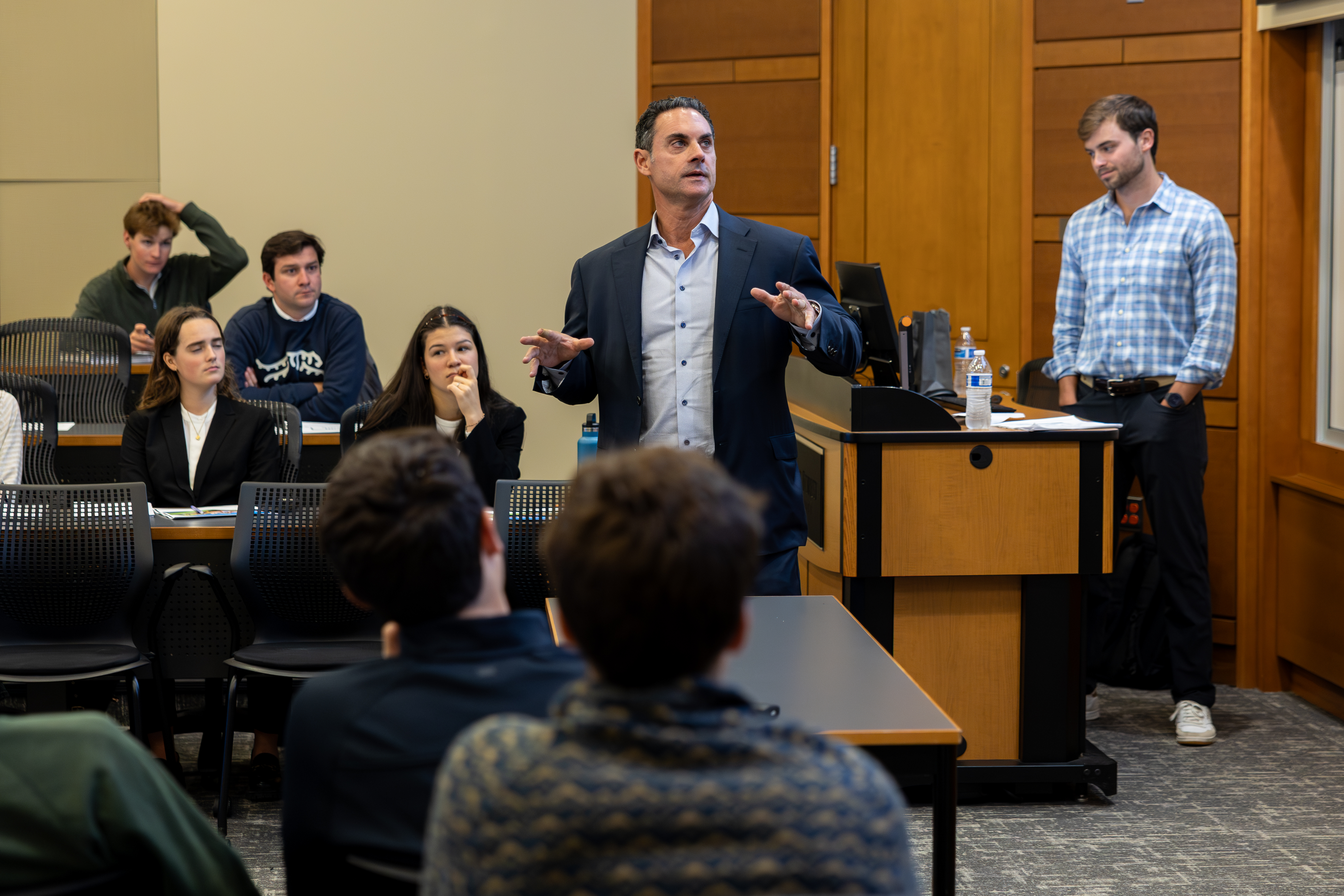
The visit puts two generations of the firm in one room, talking through actual transactions. Finance students spend plenty of time learning what a market ought to do. An investor can bring them the more awkward question of how a particular company gets a deal completed.
Two kinds of money, several kinds of ownership
Private credit and private equity are frequently filed together in conversation. Inside a business, they perform different jobs. Debt creates a repayment obligation. Equity creates an ownership interest. Combining them requires choices about cash flow, risk and the share of future value that changes hands.
Capitala's published general criteria describe established companies with $5 million to $20 million in EBITDA, margins above 10 percent and a history of positive cash flow. The emphasis is on businesses that already produce earnings. EBITDA is a measure of earnings before interest, taxes, depreciation and amortization; it is neither revenue nor cash in the bank.
The available structures include senior credit, unitranche facilities and equity. Unitranche combines lending into one facility, making the borrower's arrangement simpler even when participating lenders divide the economics and repayment priorities among themselves. Capitala can also supply minority equity or control equity. The ownership result depends on the transaction.
That range matters to Alala's story because it keeps a financing discussion from having only one answer. An owner seeking expansion money, a sponsor buying a company and a business refinancing debt may each need something different. The arithmetic has to suit the company that will make the payments.
Private credit
A loan with agreed repayment terms and lender protections.
Private equity
An ownership stake that participates in the business's value.
The bank stays in the picture
There is a tempting shortcut in describing private lending: imagine a bank leaving the room and a private fund taking its chair. Alala's model is more sociable. Capitala works with banks that know customers whose financing needs extend beyond what those institutions can provide themselves.
That arrangement gives each participant a reason to keep talking. The bank can retain its core customer relationship. The business can seek additional capital without abandoning a lender it already knows. Capitala receives introductions to opportunities that arrive with some history attached. A referral carries a different kind of information from a cold pitch.
In March 2025, Capitala announced an oversubscribed fundraise exceeding $1 billion in commitments. The total included leverage and separately managed accounts. Alala reported 42 new bank partners added during the raise, with 79 banking partners then on the platform. By the firm's September 2026 TRS announcement, its reported network had reached 98 banking relationships.
These are dated snapshots of the firm's network, rather than a measure of Alala's personal wealth. They show how much of the business depends on assembling relationships as well as assembling capital. The founder's work includes finding people who will bring the next financing problem to the table.
An owner need not arrive with a fund
Another part of Alala's working world is the independent sponsor: someone who identifies a transaction before having a committed pool of capital to pay for it. Finding a business and obtaining the money to buy it are separate achievements. The second can undo the first.
Capitala has worked with independent sponsors for more than 20 years. Its process moves from an initial conversation through a preliminary review, a term sheet, and diligence and funding. Each stage gives the prospective partners a chance to test whether the transaction, the timing and the financing can fit together.
On September 29, 2026, Alala joined Tom Kenary of Houlihan Lokey's Capital Solutions Group for an episode of Capitala Conversations, hosted by Sam Tidswell-Norrish. They discussed what happens after an independent sponsor signs a letter of intent: partner selection, debt and equity, seller rollover and when a capital adviser should enter the process.
A letter of intent is a promising beginning. The eventual financing still has to reconcile the buyer, the seller, the lenders and the investors. Giving that subject a public conversation is consistent with the classroom visit: the work becomes easier to understand when someone walks through the sequence.
The map still has blank spaces
Alala has also treated the ownership and location of businesses as reasons to look more widely. Capitala's 25th-anniversary account described approximately $1 billion invested in businesses meeting its social-impact criteria, including minority-, veteran- or woman-owned or controlled companies and businesses in low- to moderate-income areas.
By March 2025, the firm reported investments in 35 states. Alala had previously set a goal of reaching all 50. A national map makes a useful counterweight to finance's habit of clustering attention in a few cities. The remaining states are a concrete expression of his ambition: more places in which to find companies that fit.
There are other circles in his life. He belongs to the U.S. Supreme Court Bar, owns an interest in DK Wine Group and serves as social chair of the Et Amicorum Book Club. His Princeton connection continues through track and field trusteeship and the Larry Ellis Award for support of athletes and coaches. A book club's social chair is a pleasantly specific title on a finance biography. Even a calendar of capital commitments can leave room for company.
“We've been around for 25 years, but I see us not even being to our midway point.”
Joe Alala, on Capitala's 2023 anniversary
The recent portfolio offers a less picturesque companion to the cowboy boots: industrial gas turbines. Capitala supplied debt and equity for the acquisition of Houston-based TRS Services in February 2024. The company repairs and manufactures turbine components. A strategic buyer acquired it in August 2026.
The boots and the turbines belong to different markets and different moments. Each illustrates the practical territory Alala chose: companies with work to do, an ownership transaction to navigate and a financing package to complete. Twenty-eight years after starting in Charlotte, he is still occupied with the space between a business's plans and the money those plans require.