The bow ties were in order. The comedians were less obedient. At the Men of Menil dinner in 2016, 170 guests gathered for an evening that combined art, black tie and the useful business of laughing at oneself. George Kelly was one of four co-chairs. The event raised more than $332,000. For someone whose working life involved buying and building businesses, this was another way to assemble support around an institution.
Kelly belongs to two Houston worlds that regularly share a guest list: private equity and the arts. He co-founded the investment firm now known as Capstreet, whose origins date to 1990. He also serves on museum boards, including the Menil Foundation and the Chinati Foundation. His career invites an interesting question: what does a person help build after helping build a firm?
The answer takes in investment funds, industrial businesses, a sculpture outside a drawing institute and a museum party with circus performers. It is a wider itinerary than the phrase “private equity investor” usually promises. It also gives his story a particular geography. Houston is the base. Marfa and Philadelphia are part of the route.
The education before the acquisitions
Kelly studied economics at Union College and earned an MBA at Dartmouth’s Tuck School of Business. Before founding Capstreet, he was a senior vice president at Duncan Cook & Co., a Houston private equity firm, and at investment bank Rotan Mosle. Those positions placed him in both the financing and ownership sides of business.
There is a practical difference between arranging a transaction and living with its consequences. Once an investor becomes an owner, the presentation has to survive contact with payroll, customers and the next management meeting. Kelly’s subsequent career has unfolded in that second setting, where buying a business begins a period of responsibility rather than ending the assignment.
Capstreet’s lineage includes Summit Capital Inc., formed in 1990, and Summit Capital Group, LLC, founded in 1997. The latter took the CapStreet name in 2002. The sequence is a useful reminder that a firm’s familiar name can arrive well after its founding chapter. Kelly’s association with it stretches across those changes.
Today, his title is co-founder and senior advisor. That wording locates him differently from the managing-partner role he held in earlier announcements. He remains connected to the portfolio through a board seat at Allredi. The company distributes surface-preparation, abrasive and safety products to industrial contractors. Its business supplies a concrete counterweight to the abstract language of capital.
A fund closes. The work stays open.
On December 11, 2019, Capstreet announced the closing of its fifth fund with $500 million in commitments. The original target had been $400 million. Existing investors returned, and new investors joined them. Kelly, then a managing partner, spoke about that support and the continuation of the firm’s investment approach.
Capital commitments to the fund. Original target exceeded by 25%.
The difference between those two numbers is straightforward. The purpose of the money requires more explanation. The fund was intended to recapitalize entrepreneur- and family-owned businesses, supporting growth through operations, technology and acquisitions. These are companies that already have a working business to improve, rather than an idea waiting for its first customer.
Kelly’s remarks described growth through operational work, technology improvements and acquisitions. The nouns are familiar in finance. Their implications are more demanding. New capital has to become usable capacity inside a business. An acquisition has to fit. A technology investment has to earn its place in the daily work.
“accelerate growth through operating initiatives, technology enhancement and strategic M&A.”
George Kelly, on Capstreet Fund V, 2019
Fundraising measures willingness to entrust money to a team. Building companies tests what the team does with that trust. Kelly’s career sits across both activities. The fund closing was a milestone for Capstreet as a firm, achieved by a group of people and investors whose work cannot sensibly be compressed into one founder’s biography.
The less glamorous part of growth
Capstreet’s current investment criteria include businesses with $3 million to $15 million in EBITDA, primarily majority investments, and entrepreneurs who reinvest alongside the firm. EBITDA is an earnings measure before interest, taxes, depreciation and amortization. The criteria describe a particular stage of company life: substantial enough to have established operations, with room for further development.
The firm’s approach begins with researching markets and meeting entrepreneurs, then moves toward hiring, technology and a longer-term acquisition strategy. Capstreet calls its operating toolkit the Capvalue Framework. The name is tidy. The work underneath ranges from sales and product decisions to financial reporting and integration. A growing business eventually needs its internal arrangements to keep pace with its ambitions.
That can mean systems, clearer responsibilities or additional expertise. None is an obvious candidate for a celebratory photograph. Yet the operational side matters to the story of the firm Kelly helped establish. Expansion creates demands as well as opportunities. More customers, more locations and more employees bring more decisions that have to reach the right people in time.
In 2021, Kelly described the expansion of Capstreet’s operating executive team as part of its continuing evolution. In a 2023 promotion announcement, he emphasized developing and supporting internal talent. Those statements place people inside the growth argument. They also point toward continuity: a firm founded decades earlier has to keep creating room for colleagues to carry its work forward.
Four co-chairs, one useful evening
The 2016 Men of Menil dinner provides a more social view of institutional work. Kelly co-chaired it with Brad Bucher, Danny David and Bill Stewart. Comedians Matthew Broussard and Andrew Norelli supplied the entertainment; Pat Hazell, whose writing credits include Seinfeld, served as master of ceremonies. A fundraising dinner had found a sensible use for people who interrupt politely.
The event’s proceeds supported the Menil. Its combination of formal clothes and comedy makes a useful scene in Kelly’s story, without turning a guest’s attendance into a personality diagnosis. What matters is the role: he helped chair an occasion organized to bring people and money together for a museum.
That responsibility is distinct from writing a cheque. A co-chair appears alongside other organizers and the institution itself. The shared credit belongs in the picture. It is one reason Kelly’s arts involvement reads as a network of commitments rather than a single decorative line appended to a business biography.
The circus had a serious purpose
In December 2022, the Menil’s 35th-anniversary celebration used a Surrealist circus theme. Linda and George Kelly co-chaired it with Cindy and David Fitch. They were also major underwriters. The evening raised $2.54 million for the museum’s buildings, green spaces and programs, which are free and open to the public.
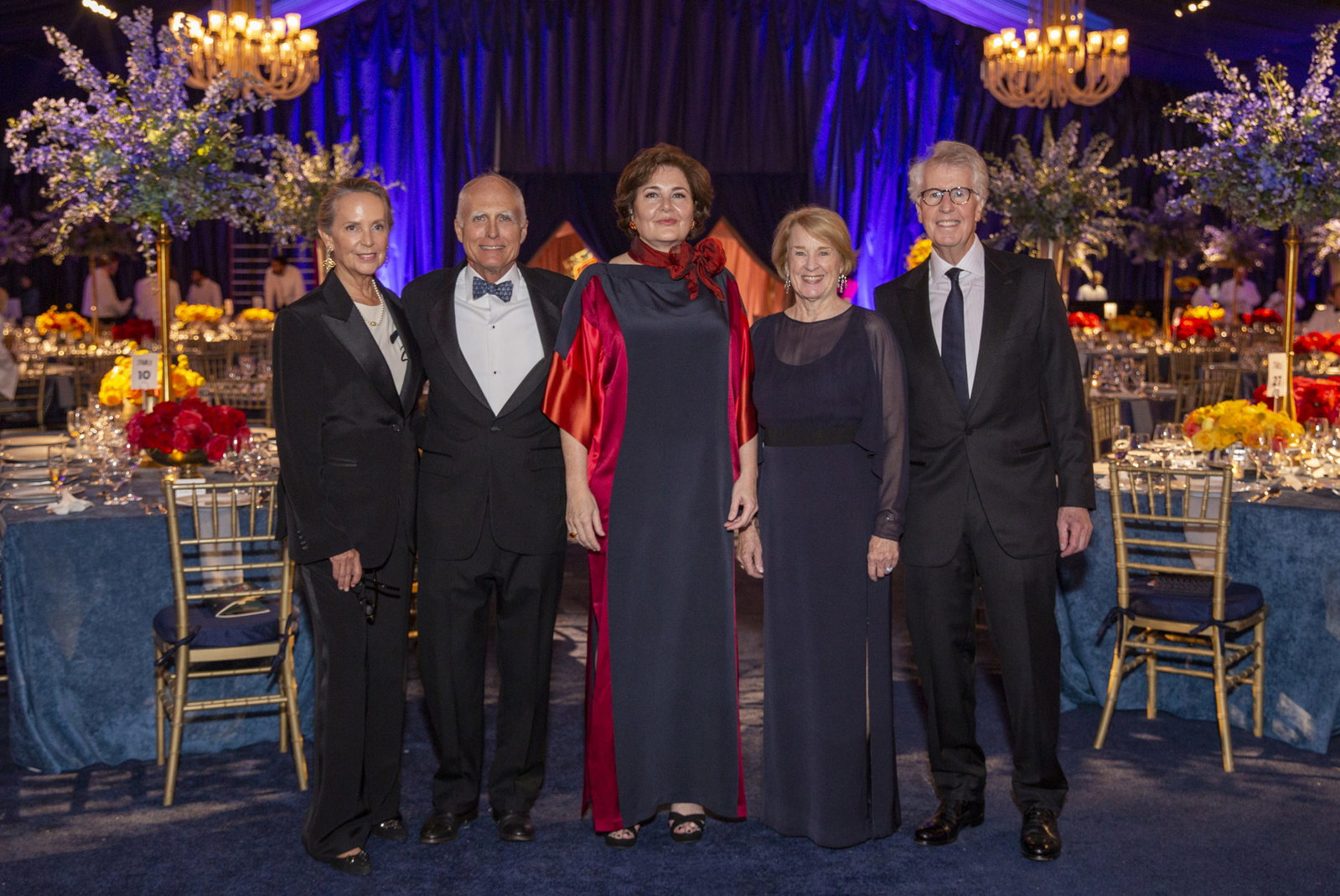
The result belongs to the evening’s collective effort. For Kelly, the personal detail is his participation alongside Linda and the other co-chairs. For the city, the consequence is what the proceeds supported. The party’s purpose extended beyond its guests to people who could enter the museum without buying a gala ticket.
A circus theme is entertaining enough on its own. Here it also made a financial point: one night of paid celebration helped sustain a place where admission is free. The arrangement connects a selective fundraising occasion to a public benefit. Art institutions need both the visitor who simply walks in and the supporters who make that welcome possible.
A curve with many names behind it
There is another trace of the Kellys’ support at the Menil Drawing Institute entrance. Ellsworth Kelly’s Menil Curve, dated 2015, is a painted stainless-steel sculpture whose white surface sits against a white courtyard wall. Linda and George Kelly are among the contributors credited with funding its purchase. Artist and patron share a surname; the roles are separate.
The sculpture rewards a different kind of attention from a fund announcement. Its effect comes partly from the relationship between object and setting. The purchase credit, meanwhile, shows a group of supporters helping a work become part of a museum. Each name occupies a small portion of a larger institutional record.
In 2024, the Kellys also supported Abstraction after Modernism: Recent Acquisitions. The exhibition included work by artists such as Sam Gilliam, Agnes Denes and Richard Serra. Their involvement appears again among several supporters, reinforcing the recurring nature of the commitment. The activity reaches beyond a gala into acquisitions and exhibitions visitors can encounter for themselves.
Keeping an institution in view
At Chinati in Marfa, Kelly serves as treasurer. Founded by Donald Judd in 1986, the foundation brings large-scale art, buildings and land into a deliberately connected setting. Its responsibilities include caring for the collection and supporting exhibitions, education and artists. Treasurer is a short title for a role situated inside an institution built to think over a long span.
Philadelphia adds another dimension. Kelly appears on the Philadelphia Museum of Art’s fiscal 2019 audit committee list, and Linda and George are named among supporters responding to its Williams Challenge in 2021. These commitments extend his museum involvement beyond Texas. They also make the administrative side visible: supporting art includes attending to the organizations that preserve and present it.
The story continues in Houston. Linda and George Kelly are listed among supporters of Terry Winters: Vitalized Geometry, which opened at the Menil in September 2026. It presents 44 prints and works on paper. The continuing support is a modest but specific present-tense detail in a career that began long before this exhibition.
Kelly’s public life is best understood through these associations: a firm he helped found, colleagues developing its work, companies with boards, museums with obligations and exhibitions with audiences. The numbers mark occasions. The institutions connect them. After the fund closes and the dinner guests leave, there is still a business to run, a collection to care for and a door to open.