A credit card is a curious thing for Michael Rhodes to give up. He spent years running a North American cards business, then became chief executive of Discover. Yet, less than a year after arriving at Ally Financial, he agreed to sell its credit card operation. The portfolio contained $2.3 billion in receivables and 1.3 million active cardholders. This was a considerable item to cross off the company’s to-do list.
The decision provides a useful introduction to Rhodes. His experience could have supplied an argument for keeping the business. Instead, he made an argument about where Ally should spend its attention. In January 2025, the company announced a sale to CardWorks and its Merrick Bank subsidiary. The transaction closed that April. A banker with a long résumé in cards had decided that cards did not belong in this particular bank’s future.
“Strategy is about choices,” he said in October 2026. Most executives can agree with that sentence while leaving every existing project comfortably in place. Rhodes has attached transactions to it. His tenure at Ally is becoming a story about subtraction, and about how much ambition can survive the removal of a few ambitions.
The engineer before the banker
Rhodes graduated from Duke’s engineering school in 1987 and began his career at Failure Analysis Associates. The company name is almost too convenient for a future banker’s biography. Engineering asks how a system behaves under pressure; banking eventually asks much the same question, although its experiments tend to attract more anxious shareholders.
He went on to earn an MBA at Wharton. His subsequent career took him through MBNA and Bank of America, with management responsibilities across the United States, Canada, the United Kingdom, Spain and Ireland. The geographical range matters. By the time he arrived at Ally, his experience included different markets, payment businesses and ways of reaching customers. He had worked well beyond the confines of a single product.
In 2011, he joined TD to lead North American Credit Card and Merchant Services. He later led its consumer bank and wealth management business, then held responsibility for innovation, technology and shared services from 2017 through 2021. In 2022, he became group head of Canadian personal banking. The sequence moved between the business a customer sees and the machinery that makes it work.
At TD, that machinery supported a branch network numbering more than a thousand locations, alongside mobile, online and telephone banking. His technology responsibilities included strengthening operations and preparing for developments in artificial intelligence and cloud computing. The eventual move to a bank without branches therefore came after years spent with a rather substantial collection of them.
Two chief executive jobs, one short spring
Discover appointed Rhodes as its next chief executive in December 2023. He began the job on February 1, 2024. Later that month, Capital One announced its proposed acquisition of Discover. Within weeks, another company was announcing that Rhodes would become its chief executive. A conventional career timeline needs unusually small print to accommodate that spring.
He ceased serving as Discover’s CEO on April 1 and stayed briefly as an adviser. On April 29, he started at Ally and joined its board. He followed Jeffrey Brown, who had left in January after nearly nine years leading the company, and Doug Timmerman, who had served as interim chief executive. Rhodes was taking over an institution with an established identity, rather than arriving at a blank sheet of paper.
Ally’s chairman, Franklin Hobbs, emphasized Rhodes’s consumer banking experience, use of data and attention to employees when announcing the appointment. Those were practical qualifications for a business linking a digital bank to an auto lender. Rhodes’s welcome message, meanwhile, was about joining more than 11,000 colleagues and getting to work. The scale of the assignment was already waiting for him.
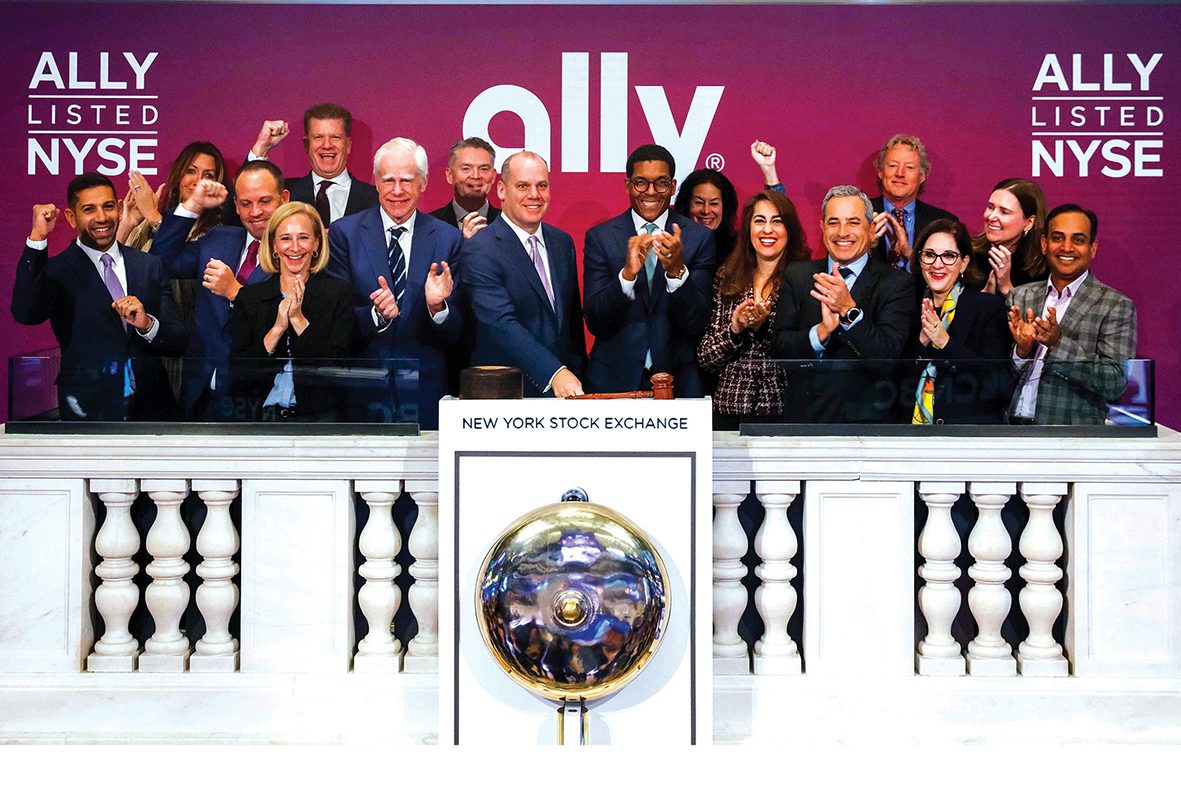
What belongs on the list
The credit card sale made the new direction tangible. Ally had acquired the business through its 2021 purchase of Fair Square Financial. Now it was sending the portfolio and platform to a company already familiar with the operation: CardWorks had been its servicing partner. For Rhodes, selling was a way to simplify the organization and put resources behind its core businesses.
Mortgages received a similar examination. Ally stopped accepting new mortgage applications after January 31, 2025, and ceased consumer mortgage originations during the second quarter. Existing loans would run off over time. Closing an application window is less theatrical than opening a new division, but customers, employees and capital all feel the consequences.
The resulting priorities were dealer financial services, consumer banking and corporate finance. These are broad businesses in their own right. Focus here means choosing the fields in which Ally intends to compete, then accepting the work that each choice entails. It also makes the chief executive’s performance easier to question: fewer priorities leave fewer places to hide an unfinished job.
At Fintech Meetup in March 2025, Rhodes framed the narrower organization as a basis for growth. “Don’t mistake focus for lack of ambition,” he said. The distinction explains the card sale particularly well. Experience in a business does not oblige a chief executive to keep owning it. Knowing a category can also help him decide how much money and management time it would require.
The customers on the other side of the screen
There is a human complication in the phrase “digital bank.” The customer still expects someone to help when something goes wrong. In November 2024, Ally’s Banksgiving program used customer care calls to ask people about financial challenges, then offer assistance. Requests included rent, swimming lessons and a family vacation. Rhodes singled out the customer care specialists as central to the bank’s customer focus.
His public writing suggests that this question predates his Ally appointment. In 2016, he published an article about customer support in the digital age. In 2017, he wrote about designing for humans. These interests sit naturally beside his technology jobs: a faster process only becomes useful when someone can actually use it. An elegant system can still produce an exasperating afternoon.
He has also appeared in settings where the audience is building a career rather than evaluating a bank. At Ally’s 2024 Moguls in the Making competition, he spoke with students about economic mobility. The entrepreneurial pitch program brought together students from historically Black colleges and universities. It offered a different occasion for a chief executive to listen, with ideas coming from people who had not yet accumulated his decades of banking experience.
His Duke connection has continued well beyond graduation. Elected a trustee in 2019, he chairs the university’s Graduate and Professional Education and Research Committee in its July 2026 biography. His community board history also includes the Boys & Girls Clubs of Delaware, United Way of Delaware, the Delaware Symphony Orchestra and Winterthur. The engineer’s extracurricular interests have room for both instruments and gardens.
Before the clever answer, arrange the data
When Rhodes discusses artificial intelligence, he spends time on the preparation. In a 2025 interview, he described Nucleus, Ally’s effort to bring customer interactions, transactions and accounts into a common data system. A bank contains plenty of information. Making that information coherent is a separate job, and a less photogenic one than demonstrating a new chatbot.
He has stressed that the quality of the data limits what AI can accomplish. His examples of AI’s uses have included telephone customer service, marketing, user experiences and administrative work. At Fintech Meetup, he described helping colleagues become more efficient and effective. The engineering connection is visible in what he chooses to explain: organize the inputs, understand the process, then ask the technology to improve it.
“Your AI solutions are only as good as your data.”
Michael Rhodes
That emphasis also brings his career’s two halves together. He has managed technology functions and consumer businesses. A new tool must pass through both worlds before it becomes a useful banking service. The attraction of AI is easy to announce. The patient work of arranging records and revising processes gives an announcement somewhere to go.
The arithmetic gets a vote
By October 20, 2026, Ally’s third-quarter results gave Rhodes another set of numbers against which to discuss the strategy. The company reported GAAP earnings of $1.30 per share and adjusted earnings of $1.34. Return on common equity was 12.1%; core return on tangible common equity, a non-GAAP measure, was 13.1%. Those measures describe different things and deserve their separate labels.
Ally Financial · Third quarter 2026 · Reported October 20
The report also recorded $178 million in share repurchases during the quarter. These are company results, achieved by an organization, rather than personal trophies for its chief executive. They nevertheless put a concrete test beside his decisions. Selling a business is an action. Improving what remains is the longer assignment.
Rhodes repeatedly gives his colleagues a share of the authorship. In public remarks about legacy, he has redirected attention toward the team and its collective work. His ambitions for Ally are attached to a bank that existed before he joined it, customers who already relied on it and employees who will have to carry the strategy into everyday decisions.
That makes the credit card sale an apt place to return. A career can teach someone how to run more things. It can also teach him to ask which things belong together. Rhodes arrived with engineering, cards, technology and consumer banking on his résumé. At Ally, he has been deciding what deserves a place on the next page.