Before Tim Spence had a bank to run, he had a list of companies and a proposition. As a student at Colgate, he asked his father to send him an Oregon business journal. Then he wrote to businesses on its list of the state’s 50 fastest-growing technology companies. He would work for free, he offered, if there was a possibility of a longer-term job. It was an unusually direct way to answer the undergraduate question of what, exactly, happens next.
A finance internship led into technology-company work. Consulting followed. Eventually, one of the banks he advised hired him. Today, Spence is chairman, chief executive officer and president of Fifth Third Bancorp. His career has taken him from trying to get inside an organization to deciding how a much larger one should work.
The continuity is easier to see than the job titles suggest. He keeps returning to the relationship between an idea and its practical consequences. A strategy can sound persuasive in a meeting. Someone still has to build it, sell it, manage its risks and live with the result.
An offer in the mail
Spence grew up in Portland, Oregon, and graduated from Colgate in 2001. His studies combined English literature and economics. That pairing offers an appealing detail for anyone who has ever had to explain a humanities education at a family dinner. The eventual bank chairmanship probably makes those conversations easier.
His early technology roles included sales and marketing, corporate development and finance. In 2006, he joined Oliver Wyman, where he became a senior partner advising financial institutions on strategy, innovation and performance. He also served as the firm’s Midwest market leader. Banking became something he could examine across organizations, rather than through a single employer’s habits.
Consulting gave him access to questions larger than the individual products he had worked on. It also made Fifth Third a familiar institution before it became his workplace. There is a particular education in helping other people make choices. Taking responsibility for those choices adds another kind.
A consultant becomes accountable
Fifth Third hired Spence as chief strategy officer in September 2015. Greg Carmichael, who became CEO that year, would eventually choose him as his successor. The progression included responsibility for consumer banking, payments and strategy before his appointment as president in October 2020.
Those roles brought the bank’s customers into closer view. Retail banking, mortgage lending, auto lending and payments had different working rhythms. Digital services and fintech partnerships cut across them. His remit put him near both the businesses earning revenue and the capabilities intended to change how they operated.
In 2018, American Banker named him Digital Banker of the Year. The award came four years before the CEO appointment. It marked a period when his responsibility was to help an established institution adapt to the ways customers increasingly expected to handle money.
He succeeded Carmichael on July 5, 2022. The board added the chairmanship effective January 2, 2024. Each promotion broadened the consequences of his decisions. A chief strategist can concentrate on the direction of travel; a chief executive inherits the people, routines and competing demands that determine whether anybody gets there.
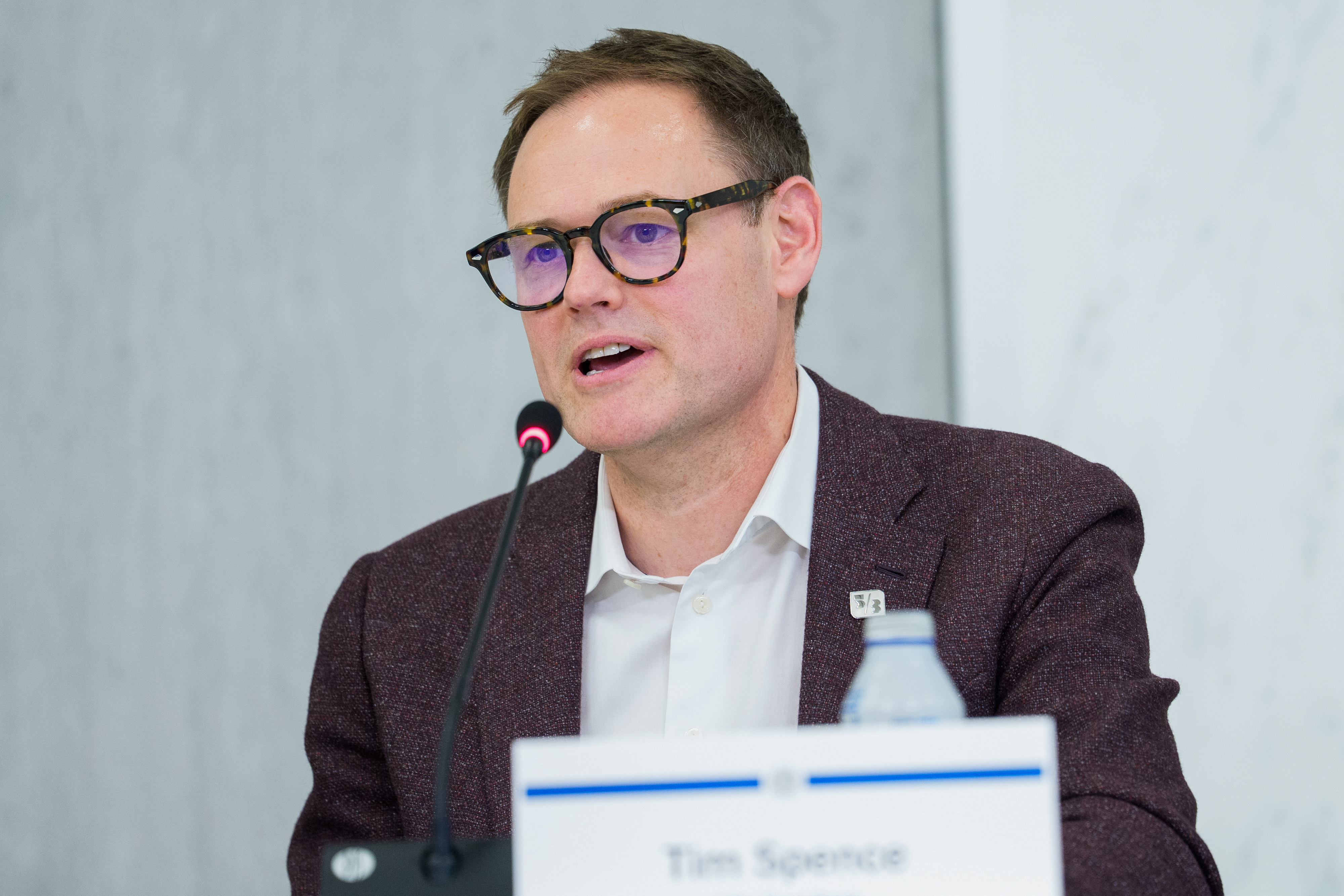
The bank on the other side of the table
Spence’s technology background became useful in conversations with people whose companies Fifth Third might buy. Eric White, founder of Dividend Finance, remembered hearing him describe his earlier startup and consulting work during an initial meeting. It helped White recognize a prospective buyer with experience outside conventional banking.
Dividend financed solar and other home-improvement projects. Fifth Third completed its acquisition in May 2022. White continued running the business with a degree of autonomy. The arrangement made the people question inseparable from the technology question: what should a bank preserve when it brings another company inside?
For a founder, an acquisition changes the environment around years of work. The buyer gains a product and the team’s accumulated judgment. A useful partnership has to give that judgment somewhere to operate. Spence’s own time in technology businesses gave the conversation a shared starting point.
This helps explain why his career matters beyond its sequence of promotions. He has worked in organizations selling something to customers and in a firm advising the people running those organizations. At Fifth Third, those perspectives meet across the table. The ability to recognize another team’s working assumptions can be as practical as understanding its software.
Three priorities, in a particular order
Spence describes Fifth Third’s priorities in a deliberate sequence: stability, profitability and growth. Put the words on separate lines and the first one does much of the work. Depositors need access to their money. Employees need a functioning institution. A bank’s appetite for expansion has to coexist with those obligations.
His 2025 shareholder letter links success to long-term shareholder returns and the trust earned with customers and regulators. It also emphasizes the daily effort to improve by one percent. The ambition is expressed through repeated, measurable work. It leaves plenty of room for difficult questions about which details deserve attention.
“We do not believe in averages; they mask details that matter.”
Tim Spence, 2025 shareholder letter
That sentence gives the fine print a starring role. An average can make several different experiences look reassuringly similar. A customer encountering a problem has little reason to care that somebody else had an excellent day. Spence’s formulation asks managers to look beneath the aggregate and examine the actual variation.
It is also a useful way to read his expansion plans. More assets and more locations create visible scale. Their value depends on many smaller decisions: who serves a client, what a system permits, how a product is explained and whether a promise survives its encounter with daily use.
The weekend after the paperwork
On October 6, 2025, Fifth Third announced an all-stock deal to acquire Comerica, valued at about $10.9 billion at announcement. Spence went on television to explain it. On CNBC, after being addressed as Timothy, he joked that the presenter and his mother were the people who used that name. Even a large bank transaction can spare a moment for family nomenclature.
In a separate Bloomberg interview that day, he described acquisitions as disruptive and carrying additional execution risk. His case for the transaction rested on strategic fit, sufficient returns and an institution that would operate better after integration. He pointed to Fifth Third’s retail capabilities and Comerica’s middle-market commercial franchise.
He also described preparation that predated the announcement. Fifth Third had considered crossing into a larger regulatory category when bidding on First Republic in 2023. Afterward, it continued building the capabilities required for a larger bank. That earlier work formed part of his explanation for being ready to take on Comerica.
The merger closed on February 1, 2026. Fifth Third announced the completion the following day, describing a combined institution with approximately $294 billion in assets. Plans included expanding the branch network in Texas and bringing the two banks’ commercial, payments and wealth capabilities to more clients. Those plans would require years of work after closing.
The technology and brand conversion arrived over Labor Day weekend. On September 8, the bank announced that approximately 600,000 customers’ accounts and 293 banking centers had moved from the Comerica franchise onto Fifth Third’s platforms. A legal combination had become a shared operating system.
customers’ accounts, approximately
across 293 former Comerica banking centers
Spence thanked teams for planning, training and testing, and said the bank was continuing to monitor the customer experience. That last obligation keeps going after the announcement. For the person opening an app or visiting a branch, the transaction is judged through whatever happens next.
A city to come home to
Alongside that expanding footprint sits a more personal attachment to place. Spence has described wanting somewhere his family could put down roots and contribute, rather than living and working in different places. Cincinnati became that home. A bank headquartered on Fountain Square gave him a business role with a local address and a civic dimension.
His responsibilities now include chairing the Cincinnati Business Committee, serving as vice chair of the Ohio Business Roundtable and sitting on Xavier University’s board of trustees. Nationally, he serves on the supervisory boards of The Clearing House and the Bank Policy Institute, where his work includes technology policy through BITS.
These commitments stretch the job beyond financial reporting. A city supplies colleagues, customers, institutions and relationships that persist through changes in title. Putting down roots means becoming available to some of those obligations. It gives a bank executive another way to understand the place where decisions eventually land.
On October 1, 2026, Fifth Third launched Innovation Banking, combining Comerica’s experience serving growth companies with Fifth Third’s Newline payments platform. The offering aims to stay with companies as their needs develop, from operating accounts into financing and other services. It brings Spence’s early technology world back into the picture.
The student who wrote those letters was asking a company to make room for him. His work now includes deciding how a bank can make room for companies at different stages of their lives. There are more accounts, more employees and considerably more paperwork involved. The question of what can happen after someone gets through the door still has his attention.