A car stereo is a splendid thing until somebody hands you a drill. Bill Crutchfield understood the equipment. His prospective customers were less certain about making holes in their cars. In 1974, that difference in confidence nearly finished his new mail-order business before it had properly begun. The people requesting his catalog were interested enough to write for it. Then, confronted with the practicalities of installation, many stopped short of sending money.
It is an appealing predicament for an electronics enthusiast: knowing so much that the hard part has become invisible. A receiver, a pair of speakers, some wiring. To the person selling them, a pleasant afternoon. To the person buying them, the possibility of explaining to a spouse why the family car now had an extra opening. Crutchfield had identified a market. He still had to discover what would let people enter it.
He asked them. The answers changed the catalog, then the company, then the work he would spend the next half century doing. His business would explain how things worked, how they fitted together, and how an ordinary person might make them work at home. The lesson had a pleasingly awkward source: customers had to teach the expert what needed explaining.
Before the catalog, a bedroom full of sound
Crutchfield was born in Charlottesville, Virginia, in 1942. Electronics arrived in his childhood as something to investigate and assemble. At 13, he put together a stereo system using separate amplifiers, speakers, and a reel-to-reel recorder. A demonstration tape sent the sounds of trains and airplanes from one side of his bedroom to the other. For visitors, this was a small domestic spectacle. For the boy arranging the equipment, it was an invitation to keep going.
By 15, he was installing stereo equipment in Charlottesville homes. The hobby had acquired customers. He kept the little business going through school and the University of Virginia, graduating in 1965. There was already a recognizable pattern: new equipment appeared, people wanted its benefits, and somebody had to bridge the distance between buying it and enjoying it.
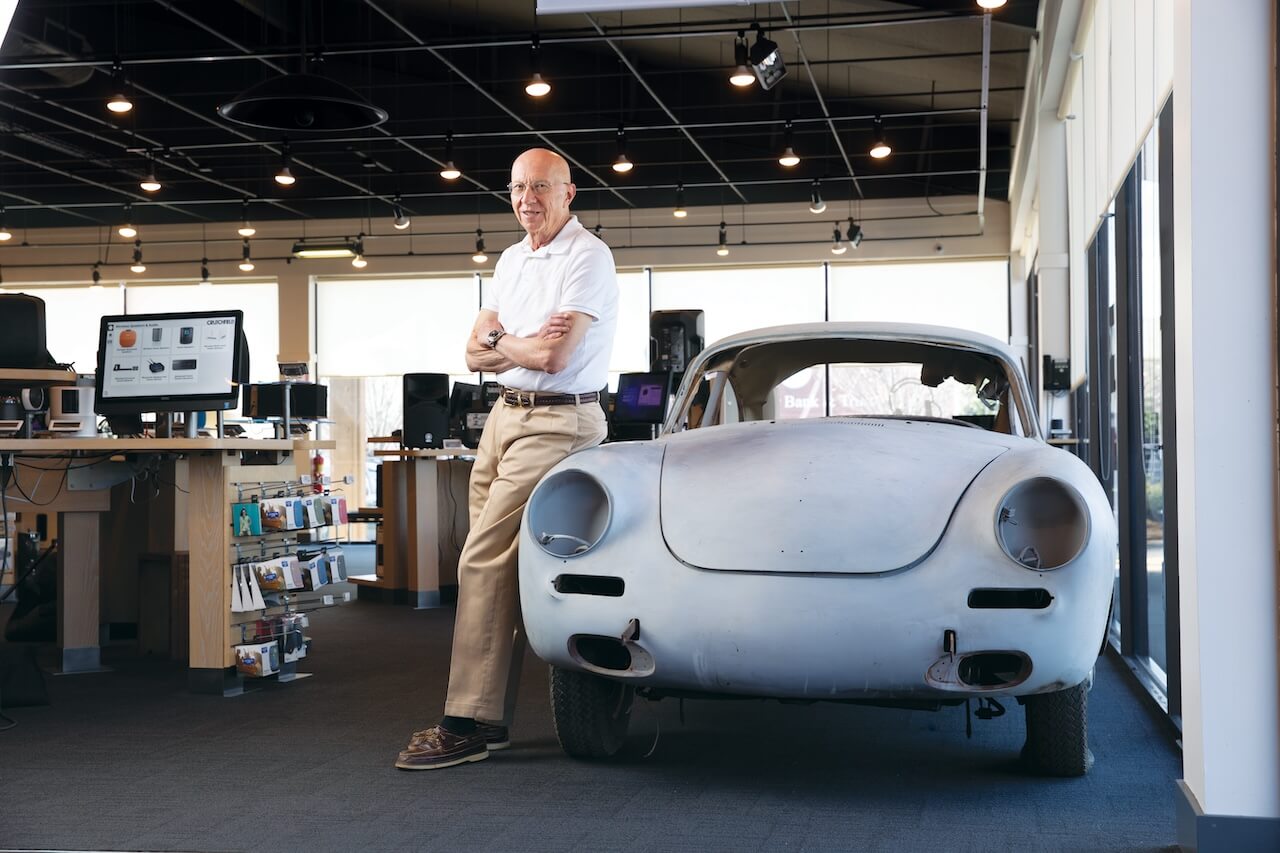
His next job carried rather different responsibilities. In the Air Force, he commanded a Titan II intercontinental ballistic missile crew and became a captain. He left the service in 1970. Back in Charlottesville, management jobs followed, including running a materials-handling business that sold and serviced forklifts. Car restoration provided another outlet for the entrepreneurial itch. He worked on old Porsche 356s and wanted modern stereos to make them more attractive to buyers.
The cars were hardly the precious objects their prices might suggest today. In his 2024 MotorWeek interview, he recalled buying barely drivable examples for $500. Restoring them was a labor of love with disappointing economics. Looking for car-audio equipment opened a more promising line of inquiry. The Porsche became a business lead with wheels.
The customer who supplied the missing instruction
Crutchfield started the company in March 1974 with $1,000 and a $25,000 bank credit line. His mother’s basement supplied the stockroom. A catalog could carry the selection beyond Charlottesville without requiring a chain of shops. On paper, mail order offered a sensible answer to the problem he had encountered while restoring cars.
The first year’s sales came to only $2,324. Printing and mailing thousands of catalogs had consumed money considerably faster than orders replaced it. By then, he had used $20,000 of the credit line. A business can look particularly theoretical when the bank has begun taking a practical interest.
His questionnaires went to buyers and to people who had requested catalogs without purchasing. Their replies exposed the obstruction: choosing the right equipment and installing it felt intimidating. A conventional product listing assumed too much. The revised publication mixed shopping advice and installation explanations with merchandise, a hybrid of magazine and catalog that became known as a magalog.
The change worked. It also gave Crutchfield a job more specific than selling stereos. He could make an unfamiliar task manageable. Explaining an installation had commercial value because the explanation allowed the purchase to happen. The technical knowledge was already there; the breakthrough was making room for the beginner.
Capital, credit and sales measure different things. Together, they show how little room the startup had to stumble.
Respect, with operating instructions
Success introduced a second problem. A growing company could no longer carry the founder’s intentions from person to person as casually as a small workshop. In 1983, sales fell 10 percent and the business lost money. Crutchfield’s account of that period is strikingly personal. He describes employees becoming less cooperative, customers receiving less care, and procedures getting in the way of useful work.
One proposed remedy was to compete harder on price by reducing service. He chose to spell out the standards he thought had gone missing. The initial Basic Beliefs centered on satisfying customers, respecting coworkers, and taking care over the work. He put adherence to those beliefs into employee reviews and established training through Crutchfield University. Respect acquired consequences in the running of the business.
A belief printed on a wall is inexpensive. An employee given time to learn a product is a budget decision. A customer’s question answered after the sale consumes someone’s working day. These are the places where a proprietor’s language becomes a customer’s experience. Crutchfield’s philosophy asks the company to keep paying for the behavior it praises.
In 2000, it introduced technical support for the lifetime of products customers bought. The promise extends the relationship beyond the pleasant instant when money changes hands. Equipment grows older. Another component joins the system. An owner forgets a setting. Somebody at the retailer is still expected to help. For a business built around explaining, the sale leaves plenty of work unfinished.
Respect acquired consequences in the running of the business.An operating philosophy, made practical
A pilot’s idea of keeping things close
Crutchfield’s interests have never fitted neatly inside a warehouse. He is also a pilot. In 2012, when the National Business Aviation Association invited him to speak at its annual convention, it described a flying career already more than 50 years long. The subject of his appearance was practical: how business aviation had helped his company.
The connection becomes clearer in Southwest Virginia, where the company opened a contact center in 1998. A business selling at a distance still needs ways for its own people to stay connected. The telephone compresses the distance to customers; an airplane can compress the distance between workplaces. For Crutchfield, flying belongs in the story of operating a company as well as in the story of enjoying machines.
His public roles have kept him connected to Virginia, too. He has served on the University of Virginia’s Board of Visitors, lectured at its business school, and worked on state commissions and councils under governors from both parties. By 2025, his responsibilities included the Governor’s Advisory Council on Revenue Estimates. A founder who began by making technical choices intelligible had also spent years participating in institutions where people argue over complicated decisions.
A very reasonable question about the internet
When his IT director proposed a website in 1995, Crutchfield’s response was a question: “What’s a website?” He authorized the experiment after hearing the explanation. It is a useful moment in a career sometimes described through foresight. At a consequential turn, he was willing to be the beginner in the room.
The site launched that September. The company already had experience helping customers make decisions without touching merchandise first. Moving information onto a screen gave that habit another place to operate. The medium changed the speed and scope of the conversation; the customer still needed to know whether a purchase would work.
Crutchfield describes an open-door office and a practice of walking through the buildings to talk with employees at different levels. That approach gives ideas a route upward. The website proposal came from a senior colleague, but its reception illustrates the larger point. Curiosity requires room for somebody else to know something first.
He has also been candid about experiments that failed commercially. Selling personal computers proved difficult to reconcile with the level of support he wanted to offer. A technically interesting category could still be a poor fit for the business. Enthusiasm for machinery did not relieve him of the obligation to make its economics work.
- 1975Explain it in printThe magazine meets the catalog.
- 1995Put it on the webThe first website launches.
- 2000Keep answeringProduct-lifetime support begins.
- 2019Let people listenSpeakerCompare reaches the website.
Can you hear the explanation?
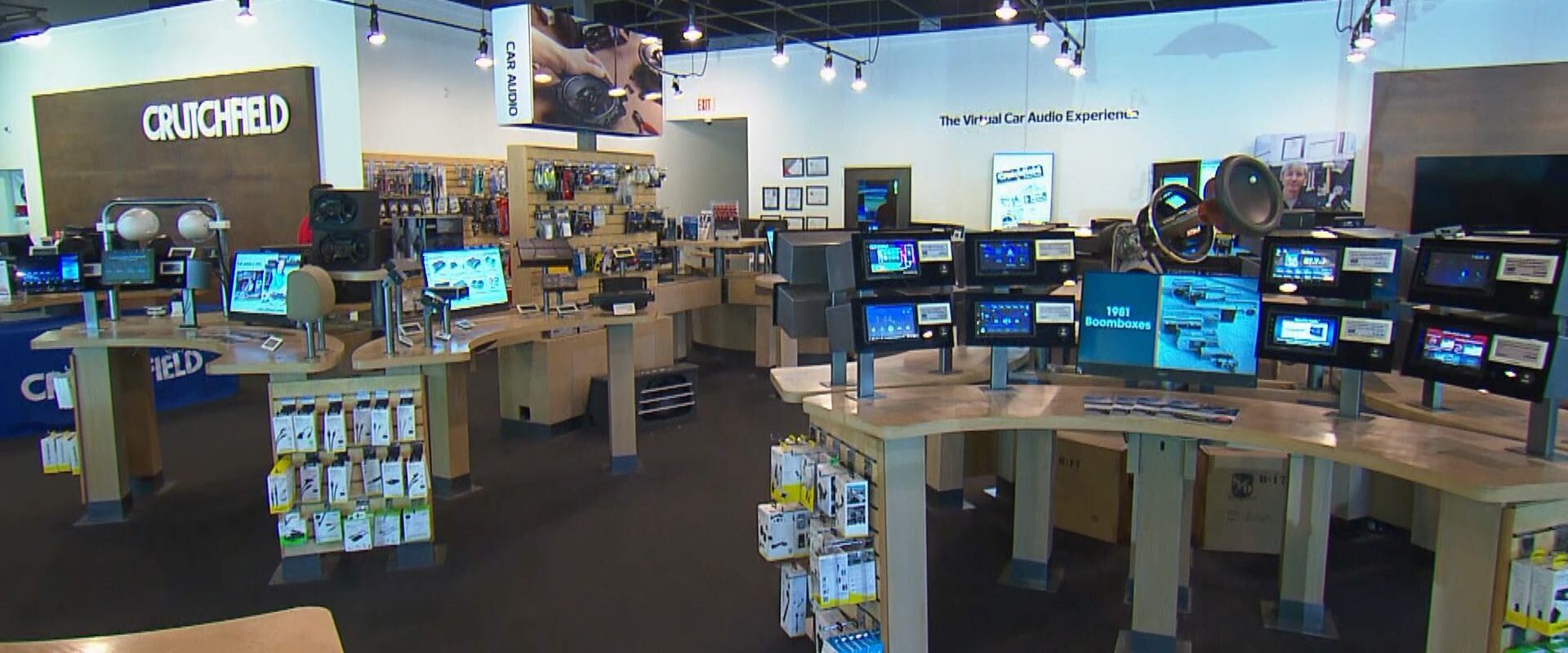
Speakers presented a particularly awkward problem online. Descriptions and specifications can explain a great deal, but people buy speakers to listen to them. Crutchfield’s answer developed into virtual listening technology, used in the Charlottesville store in 2012 and brought to the website in 2019 as SpeakerCompare. Shoppers could compare simulated speaker sound through headphones.
The ambition has the same shape as the old catalog revision. Identify the part of the purchase that leaves someone uncertain, then build a way to investigate it. The solution had moved from printed instructions to audio engineering. The founder’s attention remained on the moment a shopper hesitated.
Even the paper publication changed jobs. As online shopping grew, Crutchfield reworked the catalog into the Discovery Book, emphasizing explanations and ideas while directing readers to the website for purchases. He wanted to keep using the knowledge of the writers and designers who had made the publication valuable. Paper could still be useful without trying to perform every task it once had.
Recognition accumulated around this work. He entered the Consumer Electronics Hall of Fame in 2007. The following year, at Samsung’s invitation, he carried the Olympic torch in Hangzhou, China. In 2024, the company reached its 50th anniversary; in 2025, he joined Virginia Business’s inaugural group of 30 Icon Honors recipients. The photograph beside the old Porsche offers a less ceremonial version of the same history: a founder next to the object that gave him a problem to solve.
Asked in 2024 where he saw himself in ten years, he answered, “Still working. I’ll be 91 then!” The future he described was a continuation of the job. Customers would encounter unfamiliar technology, and the company would have to learn how to help them. There would be fresh equipment to understand, fresh questions to ask, and another expert somewhere who had forgotten how confusing the obvious can be.