A cardboard box arrives on a doorstep, and the transaction seems complete. Somewhere before that satisfying little thump, however, somebody had to arrange the paper. Bill Conboy’s working life comes into focus a few steps upstream from the parcel: at the warehouse, beside the railway, where a roll of paper becomes somebody else’s next delivery.
Conboy founded ELM Global Logistics on Long Island and helped build it into a family business with a warehouse footprint exceeding a million square feet in New York and New Jersey. His public comments tend toward the mechanics of that achievement. Space. Freight rates. Customer deadlines. The family members and employees who keep the operation going. These subjects offer a useful route into a founder whose business is built around other people’s goods.
The appeal of his work is easily overlooked. A warehouse can look like a pause in the action. For the customer waiting on material, it is part of the action itself. Conboy’s career has involved finding useful things to do during that pause, and useful ways to bring it to an end.
A family business, measured in square feet
The beginning was modest: a small warehouse operation and a team that included relatives and close associates. Conboy and his wife, Gale, built the business together. Over the years, children and extended family joined the work alongside employees outside the family. The family connection became part of ELM’s operating identity, as enduring as its Brentwood base.
ELM’s own current history describes an opening operation of three employees, one customer and 40,000 square feet in 1980. Those numbers have a pleasing lack of grandeur. One customer can fill an order book and dominate a founder’s attention at the same time. Six loading docks and two rail doors, the starting configuration ELM describes, are concrete assets with concrete limits. Growth requires deciding which limit to tackle next.
Conboy’s later decisions show that adding space was only part of the calculation. Buildings could be combined, operations moved, and customers served from a different arrangement of the same regional geography. The interesting unit of progress was the operation that a building made possible.
*ELM’s current company history describes its opening operation in 1980. The footprint is company-wide, not one building.
The attraction of one roof
In April 2002, ELM signed a six-year lease for a 104,000-square-foot industrial building in Hauppauge. The space had been occupied by American Tissue. Conboy described a restructuring intended to capture the efficiencies of a larger facility, with operations moving from Deer Park and Brentwood. The move also gave ELM more room in the Hauppauge Industrial Park.
There was another piece of business behind the property decisions. Earlier that year, ELM had reached a warehousing and distribution outsourcing agreement with Olympus America, followed by a lease at 400 Rabro Drive. Customers were bringing work that needed somewhere to happen. A lease, in that setting, was a working answer to a customer relationship.
In 2003, Conboy made a further consolidation move at Brentwood. ELM agreed to a 15-year lease covering 560,000 square feet at 50 Emjay Boulevard, where it already occupied 400,000 square feet. The newly available space offered a chance to gather more operations together. Conboy expected bringing nearly two-thirds of the business under one roof to improve efficiency.
The arithmetic of a warehouse is less glamorous than the arithmetic of a startup valuation. It also has fewer places to hide. Goods arrive at one door, people handle them, and goods leave at another. Each unnecessary journey between buildings gives the operator another expense to explain.
Long Island came with a calculation
By 2014, remaining in Brentwood required another decision. ELM considered moving operations to New Jersey, where it already had a warehouse in Burlington. Conboy said the move could lower costs for customers as the number of Long Island companies with large shipping requirements diminished. Familiar surroundings had to compete with an alternative that made financial sense.
The resulting agreement kept ELM at Emjay Boulevard with a 15-year renewal for 542,000 square feet on 30.5 acres. Assistance from the Town of Islip Industrial Development Agency helped make staying workable. Richard Cohen of Ashlind Properties guided ELM in approaching the agency; the landlord also participated in the arrangement.
That episode gives the family-business story some useful grit. Continuity involved negotiation, incentives and a comparison of customer costs. Staying put was a business decision with several parties around the table. A familiar address still had to earn its place on the shipping paperwork.
The railway was already in the building
ELM’s Brentwood operation occupied a former Hills Supermarket distribution center. Tracks ran inside the facility. That inherited feature gave Conboy a way to handle goods whose economics favor a large load over a long distance. Cornmeal, lumber and rolled paper were among the commodities ELM handled by rail.
In 2015, he explained the calculation in practical terms: bulk shipments originating in the middle of the country or on the West Coast could cost less by rail. He also acknowledged the tradeoff. Trains took longer. A customer needing material quickly might choose a truck; a customer with time could consider the railway.
There is something agreeable about a sales argument that admits the clock exists. The suitability of rail depends on the shipment and the deadline. Conboy’s explanation leaves room for both modes of transport, and for the customer whose circumstances change between one order and the next.
The cardboard connection
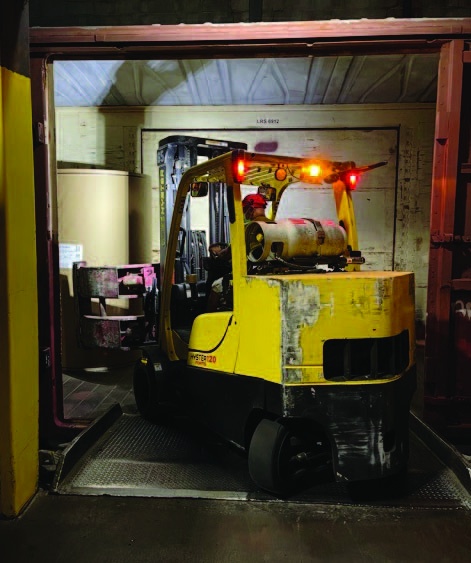
In 2021, demand for packaging paper brought that relationship with rail into sharper view. Newly available room at Brentwood coincided with a surge in paper shipments. Conboy described the change through an image any shopper could understand: purchases once carried home from stores were arriving inside cardboard boxes.
“Suddenly everyone wanted what they have been getting at stores to arrive on their doorstep in a cardboard box.”
Bill Conboy, 2021
The warehouse then had capacity for 15 railcars and 75 truck bays. Paper could move across the dock for delivery or remain in storage until needed. ELM’s relationship with New York & Atlantic Railway reached back to 1997, when rail shipments brought paper rolls for a Long Island newspaper. The goods had a new destination in the packaging economy; the railway connection had years of use behind it.
This is a particularly good detail in Conboy’s story. A building associated with an older distribution business could serve a changing pattern of shopping. The physical work remained legible: receive the paper, hold it where necessary, and get it to the next operation. The novelty was in what customers needed that paper to become.
- 01Rail arrivalRolled paper
- 02ELM warehouseReceive + hold
- 03Factory deliveryFeed production
Fifteen or twenty loads, then do it again
By February 2024, Conboy was describing the business through a corrugated-box manufacturer. Rolled paper arrived at ELM by rail. ELM held the material and supplied the customer’s production line, delivering as many as 15 or 20 loads in a day. Finished boxes then moved onward to customers including Amazon.
He also described a California canning company that sent inventory east by rail and used ELM as a place for customers to collect orders. The arrangement gave the manufacturer an East Coast distribution point without opening its own facilities there. ELM managed inventory, picked orders and loaded trucks.
Both examples reveal what Conboy was selling through the warehouse door: access to an operation that a customer could use without assembling every part itself. The paper customer needed a steady supply to production. The canning customer needed inventory closer to buyers. The same provider could answer two different questions about where goods should wait and who should move them next.
The next generation has work to do
For Conboy, growth also has a family dimension. By November 2024, he was speaking about grandchildren becoming involved in the business. The family had moved beyond the founders and their children into another generation’s working lives.
He expressed pride in low employee turnover and credited family members and close associates with a large part of the company’s success. The emphasis matters. A freight operation can be described through its buildings and equipment, but Conboy’s account of its continuity includes the people who return to work there.
The grandchildren give the story a forward direction without requiring a grand prediction. A family company becomes a different kind of responsibility when younger relatives start contributing. Experience has to be useful to someone besides the person who accumulated it. The warehouse needs orders today; the business needs people prepared to handle tomorrow’s.
Conboy’s career has been spent making room: gathering operations beneath one roof, keeping a Long Island base economically workable, and finding space for goods on their way to another purpose. Now that idea includes another generation. Somewhere in the middle of all those square feet, the next delivery still has to leave on time.
- ELM Global Logistics ↗Official company website
- ELM’s company history ↗Warehouse milestones
- ELM on LinkedIn ↗Company account
- The rail and paper connection ↗New York & Atlantic Railway · 2021
- The customers behind the warehouse ↗Inbound Logistics · February 2024
- A family business across generations ↗Long Island Business News · November 2024
- The 2003 Brentwood consolidation ↗Archived business reporting
- The 2014 decision to stay ↗Archived business reporting