Consider the restaurant menu. Inside the dining room, it is a carefully managed object. Someone checks the prices. Someone removes the dish the kitchen can no longer make. Online, historically, it might be a PDF requiring a small expedition across a phone screen. The restaurant has put thought into everything the guest touches, then handed the first encounter to a file attachment.
BentoBox built a company around that mismatch. Its starting point was the website. Its opportunity was everything a restaurant could do once the website became useful.
- Restaurant websites became storefronts for orders, catering, gift cards and events.
- BentoCore brought menus, guest information and marketing into one hub.
- Fiserv bought the business in 2021. New customers now enter through Clover POS.
The owner was never the web designer
Krystle Mobayeni, a designer, and Pierre Drescher, an engineer, founded BentoBox in 2013. Their early restaurant customers included The Breslin, The Meatball Shop and Union Square Hospitality Group. These were businesses for which atmosphere was part of the product. A website needed to carry some of that personality.
But personality alone would have made BentoBox a design service. The more useful discovery concerned labor. In a 2015 interview, Mobayeni explained that restaurant operators generally were not building their own websites. They hired someone. Giving them another do-it-yourself tool misunderstood who would actually do the work.
BentoBox made the initial build something specialists could handle, then gave restaurant teams controls for everyday changes. That division matters. A manager needs to change tonight’s menu, without becoming the person responsible for tonight’s software project. The competitive question became how much ongoing work the platform removed.

The early customers also supplied something software could not manufacture: credibility. Mobayeni credited well-known restaurants with helping establish trust in a close-knit industry. The lesson for another business is quite practical. Find customers whose judgment other buyers already respect. Solve their problem thoroughly enough that a recommendation feels safe.
When the dining room disappeared
For years, the argument for a stronger restaurant website could sound optional. Reporting in 2021 described owners treating BentoBox as a nice extra before the pandemic. Then dining rooms closed. Restaurants needed takeout ordering, delivery scheduling and gift-card sales. The same website suddenly had a different job.
That reporting put BentoBox at roughly 4,800 clients before the pandemic and more than 7,000 afterward. The numbers describe a particular moment, rather than today’s customer base. They also capture a change in purchasing psychology: an online transaction became a way to keep trading when the familiar transaction across a table was unavailable.
“data-informed, spirit-driven”KRYSTLE MOBAYENI / A CULTURAL CORNERSTONE, 2024
Commerce widened the possibilities. A restaurant could sell a catered lunch, collect an event inquiry or offer a gift card through its own site. In her 2021 interview with The Spoon, Mobayeni argued for treating online and in-person hospitality as a connected experience. For operators, that meant another way to reach guests directly and diversify sales.
The menu and the memory
By 2024, the problem had changed again. Restaurants had accumulated tools. Mobayeni’s account of the new platform described consistent feedback from operators: too many disconnected systems were consuming time. The response was BentoCore, the central hub behind the BentoBox Marketing & Commerce Platform.
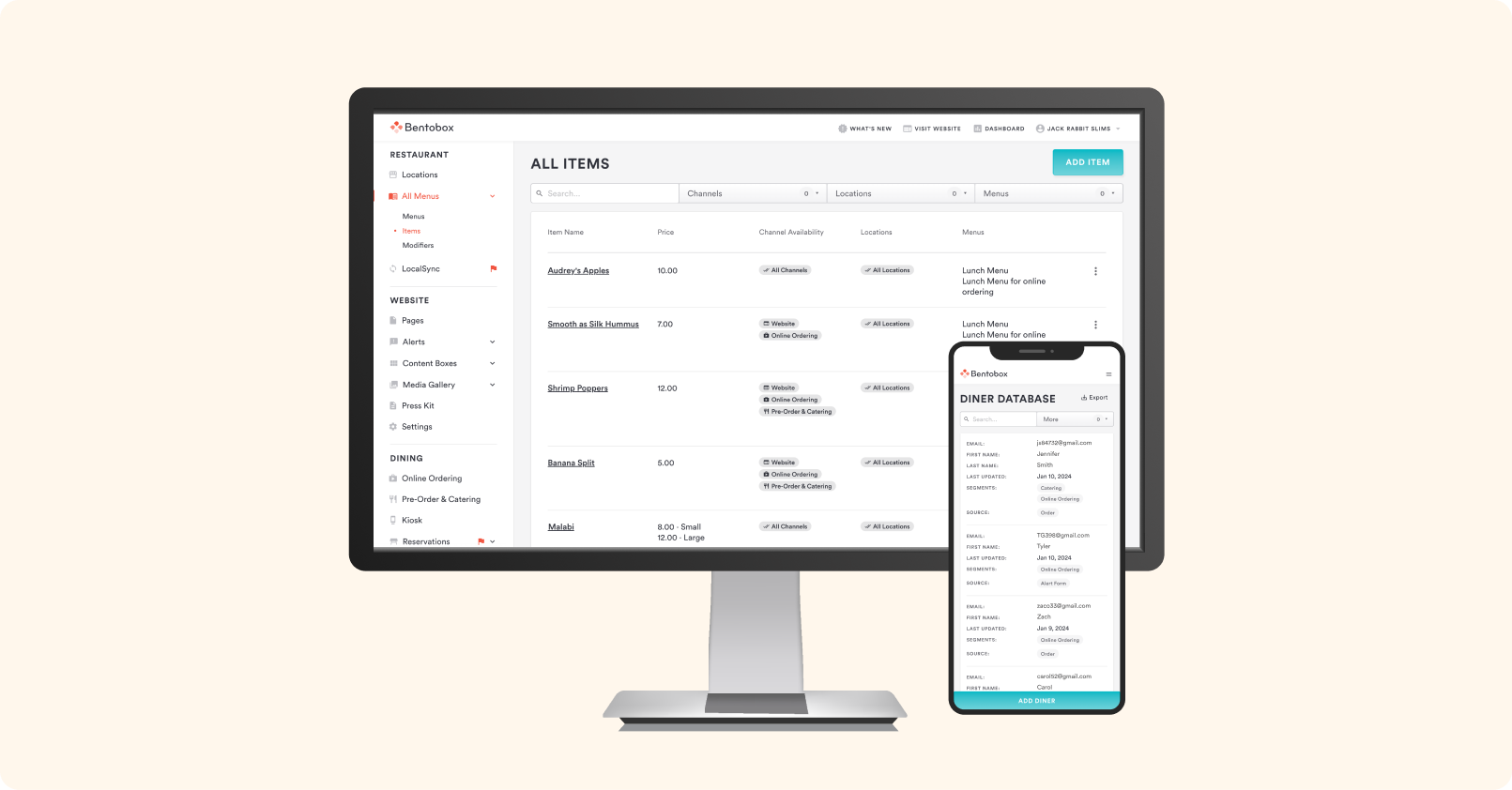
The launch announcement describes shared menu information, brand materials and diner data powering optional modules. Website, ordering, catering, reservations and events can draw on that common foundation. Automated email and SMS tools, alongside loyalty features, give restaurants ways to follow up after a transaction.
Shared information. Several places to put it to work.
A useful way to read this architecture is as two forms of memory. The menu remembers what the restaurant sells. The diner database remembers interactions. Connecting them can make a follow-up more relevant and a menu correction less repetitive. That is the product’s intended advantage; whether it saves time depends on the restaurant’s actual workflow.
Its expertise lies in these restaurant-specific details, supported by setup work. BentoBox’s onboarding description includes entering menus, uploading brand assets and configuring purchased modules. In a 2023 podcast, Mobayeni also described bringing hospitality workers into support, success and onboarding roles. People who understand service can help translate an operator’s complaint into a software decision.
A front door inside a bigger house
Fiserv completed its acquisition on November 22, 2021. Its financial reporting records a purchase price of $317 million, net of $24 million in acquired cash. The buyer already had Clover. Adding BentoBox connected the digital storefront with a larger payments and point-of-sale business.
Fiserv financial reporting / 2021 transaction
In May 2025, Clover launched Clover Hospitality by BentoBox. The announcement included a Checkless Payments pilot at Union Square Hospitality Group’s Manhatta, designed to remove the wait for a bill. The original website company was now part of an effort reaching into the dining room itself.
For a buyer today, the first filter is straightforward. BentoBox’s website says its services are available only to Clover POS customers. Its former pricing page redirects there. The business historically sold subscriptions and add-on modules; a current buying decision needs a Clover quote covering the relevant software, setup and transaction terms.
That places it among restaurant commerce and marketing alternatives such as Popmenu, Owner and ChowNow, while Toast and Square offer broader competing ecosystems. A restaurant already committed to another POS has a substantial compatibility question. A venue needing only a simple informational site may have little use for the wider machinery.
The transferable idea is smaller than the platform: start with one recurring task customers struggle to manage, then follow the adjacent work. For a restaurant, a sensible first step is to trace a guest’s route from menu to checkout to return visit. Every avoidable interruption is a place to improve hospitality before anyone pulls out a chair.
Keep a table open
BentoBox / Clover · LinkedIn · X · Instagram · Facebook
The founder’s platform letter · Listen: Mobayeni on the meez podcast · Watch: From Web Designer to Tech CEO · Clover Hospitality announcement