Restaurant Tech / Co-Founder & CEO
Adam Dougherty
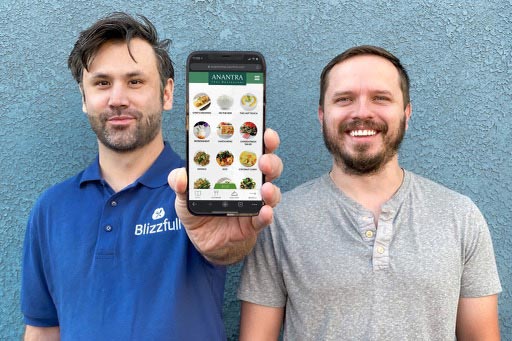
He went to film school, then decided a restaurant's checkout screen deserved as much craft as a movie poster. So he built one.
He went to film school, then decided a restaurant's checkout screen deserved as much craft as a movie poster. So he built one.
Around 2012, Adam Dougherty and Zach Zurn were web developers trying to do something deceptively simple: get the office lunch order placed without the usual chaos of menus, phone calls, and forgotten side requests. The friction annoyed them enough to build a fix. That fix became Blizzfull, a restaurant-technology company now run out of Glendale, California.
Today Dougherty is co-founder and CEO. Blizzfull builds branded websites and online ordering that live on a restaurant's own domain, not a marketplace. The premise is almost old-fashioned: a restaurant should own the people who eat its food. When an order goes through GrubHub or Uber Eats, the customer becomes loyal to the app. Blizzfull hands that relationship back.
What makes the story odd is the resume. Most people in restaurant ordering software come from restaurants or from enterprise software. Dougherty came from cinema. He studied Film/Cinema/Video Studies at USC, with detours through computer science at Stanford and West Valley College. That background is not a footnote. It is the whole product thesis.
Dougherty and Zurn both worked in the film industry before they wrote software for a living. That order of operations matters. They learned to care about how a thing looks before they learned to ship it. In an industry full of functional-but-forgettable order screens, the difference shows.
USC film school. A career in the industry. A trained instinct that a frame either earns attention or wastes it - and that nothing ships ugly.
Web development, then a full restaurant platform. The same eye, now pointed at checkout flows, menus, and the moment a hungry person decides to click "order."
// "Our goal is to bring our Hollywood experience to our restaurant partners' websites and combine that with order entry functionality."
Blizzfull grew from an ordering tool into a full platform. The pieces are designed to keep a restaurant's whole digital life under one roof - and, after 2023, increasingly run by AI.
Fully branded restaurant sites and mobile web apps with ordering built in - not bolted on.
Automated customer segmentation to bring diners back, without a separate marketing stack.
QR-code digital menus with real-time updates and kiosk ordering for in-restaurant tables.
Loyalty programs that reward the restaurant's customers - because they are the restaurant's customers.
Automated menu descriptions and upsell suggestions, generated rather than hand-typed at midnight.
Orders, marketing, and menus managed from a single unified control panel.
With GrubHub and Uber Eats, there is no opportunity to build loyalty with that customer. They become loyal to GrubHub or Uber Eats but not to the restaurant.
A restaurant should be looking for a solution that is completely customizable.