He was stuck waiting for a bill at a San Francisco airport restaurant. Instead of complaining, he built the company that moves online orders straight into restaurant registers.
Every restaurant runs on a dozen apps that refuse to talk to each other. Vishal Agarwal built the thing that makes them talk.
When you tap "order" on DoorDash and a cheeseburger shows up, a lot has to happen in between that you never see. The order has to leave the app, land in the restaurant's point-of-sale system, print in the kitchen, and not get garbled on the way. That handoff is unglamorous, error-prone, and expensive when it breaks. It is also, more or less, Vishal Agarwal's entire business.
Agarwal is the founder and CEO of Checkmate, a New York company that most diners will never hear of and most restaurant operators cannot live without. Checkmate takes the online orders flowing in from delivery marketplaces and first-party websites and pipes them directly into a restaurant's register, while keeping menus synchronized across every platform at once. Change a price in one place, and it updates everywhere. That sounds small. Multiply it across a dozen delivery apps, thousands of locations, and a menu that changes with the seasons, and it stops being small.
The company today handles far more than the check. It runs first-party ordering, third-party integrations, menu management, accounting reconciliation, refunds and dispute management, kiosks, and increasingly AI - including voice systems that let restaurants take phone orders without a human picking up. The customer list runs from independent eateries to enterprise brands like Arby's and Wendy's. Inspire Brands, one of the largest restaurant companies in the country, put money into Checkmate's Series B. Square wired the platform into its tablets. By 2021 the company had crossed 100 million processed orders. It had done roughly 1 million in 2018.
What is striking about Agarwal is that he does not present as a technologist. He is analytical and numbers-obsessed - he came up through marketing and finance, not engineering - and he runs a company full of engineers without being one himself. Asked once how he stays current in an industry that reinvents itself constantly, his answer was one word: "Read." He has said the thing that keeps him effective is not code but the discipline of paying attention. "What was true even a month back may not be as relevant today," he has said, "and the industry may have moved on."
That is a useful worldview for someone in restaurant technology, a field where the ground genuinely does keep moving. Delivery apps change their terms. New ordering channels appear. Margins get thinner. A company built on the assumption that everything is stable would be a company built to be surprised. Checkmate is built the other way - as connective tissue that assumes the endpoints will keep changing and its job is to keep them talking anyway.
The founding story is almost too neat, which is part of why it sticks. Agarwal was at an airport restaurant in San Francisco. His flight was approaching. He wanted to pay and leave. There was no server in sight, and the bill would not come. Sitting there watching the minutes disappear, he started imagining a version of the world where he could just pay from his phone and walk out.
That was the seed. The first idea for Checkmate was about the check itself - letting diners pay without waiting, and split the bill with friends without the arithmetic. The name carries the promise: end the wait for the check, checkmate. But like a lot of good companies, Checkmate did not stay where it started. As Agarwal and his team got closer to restaurants, they kept finding bigger, uglier problems upstream of payment - orders getting lost between apps and registers, menus drifting out of sync, reconciliation nightmares at the end of the month. So the company followed the pain.
The path there was not a straight line. Agarwal was born and raised in India, studied commerce at Delhi University, and earned an MBA in marketing from the K.J. Somaiya Institute of Management Studies and Research in 2005. He spent roughly four years at Citigroup. Then he moved to Vancouver to help run marketing at an e-commerce startup, Choxi.com, where he was executive vice president, chief marketing officer, and a board member from 2010 to 2016. Banking, then e-commerce, then restaurants - a sideways route that gave him a very particular skill: making sense of messy data across systems that were never designed to work together.
Online orders from delivery apps and first-party sites drop straight into the restaurant's POS - no re-keying, fewer mistakes.
One change updates every platform at once, so a price or an 86'd item never lives in twelve inconsistent versions.
Reconcile and Refund & Dispute Management tools chase down the pennies that go missing between marketplaces and the bank.
Self-service kiosks and AI-powered digital menu boards extend the same order flow into the physical restaurant.
Voice AI lets restaurants take phone and drive-thru orders without tying up a human on every call.
Built to run from a single independent shop up to national brands like Arby's and Wendy's on the same rails.
The company's origin was a slow restaurant check, not a whiteboard. Annoyance, well-directed, is a founding document.
The name doubles as the mission: Checkmate, as in, end the wait for the check.
He runs a company full of engineers without being an engineer himself - his edge is deciding which problem is worth solving.
Before restaurants, he ran marketing at Choxi.com and, before that, spent years at Citigroup.
Checkmate opened an India subsidiary in 2022, bringing his company back to the country where his career began.
He is a Forbes Technology Council member and has been featured in TechCrunch and Forbes.
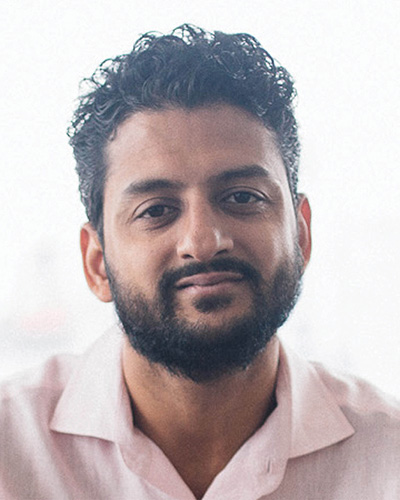
A sneak peek with Vishal Agarwal, the founder and CEO of Checkmate.