Before the five-market agency network, there were newspapers to sell, bagels to serve, restaurant shifts, and real estate. Ben Behrooz has a use for that collection of jobs now. He says the route makes sense looking backward. At the time, the work was simply the work. Today, as founder and CEO of Branding Los Angeles, he spends his days helping business owners explain themselves to people who have plenty of other things demanding their attention.
There is a pleasing economy to the progression. Selling a newspaper requires getting someone interested in a story. Running a branding agency requires getting someone interested in a business. The tools have changed considerably. The person on the receiving end still has the right to keep walking.
Behrooz’s career has taken him through music, internet media, and social publishing. His agency now works across branding, marketing, communications, and public affairs. Yet the thread he returns to is quite plain: understand who you are speaking to, then give them a reason to listen. An expensive microphone cannot solve a failure of conversation.
The jobs that eventually made sense
Behrooz grew up in Los Angeles. His family’s story, as he tells it, includes leaving Iran and receiving asylum in the United States during the 1980s. He connects his work ethic to watching his father in Downtown LA’s textile and fashion district. Entrepreneurship was something he could observe at close range, in the daily effort required to make a business function.
His account of those early service jobs carries a similar emphasis on experience. Different workplaces brought different people, expectations, and problems. He has said that the variety helped prepare him to tell stories for businesses. It is an education with a practical examination every day: a customer arrives, and something has to happen.
After UCLA, his route included media and communications work for Sony Music and Yahoo. Those environments exposed him to branding and digital distribution. At Truthdig, where he served as social media director, the work acquired another dimension. A publishing platform could bring attention to people and arguments that might otherwise struggle to be heard.
One memory has stayed with him. He recalls seeing a political cartoon associated with his Truthdig work held up during protests in Egypt. A graphic made for publication had become something a person carried into the street. In his telling, that moment made the reach of media tangible. A story could leave the screen and enter somebody else’s life.
“helping our clients find their voices”
Ben Behrooz’s description of his work
That phrase now appears in his agency biography. In commercial terms, it means defining a brand, refining its message, and making its personality recognizable across channels. The earlier publishing experience helps explain why he describes the task in the language of voice. He is interested in what someone has to say and whether it reaches the intended listener.
Five markets, several reasons to be there
Branding Los Angeles began with a small client base and long nights. Behrooz has also described losing his Sony Music job as a turning point toward building his own business. The origin has the ordinary discomfort of entrepreneurship: less certainty, limited resources, and work that has to be found before it can be delivered.
The business eventually extended beyond its home city. Today, Behrooz describes a network covering Los Angeles, New York, Hawaii, Texas, and Florida. In his account, some expansion followed clients as their businesses grew into additional markets. A client’s next location became a reason to develop the agency’s own presence.
Five US markets.
Hawaii has a more personal explanation too. His wife is from there. Behrooz speaks about being able to call it home and participate in its community. That detail gives the network a human geography. An office location can reflect a business opportunity and a family connection at the same time.
Location matters in work that depends on understanding a customer’s surroundings. A name, a message, and a campaign all have to meet people somewhere. Behrooz’s expansion story suggests a recurring question for the agency: what does this business need to understand about the place it hopes to serve?
The advertisement that can be switched off
In recent conversations, Behrooz has devoted attention to construction companies and home service businesses. Plumbers, electricians, and builders give branding a practical setting. Their customers need to find someone, decide whether to trust them, and establish whether the work can be done. Every promise eventually encounters a real appointment.
One detail from his PodFather conversation is especially revealing: he discusses turning advertising off when a client is fully booked. For an agency selling marketing services, it is a useful admission. Demand has to fit the business’s ability to respond. More inquiries can become a queue of disappointed people if nobody has time to help them.
That view also puts ownership in the foreground. He stresses clients owning their websites and phone numbers. Those details lack the glamour of a launch campaign, but they sit close to the daily life of a small business. Customers need a reliable way to find it, and the owner needs control over the means of being found.
His broader argument connects brand identity, public relations, search, and customer acquisition. On Your Brand Amplified, he discusses the gap between visibility and revenue, along with the difficulty of choosing clients and building a capable team. Attention is an intermediate event. The interesting question is what the business can do with it.
His conversation with Robert Gauvreau returns to alignment between branding and marketing. It also considers the continuing usefulness of longer videos and podcasts as material that can be found and reused. The practical appeal is understandable: a business owner can explain something at length, then draw shorter pieces from a conversation that already has substance.
A team needs room to think
A growing agency creates another audience for the founder: the people doing the work. Behrooz discusses this in terms of judgment. Staff need to understand how to reach a decision, rather than simply wait for the person at the top to supply one.
His account includes giving people responsibility, encouraging questions, and allowing controlled mistakes. That approach asks a leader to tolerate some friction. Teaching someone how to think through a problem usually takes longer than announcing the answer. The benefit arrives later, when the next problem can be handled without forming a queue outside the founder’s door.
“You have to suffer for your craft before it actually becomes something of substance.”
Ben Behrooz
There is a sternness to that sentence. It fits his resistance to treating marketing as a cheap checklist of deliverables. Research and discovery take time. So does learning to take responsibility for a client’s work. His idea of agency growth includes developing people who can carry those decisions themselves.
Empathy occupies a place in his recent discussions too, particularly when he talks about understanding customers and maintaining authenticity as a business expands. Those ideas meet in a practical management problem: the more people who represent a company, the more carefully they need to understand the people on the other side of it.
The beach is part of the brief
Back in Los Angeles, some of the agency’s work involves gloves and rubbish bags. Branding Los Angeles organized its inaugural Earth Day beach cleanup in Santa Monica in 2021. Staff and volunteers went to Ocean Park Beach to collect litter. The company has also organized holiday toy drives and describes providing meals through community service.
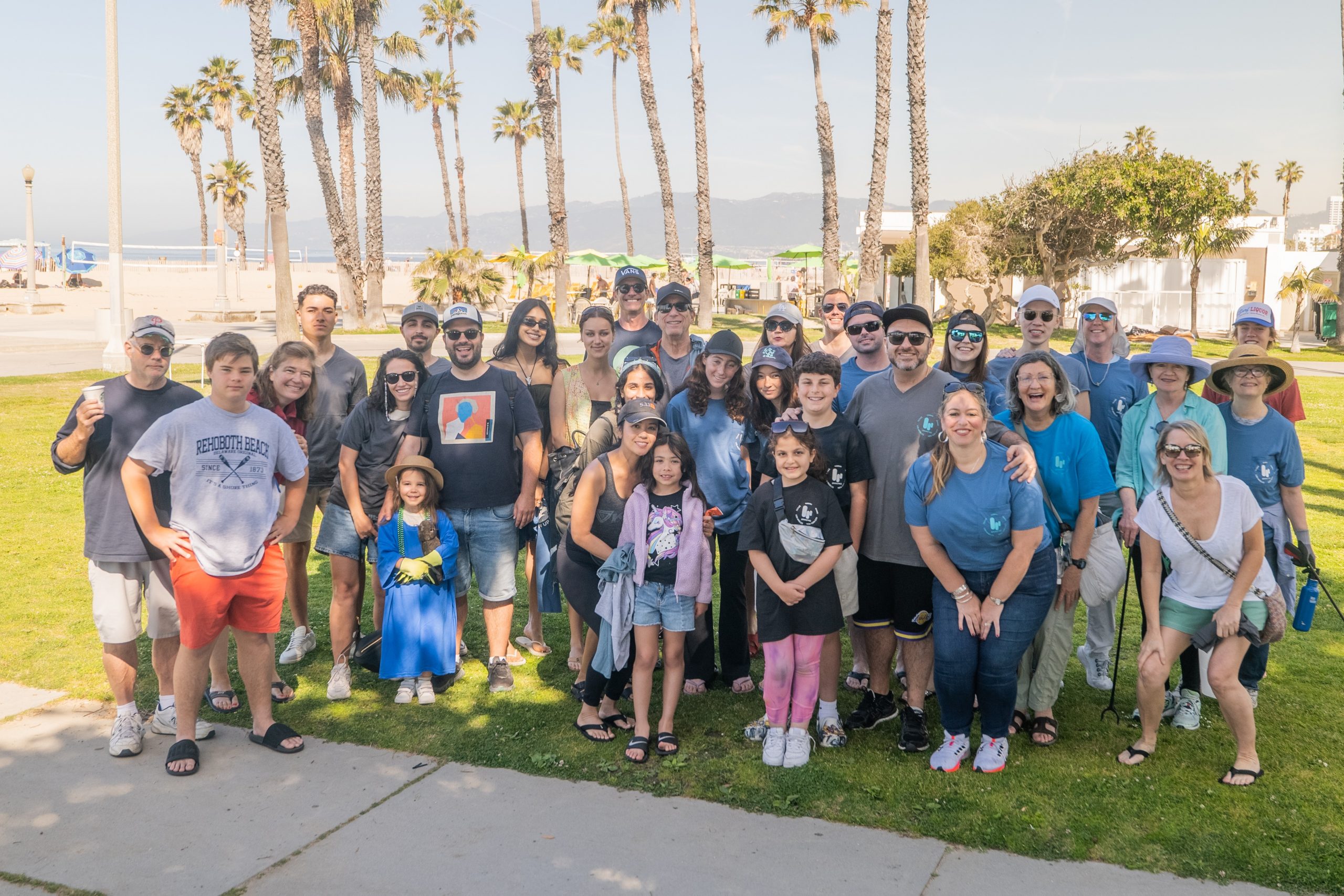
Behrooz connects these activities to company culture. Community participation also features in his conversations about business growth. There is a straightforward logic to doing something useful in the places where a company works. Organizing a cleanup requires arrangements, people, and follow-through. The beach offers a fairly direct test of whether anybody actually showed up.
In 2024, Beverly Hills Living recognized him among its 40 Under 40 honorees. Behrooz described the hometown connection as part of what made the recognition meaningful. The photograph of him holding the certificate catches that public milestone in an otherwise familiar event setting: tables, other guests, and a founder smiling for the camera.

His attachment to LA also comes through in a less ceremonial list. Asked where he would take a visiting friend, he chose the Apple Pan, the Original Farmers Market, and Dodger Stadium. The food order included a Hickory Burger and banana cream pie. A branding executive can spend his working life discussing memorable experiences, then express the same preference by naming the counter where he wants to sit.
Those choices bring the story back to the city in the agency’s name. Behrooz’s business has acquired more locations and more ways to reach people. His public account of what matters remains full of particular people and places: his father’s work, former colleagues, his team, his wife’s home, and the customers trying to build businesses of their own. Showing up is the part that travels.