The easiest part of e-commerce is the button. The hard part begins when someone presses it. A product must exist in the right warehouse, at the right price, under the right promotion. Payment has to clear. The parcel must move. A customer may ask where it is, whether the blue is really blue, or why a return has not landed. In China, that sequence can cross a brand site, Tmall, JD.com, Douyin, WeChat and a physical shop before breakfast. Baozun built a company around making those handoffs look uneventful.
From Shanghai, Baozun operates the commercial plumbing for global consumer brands. Its teams set up and run online stores, design campaigns, buy media, manage customer relationships, connect IT systems, forecast inventory, pick orders and handle returns. The company says its customer-service network alone has more than 2,400 staff and handles roughly 120 million consultations a year. This is not software handed over with a login. It is software wrapped in people, warehouses and performance targets.
That breadth is the sales pitch. A brand could hire one agency for ads, another integrator for software and a third operator for fulfillment. Baozun argues that the seams would become the problem. A promotion that spikes demand is only a success if inventory allocation changes fast enough; the delivery promise is only useful if customer service sees the same order status. Baozun tries to own the whole loop.
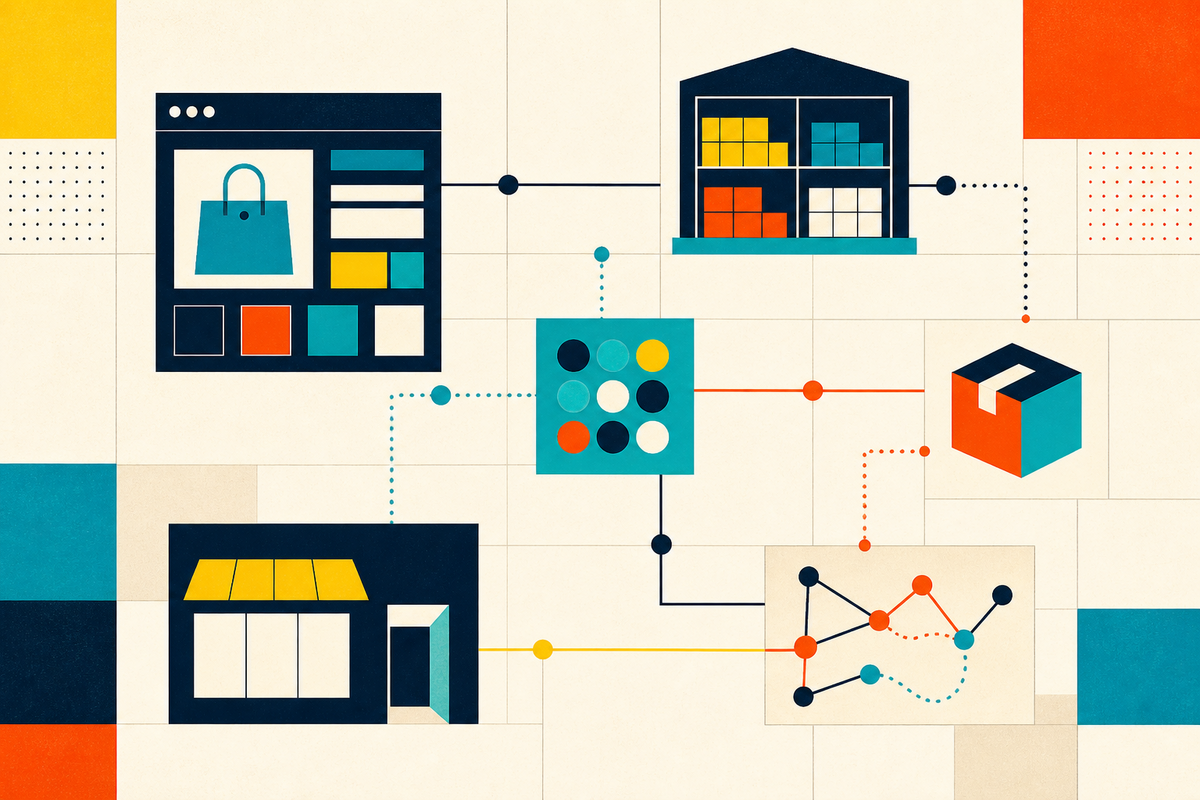
One company, several job descriptions
Baozun's formal map has three names. Baozun E-Commerce, or BEC, is the established China operation: store management, customer service and value-added services including marketing, technology, warehousing and fulfillment. Baozun International, BZI, takes related capabilities into markets outside mainland China, especially the rest of Asia. Baozun Brand Management, BBM, goes further upstream. It handles brand positioning, merchandising, retail, supply chain and local product decisions - work normally reserved for the brand owner or a licensee.
signal
store
allocation
service
data
The distinction matters because the economics change with the job. Service fees pay for operations, IT, marketing and support. Distribution arrangements add product-sales revenue. Brand management adds direct retail revenue and a larger share of both the decision-making and the risk. The service provider can blame a bad assortment; the brand manager helped choose it.
“Technology is at the center of our strategy, and it is our competitive advantage.”Vincent Qiu, founder, chairman and CEO
Baozun's technology catalog is a record of repetitive headaches turned into products. BOCDOP covers the middle machinery of omnichannel retail. Its components handle orders, product information, private-domain storefronts, customer relationships and data intelligence. Shopcat supports membership operations. Shopdog connects online and offline retail. S-ANY manages customer service, while S-Whiz adds AI assistance. In 2025, Baozun said its direct-to-consumer, product-information and order-management capabilities appeared in multiple Gartner research publications.
The Gap experiment
The clearest expression of Baozun's ambition is hanging on racks. The company began serving Gap Greater China as an e-commerce partner in 2018. In 2022, it agreed to buy the operation for a primary consideration of US$40 million; the transaction closed in 2023. Related agreements gave Baozun long-term exclusive rights to manufacture, market, distribute and sell Gap products in Greater China. A contractor became the operator.
That move created a live laboratory for an appealing theory: years spent inside digital stores produce useful knowledge about what shoppers want, where demand appears and how channels behave. Baozun can feed those signals into merchandising, store openings and stock allocation. The company calls the approach a China-for-China strategy. It is less about translating a global campaign and more about rebuilding the local machine.
The early financial evidence is encouraging but not magical. Brand Management revenue grew 25.2 percent in 2025, to RMB1.85 billion, while its adjusted operating loss narrowed. Gap China later recorded two consecutive quarters of non-GAAP operating breakeven through the first quarter of 2026. Baozun's broader group returned to positive non-GAAP operating income in that quarter. Those are signs of operational improvement, not proof that every international label should hand over the keys.
Baozun has also extended the model with Hunter. Through a joint venture with Authentic Brands Group, it acquired rights connected to the British outdoor brand in Greater China and Southeast Asia. The portfolio remains concentrated enough that Gap is still the primary brand-management business. That concentration makes the experiment easier to read - and harder to diversify if consumer tastes turn.
Selling coordination
Baozun's customers are brands with recognition but without every piece of local operating muscle. Public disclosures name Nike, Microsoft and Philips among global leaders it serves. Its own site has also identified Samsung, Levi's and other international labels over time. At the end of 2024, BEC supported more than 490 brand partners, up from more than 450 a year earlier, and reported a 95 percent renewal rate among key accounts.
Their problem is not simply access to Chinese consumers. It is operational fragmentation. Major marketplaces have distinct advertising systems, promotion calendars and customer behaviors. Social commerce rewards a different production rhythm. Official sites and mini-programs offer more control but need traffic. Physical stores create another pool of inventory and another chance to disappoint a shopper who expects every channel to know what the others know.
Peak shopping events turn that fragmentation into a stress test. An ordinary week can hide a slow data feed or a clumsy approval chain; a large promotion makes both visible in minutes. Media spending changes traffic, traffic changes orders, and orders drain stock from locations that may also be serving walk-in customers. A late inventory update can leave a store selling an item the warehouse no longer has. A delayed refund can turn a promotion into a support backlog. Baozun's practical expertise is built around these small failures of timing. Its operators prepare campaign calendars, load product content, monitor sales, rebalance stock, staff service queues and keep fulfillment systems synchronized. The work sounds procedural because it is. Yet procedure is what allows a global brand to participate in a local shopping festival without building a parallel company for a few intense weeks of the year. The accumulated playbooks also explain why Baozun can sell technology and labor together: the system encodes a rule, while the team handles the exception the rule did not anticipate.
Competitors attack pieces of this puzzle. China-focused operators such as Lily & Beauty, Onechance and UCO serve brands online. Digital agencies can own strategy and media. Systems integrators can assemble the stack. Logistics companies can deliver the box, and large brands can build internal teams. Baozun's differentiation is not that nobody else can do these jobs. It is that fewer rivals offer them across multiple categories and channels under one accountability structure.
Launch a marketplace store, rebuild a direct channel, localize campaigns, connect inventory across online and physical retail, outsource customer service, run peak-event fulfillment, or place a regional brand operation under one partner. The trade-off is dependence: the more Baozun coordinates, the more consequential that relationship becomes.
The useful mess in the middle
Baozun occupies a market category that becomes less tidy as it becomes more valuable. Calling it an agency misses the warehouse. Calling it a logistics company misses the media desk. Calling it SaaS misses thousands of operators. Calling it a retailer misses the hundreds of brands that hire it as a service provider. Its business resembles an operating layer spread between the consumer brand and the commerce platforms.
That position brings uncomfortable exposures. Baozun's largest customers matter: its top five and their affiliates represented 19.4 percent of 2025 net revenue. Brand management carries inventory and lease obligations that fee-based work does not. The company reported a GAAP net loss attributable to shareholders in 2025 even as non-GAAP performance improved. Platform rules, consumer demand and a crowded services market can change faster than a warehouse contract.
But the middle also supplies the expertise. Baozun has operated through years of shopping festivals, marketplace shifts and channel multiplication. Every campaign reveals demand; every return reveals a product issue; every support ticket reveals a broken promise. When those signals share infrastructure, a service business can accumulate something more durable than labor capacity: a working model of how retail behaves.
The company's latest results suggest the machine is getting more efficient. Fiscal 2025 revenue reached RMB9.95 billion, up 5.6 percent, and annual operating cash flow more than tripled to RMB420.4 million. In the first quarter of 2026, revenue rose 15.3 percent and working-capital turnover improved sharply. The numbers do not remove the risk in Baozun's transition. They make the transition worth watching.
A shopper may never know Baozun exists. That anonymity is almost a product feature. When the listing is accurate, the promotion works, the parcel arrives and the return is painless, the brand receives the credit. Baozun is betting that the invisible system behind those moments can do more than keep the store running. It can tell the store what to become.