At three in the morning on Black Friday, somebody has to watch the machinery. ZakApps once posted a photograph thanking its application-support crew for doing precisely that while its developers worked behind the scenes. It is an unusually honest advertisement for enterprise software. The shopper sees a clean page and a working button. The engineers see inventory feeds, payment services, product records, carrier systems, an ERP and several excellent opportunities for one small failure to become a very public one.
That hidden middle is where ZakApps has built its business. Founded by Zakir Khan Sabu in Chennai in 2014, the privately held company designs, integrates and supports software for retailers, logistics operators, digital-media sellers and SAP-heavy enterprises. LinkedIn lists its headquarters in Milton Keynes and 168 employees; the engineering operation remains visibly rooted in Chennai. The arrangement gives ZakApps a useful two-continent shape: close to customers in Britain and Europe, with a broad technical team in India.
Commerce has a back room
The menu is broad: business-process mapping, supply-chain and logistics systems, SAP Fiori interfaces, electronic software distribution, native mobile apps and e-commerce development. ZakApps also works with Magento, Shopify and SAP Commerce Cloud. On a generic capabilities slide, that could sound like any mid-sized development shop. The distinction appears in the examples, which begin with operational irritants rather than fashionable technologies.
For an unnamed retailer operating in the UK and Ireland, ZakApps built a Fiori “one-stop” view of an article - retailer-speak for a product - along with stock checks across warehouses, price-change history and sales reporting. The company says the work replaced legacy screens and ad hoc Excel reports. For another retail assignment, it built order-management software that lets buyers compare products, check current and historical stock, and weigh shipping cost, duty, lead time and transport delays before selecting a vendor. The application links an internal ERP to outside shipping agents.
“Technology is just an enabler of business.”ZakApps’ statement of values
It is a better line than most corporate mission copy because ZakApps’ strongest work actually follows it. Map the process. Find the awkward handoff. Then choose the software. The first thing likely to fail in this world is rarely the color of a button. It is the seam between systems: a stale stock count, a carrier update that never arrived, a product record that does not match, a report trapped in somebody’s spreadsheet.
The practical loop
A game key walks out of a store
The company’s electronic-software-distribution work is the neatest illustration. Physical games and software create inventory: boxes occupy shelves, codes must remain secure, and a shop can run out of one title while sitting on too much of another. ZakApps built a system that obtains digital product keys, stores them in what it calls a Level 3-secured vault, and distributes them electronically. Point-of-sale integration lets a store sell the item without carrying the physical media. The customer retrieves the purchase from a digital locker.
ZakApps says the system integrated with real-time systems used by Microsoft, Nintendo and Sony. That wording matters: those names are integration endpoints, not a public customer list. Still, the mechanism is concrete. Inventory shifts from plastic boxes to controlled credentials. Replenishment becomes a data problem. The store can offer a larger digital catalogue while tying up less cash and shelf space in physical goods.
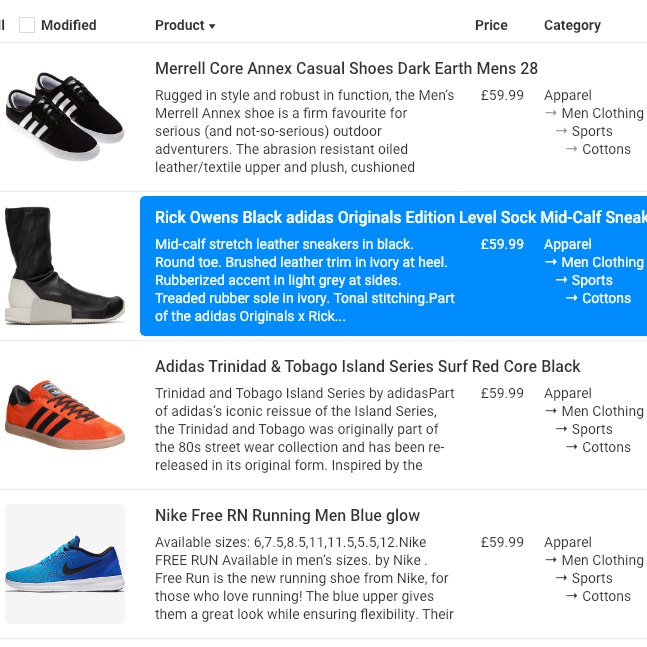
Moonbow, a product initiative the founder says was bootstrapped inside ZakApps, applies the same instinct to a different retail nuisance. It generates, edits and checks product feeds for Google Merchant Center, with support advertised for Magento, Shopify, BigCommerce and WooCommerce. Its promise is less romantic than “reinventing commerce” and more useful: help the advertising platform receive a compliant, optimized description of what the shop actually sells.
The 80,000-user clue
ZakApps’ most revealing consumer project was a native iOS and Android app for a leading UK-and-Ireland retailer whose name it does not publish. Children and parents could browse products in portrait or landscape mode. Parents could create separate wish lists for different children, represented by avatars, while the retailer’s sales team controlled the sequence of products in a customized menu. The app was designed as a plug-in to the existing commerce system rather than a replacement for it.
The company reports more than 80,000 active users in the first year and says at least one-third returned to use it as a product catalogue. Those are company-reported figures, but they offer a useful design lesson. The app did not win merely by shrinking a website. It gave a household a new organizing object - a child-specific wish list - while leaving merchandising control with the retailer. The feature and the integration served different users at once.
What can another operator copy? Start with a job that already happens badly. Give the person doing it one view instead of five. Keep the underlying systems of record when replacing them would create more risk than value. Add a consumer feature only when it changes a real behavior. And plan support for peak traffic before the campaign goes live. None of this requires ZakApps; that is why it is a useful playbook.
Why headless - and why not always
In 2025, ZakApps announced a headless SAP Commerce solution after 16 months of development. “Headless” separates the shopping interface from the commerce engine beneath it. A retailer can redesign a web, app or kiosk experience and connect it through APIs without rebuilding checkout, catalogues and order logic every time. ZakApps emphasized search and discovery plus an API-first connection to SAP Commerce Cloud, with an eye toward later AI-driven features.
The attraction is speed at the customer-facing layer. The bill arrives elsewhere: more services to operate, more interfaces to test, and more ways for data to become inconsistent. A conventional storefront can be cheaper and easier for a smaller merchant with ordinary requirements. A digital vault is only sensible when the seller can secure keys, integrate suppliers and support recovery. Real-time inventory is only real when warehouses and carriers send trustworthy updates. Process mapping cannot rescue an organization unwilling to agree on the process.
A services company learning product habits
ZakApps does not publish pricing, contract values or detailed financial accounts. A third-party company record supplied with this profile estimates annual revenue at $15 million, but ZakApps itself does not disclose the figure. Public profiles call the company bootstrapped, and Sabu’s twelfth-anniversary note described Moonbow and another initiative, Fortuna, the same way. There is no announced venture round to explain the expansion.
The likely economic engine is familiar: consulting, implementation and custom development generate project fees; application support creates longer engagements; repeated knowledge becomes a product or accelerator. That hybrid can finance patient engineering without venture deadlines. It can also pull a team in two directions. Client work rewards customization and utilization. A product rewards standardization and investment before revenue. The companies that manage both are disciplined about which customer requests become reusable features.
Current vacancies make the direction legible. ZakApps has advertised for Java, Python, frontend, mobile, DevOps, SAP ABAP, project-management and digital-marketing roles. The Python description includes AI and large-language-model integration; the commerce announcement describes an architecture ready for AI. Yet the older expertise has not disappeared. SAP, APIs, testing, databases and release discipline still dominate. AI is being added to an enterprise stack, not substituted for one.
People first, with office chairs
Sabu says an “Employee First” philosophy learned at HCLTech shaped ZakApps from the beginning. Public evidence includes a Back to Work program for women with at least four years of prior experience and a career break of two years or more, plus education support through Aram Foundation, student-project judging and a “ZA Connect” beach gathering. Glassdoor showed a 4.7 rating from 42 anonymous reviews during this research - encouraging, though self-selected and changeable.
There is a revealing condition in the returnship and several technical roles: work from the Chennai office on all working days. That can support mentoring and the close coordination enterprise delivery demands. It also narrows who can participate, particularly caregivers for whom a returnship might otherwise be valuable. “People first” is not a solved state; it is a claim tested in policies, schedules and commutes.
After twelve years, ZakApps sits between the giant consultancies and narrower software vendors. It cannot match Accenture, TCS or Capgemini for global scale. A ready-made SaaS tool will beat it on price and deployment time when the workflow is standard. Its opening is the uncomfortable middle: a retailer has important old systems, a new customer expectation, several external partners and no appetite for a multiyear reinvention.
That is why the 3 a.m. photograph lingers. ZakApps’ pitch is ultimately not that software will abolish messy operations. It is that careful mapping, integration and support can make the mess quieter - quiet enough that the shopper never learns how many systems agreed to sell one thing.