Kamsoft Technologies has the kind of services page that makes a procurement manager reach for a fresh spreadsheet. Need a website? Yes. A mobile app? Also yes. A marketplace, a game, an augmented-reality experience, a blockchain build, a 3D character and the animation that introduces it? Keep scrolling. The privately held company, founded in 2018, has assembled a broad digital workshop around a simple commercial idea: many clients would rather explain the business once than brief a parade of vendors.
The corporate front door is in Palo Alto. The operating pulse is easier to see in Karachi, where Kamsoft lists an office on Shahrah-e-Faisal and regularly recruits developers, artists, editors and U.S.-market sales staff. Its website also lists London. That geography sketches the model: sell close to international demand, deliver with a large cross-functional team in Pakistan, and keep enough disciplines together to own the handoffs.
The propositionThe product is fewer meetings
Kamsoft describes itself with the familiar language of digital transformation, but the practical offer is less abstract. It designs interfaces, writes software, builds apps and ecommerce systems, produces animation and develops games and immersive experiences. This is project work, sold business to business. There is no public subscription grid and no neat $99-a-month box. A client arrives with a brief; Kamsoft scopes a team and a delivery plan.
That makes coordination the quiet product. A founder launching a consumer app may need a prototype, brand site, mobile build, API integrations, store assets and a launch video. Bought separately, those pieces create translation work. Every vendor boundary becomes a tiny customs office: files are inspected, context is declared, and something inevitably waits in the wrong format. Kamsoft's pitch is that developers, designers, animators and strategists can pass the work across a desk instead.
Kamsoft is not really selling eight services. It is selling one throat to call when the launch starts wobbling.
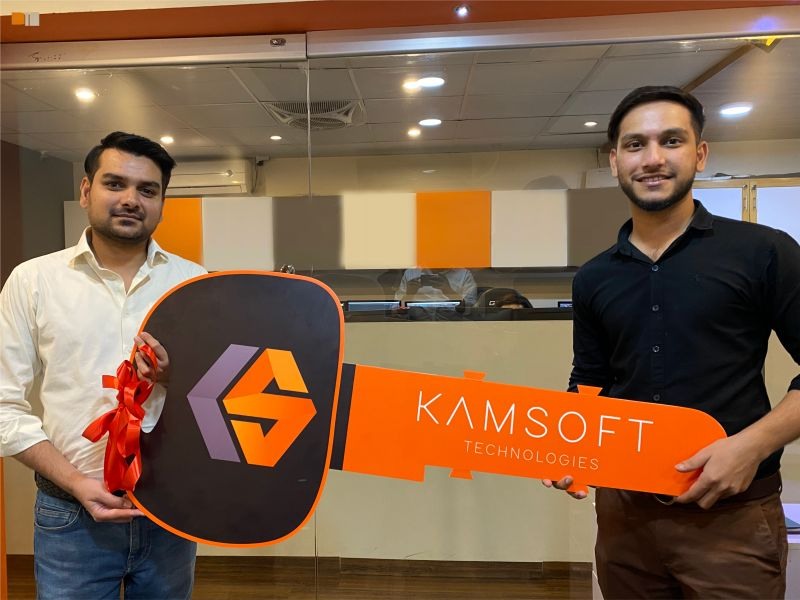
Proof in publicA marketplace reveals the machinery
The company's GlobalBuys case study offers its clearest public account of what the team actually did. The assignment was a global marketplace with personalized recommendations, transactions and real-time inventory. The stated audience covered consumers, sellers and the client's internal operators. Kamsoft says it used cloud architecture for scaling and load balancing, built search and recommendation functions with machine learning and data analysis, and created a modular framework for payment, shipping and other third-party services.
More interesting than the claimed outcome is the problem list. Traffic growth strains performance. Millions of products make cataloging and relevance difficult. Payment gateways and shipping carriers turn a clean diagram into a nest of dependencies. These are not exotic failures. They are the ordinary places where a marketplace first starts sweating. Kamsoft's response was to separate the system into pieces that could scale and integrate without forcing every change through the whole stack.
Another visible artifact is Ask It World, an Android social app published under Kamsoft Technologies, Inc. It combines communities, posts, voting, anonymous conversation, badges and a token-backed shop. The listing showed more than 100 downloads and an October 2025 update for tablet responsiveness and stability. It is modest consumer traction, not evidence of a breakout network. It is still useful proof that Kamsoft has put a product into a public app store, maintained it and dealt with the unglamorous work after launch.
Where it bendsBreadth is a feature until it becomes a fog
The full-service model has an obvious weakness: a long menu is easier to print than a deep bench is to maintain. Game physics, enterprise integrations and character rigging are not interchangeable crafts. Buyers should not mistake category coverage for equal depth in every category. The useful diligence questions are concrete: Who is assigned? What comparable thing shipped? Which work is in-house? What happens when an integration changes? How will acceptance be measured?
Cost is therefore a scope question, not a menu question. Kamsoft does not publish standard commercial terms. For a buyer, the number that matters is total ownership: discovery, build, third-party licenses, cloud use, content, maintenance and change requests. A low initial proposal can become expensive if the catalog is still changing or nobody owns data migration. A higher integrated proposal can be cheaper if it eliminates duplicate management and rework. The only honest comparison uses the same deliverables, service levels and post-launch period.
This also explains what fails first. It is rarely the shiny home screen. It is the connective tissue - a search index fed by messy product data, a payment callback that behaves differently in production, an animation pipeline waiting for a final character model, or a mobile release blocked by a privacy requirement. Kamsoft's breadth helps when those dependencies cross its own teams. It helps much less when the bottleneck is a client's unavailable data, indecisive ownership or a regulated system controlled by somebody else.
The operating cultureNight shifts, padel and an AI edit suite
Kamsoft's social feed is unusually revealing about the factory floor. Job posts place U.S.-market sales work into Karachi evenings and advertise performance bonuses, paid leave, medical support, a provident fund and interest-free employee loans for some positions. Between the recruitment notices are team dinners, padel sessions, office games and Independence Day celebrations. Employees become “Kamsoftians.” The tone is less Silicon Valley monastery, more busy production house with a camera always nearby.
One 2026 role catches the industry turning in real time. Kamsoft sought an editor who could handle Premiere Pro and After Effects alongside generative imagery, AI video, voice cloning, lip-sync and continuity repair. That hybrid brief says more than a generic AI services badge. Generative tools have entered the edit suite, but they have not removed craft; they have created new cleanup work. The human still has to notice when a face drifts, a voice lands oddly or a shot refuses to match the one before it.
Founder and CEO Kamal Hasan sits across Kamsoft and the related animation business Prolific Studio, giving the software company a visible connection to creative production. Chief Marketing Officer Bilal Hasan and Chief Operating Officer Adeel Hasan round out the leadership group listed publicly. In 2025, Kamal was nominated for a Pakistan Entrepreneur Award; in 2026, CxO Global Forum recognized him for entrepreneurship in 2D and 3D animation. Those honors reinforce the creative side of Kamsoft's identity more than its enterprise-software side.
What another service business can copy
- Bundle adjacencies, not random skills. UI/UX belongs beside software; animation belongs beside games and launch content.
- Sell the removed handoff. “One team” is valuable only when it deletes waiting, translation or duplicate management.
- Show failure modes. A useful case study names traffic, catalogs and integrations, not merely a happy ending.
- Make the delivery floor visible. People, rituals and real job briefs reveal more than a wall of technology logos.
The buyer's decisionWhen one vendor beats eight - and when it does not
Kamsoft fits best between a freelancer marketplace and a large transformation consultancy. It offers more disciplines and management than a collection of contractors, while remaining oriented toward building tangible digital things. The alternatives are a specialist studio, an in-house team, a large systems integrator or a buyer-managed group of agencies. None wins automatically. The shape of the brief decides.
Strong fit
- A launch spanning product, web and media
- An SMB without a full in-house delivery team
- A marketplace with design and integration needs
- A project where fewer handoffs matter
Weak fit
- A narrow, deeply regulated core system
- A buyer seeking an off-the-shelf SaaS product
- Work requiring constant local, on-site access
- A brief with no owner or stable acceptance test
The detail most likely to change a skeptical buyer's mind is not another capability claim. It is a matched reference: the same industry, similar integrations, a named delivery lead and a result that can be checked. Kamsoft has enough public work to begin that conversation. The buyer should make it specific before signing. Ask for the team, the architecture, the boundaries and the definition of done.
That is the sensible reading of Kamsoft Technologies. It is neither a mysterious AI company nor simply a web shop with extra navigation tabs. It is a cross-border services business trying to turn breadth into convenience. When the work genuinely crosses disciplines, that can be a sharp advantage. When the brief requires one rare specialty at exceptional depth, eight vendors may be annoying - but the right one can still be worth the meetings.