The shopping list is an oddly ambitious place to build a technology company. Milk belongs on it. So does cat food. Dinner may start as ingredients and end as a restaurant order. Migros One is trying to catch those changes of plan inside a single app, with a supermarket business waiting behind the screen.
By June 2026, the Turkish platform had 6.6 million active users, according to Migros’s August results. Its proposition is easy to grasp: buy the household groceries, order a meal, browse personal-care products or replenish the pet cupboard without beginning a new relationship with another retailer. The difficult part starts after the customer taps the button.
Migros One manages the Turkish Migros group’s online channels. Its advantages include a familiar retail name, existing shopping habits and access to stores that can help fulfil digital orders. Its challenge is to make those pieces work together well enough that convenience survives the journey from phone to front door.
Active users reported by Migros. A dated platform measure, not app downloads.
A young company with an older shopping basket
The corporate structure arrived in 2021, when Migros established Dijital Platform Gıda Hizmetleri A.Ş., known as Migros One. The underlying grocery experience went back much further: Sanal Market began in 1997. That history helps explain why this business looks different from a delivery company starting with an app and a recruitment campaign.
Orçun Onat brought experience across retail and telecommunications. He began his career at Migros in 1995, later held senior telecom roles and returned to the retailer in 2017. He took responsibility for e-commerce in 2019 and became Migros One’s CEO in 2021. His career joins two sides of this operation: managing customers at scale and getting physical goods sold.
Putting the channels together gave customers a common entrance. It also gave management a structure for expanding digital services. Migros Ticaret held 93 percent of the subsidiary at the end of 2025. This is a business built within an established retailer, with the advantages and coordination demands that arrangement brings.
The distinction matters when considering what another company could copy. An app can be commissioned. Years of purchasing relationships, customer familiarity and operational routines take longer to assemble. Migros One’s starting position included assets that a new entrant would have to finance, negotiate or build.
One app, several versions of “I’m hungry”
Sanal Market serves the supermarket shop. Hemen handles more immediate grocery needs. Yemek connects diners with restaurants. Macroonline brings Macrocenter’s range into the mix, while Tazedirekt concentrates on fresh food and its producers. Ekstra extends into non-food goods; Mion covers beauty and personal care. Petimo added another household errand in 2025.
For a customer, the useful distinction is the occasion. A planned weekly shop, an urgently missing ingredient and a hot dinner have different deadlines. Gathering them into one application reduces the need to switch services, but it does not make their fulfilment identical. An available restaurant meal and an available grocery delivery slot remain separate promises.
Planned grocery shopping
Rapid grocery needs
Restaurant orders
The practical starting point is an address. Customers can then see which services, products and delivery options are available locally. That is more useful than assuming a nationwide brand offers the same assortment or timing on every street. The final basket also gives shoppers a way to compare the total cost of convenience with collecting the goods themselves.
The business combines online retail with marketplace and delivery operations. A grocery sale and a restaurant order generate different economics: one involves selling merchandise, the other connects a diner, a restaurant and potentially a courier. Gross merchandise value measures commerce passing through the system; it should not be mistaken for the subsidiary’s recognised revenue.
Dinner joined through a familiar door
Migros Yemek began in Istanbul’s Ataşehir district in June 2022. It appeared as another tab in the existing app. The launch offered 30 lira off a first order and 20 lira off a second. Those were introductory offers at the time, a modest but concrete illustration of the spending required to encourage a new habit.
The initial delivery work belonged to restaurants. Migros announced that its own distribution capacity would subsequently provide another option. That sequence is instructive: start with the food businesses already able to prepare and move meals, then add the retailer’s delivery resources. The existing app supplied a place to find customers before the new service had earned a place in their routines.
Restaurant delivery is crowded territory. Yemeksepeti offers meals and groceries, while Uber Eats Trendyol Go also pursues those shopping occasions. Migros One’s distinctive argument is the connection to a supermarket relationship. That may make trial easier; it does not remove the need to compete on restaurant choice, service and the final bill.
There is also a production business behind some meals. Migros One Kitchen prepares food for multiple brands from shared kitchens. Its 2024 account described 38 kitchens and more than 200 new menu items developed that year. The arrangement lets several menus share a production location, although each order still depends on ingredients, preparation and a workable delivery journey.
The robots have groceries to collect
At Ankara’s Bilkent 5M operation, the technology is wonderfully literal. CarrGO robots move among grocery shelves, carrying baskets. Migros’s 2025 report describes 12 robots working across 1,500 square metres, with four orders collected simultaneously and hourly picking efficiency increasing by up to five times. Those are company-reported operating claims for this deployment, rather than a promise for every store.
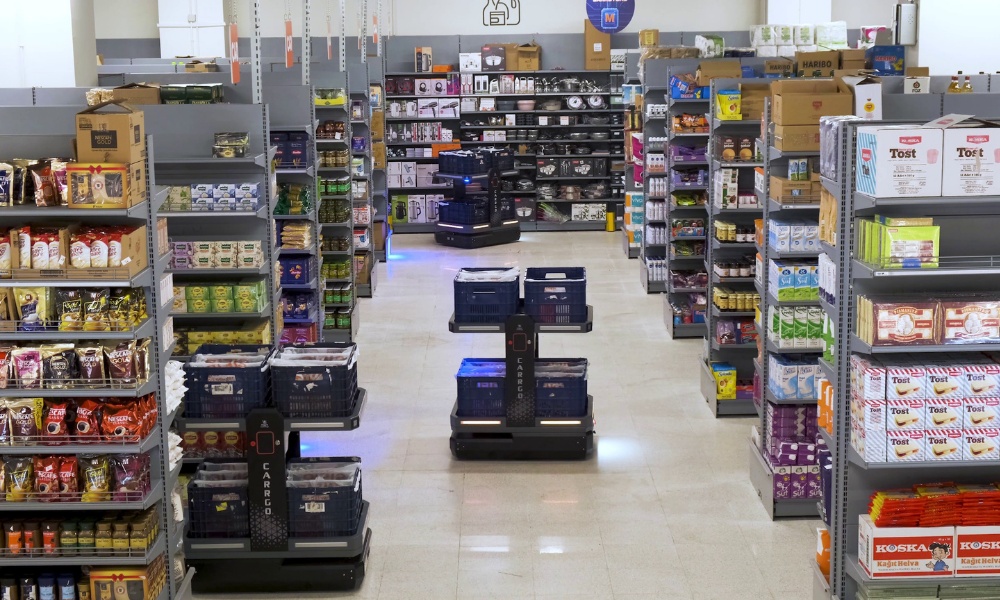
Miggra Teknoloji developed CarrGO. Its role illustrates a practical kind of partnership: a specialist builds the picking equipment, and a retailer supplies the setting where it must prove useful. The photograph is a reminder that retail automation happens among ordinary packets and shelves. The task is repetitive, but the combinations of products keep changing.
Migros also reports using TARO picking systems and shelf lights that guide employees to products. These approaches address a stubborn physical problem: the customer has assembled a digital basket, but someone must locate its contents. Seconds spent walking, searching and correcting mistakes accumulate across a large order book.
The lesson for operators is to measure the work between purchase and dispatch. Faster browsing will not compensate for a congested picking area. Automation makes economic sense when order volume, layout and utilisation justify it. A lightly used site could have an impressive robot and an unimpressive return.
Before the baskets, a software bottleneck
The engineering operation had its own friction. An AWS case study describes infrastructure upkeep and cumbersome deployment processes constraining a small team. It dates the inherited operation’s cloud project to 2018, before the Migros One subsidiary existed. The first workable cloud version took three to four weeks.
“We used automated testing and validation to reduce our 2-week deployment cycle for services to minutes.”
Mehmet Başal, head of DevOps, in an AWS case study
AWS reports a 20 percent cost reduction and 60 percent of operational resources freed for other work. These are vendor-published outcomes, not a price list for reproducing the system. The case describes a reason to change: too much engineering attention was going into running infrastructure.
That offers a more useful lesson than buying the same software. Identify the recurring work delaying a customer improvement, then check whether the replacement actually reduces it. Transferring an inefficient process to a new platform can simply give the old problem a new invoice.
Growth, with the labels left on
Migros One recorded 98 million online orders in 2025, a 17 percent annual increase. Its gross merchandise value rose 26 percent in real terms. The difference matters: order growth counts transactions, while real GMV growth describes the inflation-adjusted value of commerce. A bigger basket can change one without creating another order.
Different measures of growth. Bars share a scale; GMV is not revenue.
The August 2026 release reported 21 percent real GMV growth for Migros One in the first half. Its active audience reached 6.6 million in June, up from 5.8 million a year earlier. These figures show an expanding business, while leaving the everyday operational question intact: how efficiently can it serve the next basket?
Shopping assistance is another part of that effort. Migros has described personalised recommendations, smart search and ready baskets that reduce the work of assembling an order. The appeal is obvious for recurring purchases. A useful suggestion saves a customer a search; a poor one adds another item to ignore.
The company’s stated culture puts curiosity and customer impact alongside accountability and open communication. Its public posts describe cross-team coffee conversations and an internal AI ideas competition. These are glimpses of how management wants people to work. The customer sees the outcome in whether the app, picker and delivery operation agree about what was ordered.
Migros One’s next advantage will have to be earned in those small agreements. The customer wants the familiar brand to remember the usual purchases, make the options clear and get the order right. Owning more of the shopping list is attractive. Being trusted with the next one is the work.
Go shopping. Look behind the app.
Explore Migros shopping ↗Migros One on LinkedIn ↗Migros Türkiye on Instagram ↗Migros Türkiye on X ↗Company news ↗Read the cloud migration story ↗Watch Orçun Onat discuss Migros One ↗Watch Migros videos ↗