A shop can sell the same item twice without ever putting two customers in the same room. One buys at the till. Another sees yesterday’s inventory online. Both have behaved impeccably. Somewhere between the shelf and the server, the retailer has acquired a problem.
In one of Nextuple’s published cases, a large North American discount retailer’s central inventory system received store updates only once a day. The company already had the software. What it lacked was a sufficiently fresh account of reality. That is a useful place to begin with Nextuple, whose business is making the machinery behind a retail promise more responsive.
- Nextuple combines retail technology advice, systems integration, and custom engineering.
- Its OMS Studio lets companies modernize selected inventory, order, and fulfillment capabilities.
- Customers can choose packaged platforms, modular software, and arrangements that include source-code ownership.
A stock count with a short shelf life
The discount retailer’s problem had another wrinkle. Its systems described products at different levels: SKU, UPC, and a store-level sales variant. More frequent disagreement would still be disagreement. Nextuple connected handheld-device transactions to its inventory service through an API, translated identifiers, and added historical inventory auditing. Scans arrived near real time; sales and returns from the point-of-sale system arrived every 15 minutes.
The customer also bought the source code. It wanted a foundation its own development team could improve, without constructing the entire thing from scratch. The interesting innovation here is almost stubbornly practical: make the stock picture fresher, make the identifiers agree, and let people investigate what happened. Even a splendid forecast has trouble rescuing a count of something that has already left the building. Read the inventory case.
Fix the seam, keep the fabric
Nextuple serves retailers, grocers, wholesalers, distributors, and third-party logistics providers. Its work includes choosing platforms, connecting them, writing custom software, and supporting the resulting operation. The company sits where a commerce decision becomes an engineering project: inventory availability, order routing, fulfillment, and the integrations between them. Explore its services.
Its own Nextuple Order Management Studio, or NOMS, is a collection of modular software accelerators. The premise is that a retailer can improve a particular capability while other parts of its existing order management system continue working. A smaller replacement boundary offers a more specific question to answer: does this component solve this problem? See OMS Studio.
What is available, where can it come from, and when can it arrive?
Which steps should this order follow, and where is it getting stuck?
Who picks it, packs it, ships it, or hands it to the waiting customer?
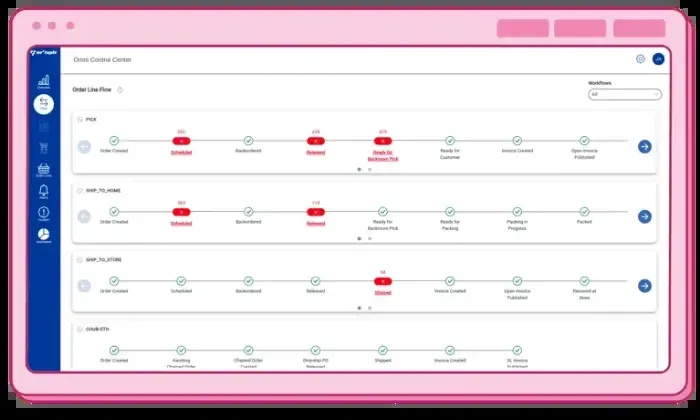
The Orchestration module handles flows such as store pickup and shipping from stores, alongside an order repository and a drop-ship gateway. Its OMNI Control Center watches order events and service commitments. The Fulfillment module reaches into the store itself: picking strategies, carrier cutoffs, box selection, customer check-in, and arrival dashboards. Those are the details behind the cheerful phrase “ready for pickup.”
Four months, and a carefully chosen verb
In December 2023, Nextuple announced that BJ’s Wholesale Club had selected OMS Studio to modernize enterprise inventory. A separate, anonymized wholesale-club case describes a customer frustrated by dependence on its SaaS vendor for changes, poor visibility, static safety-stock calculations, and time-consuming reconciliation. Its new Enterprise Inventory Service was deployed across the organization in less than four months. See the BJ’s announcement.
The case’s headline numbers deserve careful reading. The customer expected inventory-related cancellations to fall by more than 40% and conversion to improve by 10 basis points. Those were expectations. The deployment was the completed event. Ten basis points means 0.10 percentage points, a small-looking change that can matter when applied to a large volume of transactions. Explore the wholesale-club case.
Enterprise inventory service rollout, as reported in Nextuple’s wholesale-club case study.
For a buyer, this suggests a useful discipline: separate installation evidence from benefit estimates. Ask which changes reached production, what baseline was measured, and whether cancellations fell after the new rules started operating. A forecast should earn its place in a business case; a measured result should earn its own column.
The people who had seen this movie before
Darpan Seth and Laxman Mandayam had previously built Expicient, acquired by Publicis Groupe in 2015. Fellow founder Das Pattathil brought experience running Walmart’s online grocery and supply-chain technology. Nextuple’s 2018 financing announcement described a $1.5 million seed round aimed at machine-learning products and team expansion. The early pitch already concentrated on the post-purchase experience. Read the early announcement.
“What happens beyond the 'Buy' button is critical to delivering value and building brand retention.”
Darpan Seth / 2018

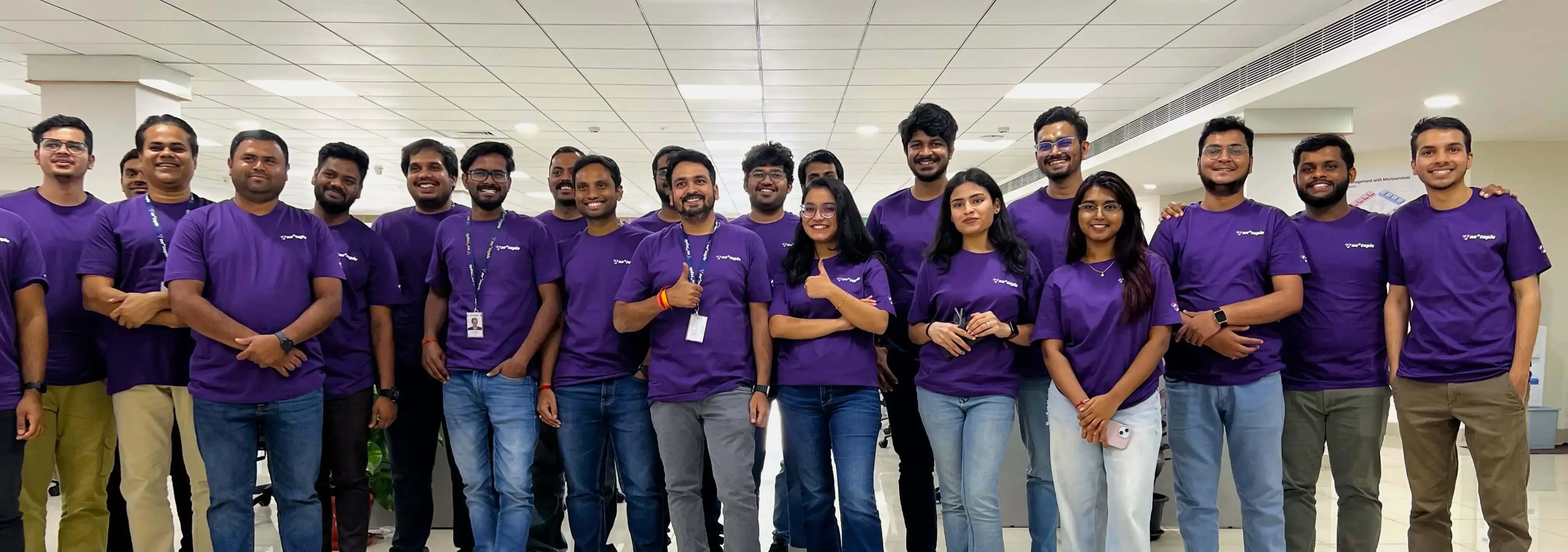
Today its leadership page lists Seth as CEO, Mandayam leading customer solutions, and co-founder Ramitha Meloor leading delivery and operations. The company’s stated values include expertise and empathy, with an emphasis on continued learning. Its careers page supplies a less abstract picture: engineers together at a hackathon, and recruitment for architecture and IBM Sterling roles. Meet the leadership.
There is evidence of a growing software business alongside the consultancy. Nextuple reported that product revenue more than doubled in 2023, while product-led implementation and engineering-services revenue grew 67%. It also reported five national retailer launches that year, representing customers with a combined $50 billion in annual revenue and 7,000 stores. Those figures describe the customers’ scale, not Nextuple’s sales. Read the growth announcement.
Owning the fix changes the bill
Nextuple’s commercial choices help explain its appeal. It offers licensed products, custom or co-developed solutions, managed deployment on a customer’s cloud, and source-code purchase options. Buyers can start with existing software and commission the differences their operation needs. Nextuple says its teams have experience extending and integrating IBM Sterling, Manhattan, and Blue Yonder systems. Explore the delivery options.
Ownership is a bargain with responsibilities attached. As an engineering inference, a retailer that takes control of source code must also arrange upgrades, security work, operations, and people who understand it. A purchase price is therefore only one part of the decision. Compare the full operating bill, the pace of change, and the skills needed to sustain the system. A small merchant with straightforward fulfillment may gain little from this level of customization.
Nextuple also operates inside established vendor ecosystems. IBM’s directory identifies it as a Gold Partner working with the Sterling Order and Fulfillment Suite. A retailer can hire it to make a packaged platform work, rather than commission proprietary components. The same technology can be a platform to extend, a platform to replace, or a partner’s product to implement. See the IBM partnership.
The next problem was upstream
By 2025, the inventory question had produced another company. Nextuple announced OnePint.ai in February, with Pattathil as CEO. The launch named enterprise clients including Dollar General, BJ’s, Tapestry, and Signet Jewelers, and described software intended to bring inventory planning and execution closer together. Read the launch news.
Pattathil’s account of the carve-out explains the change in thinking. The team repeatedly found that fulfillment performance was constrained by earlier choices about stocking, allocation, and replenishment. Planning and execution were too disconnected. OnePint.ai would address that earlier decision layer. The implication is simple: excellent routing has limited freedom when inventory is in the wrong place. Read Pattathil’s account.
Nextuple’s own AI work has a similarly concrete application. Its March 2024 predictive-promising announcement describes models for processing lead times and carrier transit times, plus simulation on historical orders before production. That sequence is worth copying: test the promise against what has actually happened before inviting customers to depend on it. Explore predictive promising.
A sandbox, a partner, and a decision
In March 2026, Nextuple became an authorized KIBO reseller and introduced KIBO Kickstart, a guided sandbox evaluation. Its deliverables include a total-cost analysis, implementation outline, enterprise architecture diagram, and ROI business case. This is a more inspectable proposition than a polished demonstration alone. It also gives buyers a commercial relationship to consider when weighing the company’s vendor-neutral advisory positioning. Explore the KIBO agreement.
Integration remains central. Nextuple’s April 2025 partnership with 910 Advisors combines order-management expertise with CRM, ERP, and middleware work. Its proposition is strongest where several capable systems still produce one awkward customer experience. Read about the partnership.
The useful lesson is to make modernization specific. Choose a failure customers feel. Establish how often it happens. Identify the event or decision responsible. Then compare a packaged fix, a modular extension, and an internal build on cost and operational effort. The shop that sells an absent item does not need a grand theory of digital transformation before it can act. It needs its systems to hear, in time, that the item has gone.