The curious object in Instacart’s business is a shopping cart. It has wheels, a basket, and the familiar proportions of something you would abandon beside a supermarket parking space. It also has cameras, a scale, and a screen. This is Caper Cart, and its existence poses a small puzzle. Why would a company famous for saving you a trip to the grocery store invest in making that trip better?
- Instacart sells households time, retailers technology, and brands access to shoppers.
- Its expansion follows the grocery trip: online, through the aisles, and past the deli counter.
- The limiting ingredient is trust. An abandoned pricing experiment made that visible.
The answer begins with the difference between delivering groceries and organizing grocery commerce. A delivery ends at a doorstep. Commerce includes the search, the substitution, the coupon, the advertisement, and the moment someone decides dinner is too much trouble. Instacart has gradually made businesses out of those surrounding moments.
The supermarket was already built
Founded in 2012 by Apoorva Mehta, Max Mullen, and Brandon Leonardo, Instacart started in the San Francisco Bay Area. Its central arrangement was economical in concept: connect customers to groceries in existing stores, with shoppers doing the selecting and delivery. The supermarket already had the inventory and the neighborhood presence. Instacart supplied another way to reach it.
That arrangement remains useful to busy households, people without easy transportation, and anyone who would prefer to spend Saturday somewhere other than the cereal aisle. Customers can order delivery or pickup from participating retailers. Shoppers handle the physical work; the app handles the coordination. A replacement for an unavailable item is where the tidy digital catalog meets the untidy shelf.
The retailer gets something different: access to customers and capabilities it might otherwise have to build. Instacart expanded into Canada in 2017, acquired Toronto ecommerce company Unata in 2018, and launched its broader retailer platform in 2022. The sequence matters. A service for people buying groceries became a supplier to people selling them.
The receipt has more than one payer
A customer sees a grocery bill. Instacart sees several commercial relationships. Consumers pay delivery and service fees; retailers pay transaction fees; members pay for Instacart+; brands buy advertising. Retailers can also subscribe to enterprise software. Those revenues depend on the same shopping activity, but they buy different things.
For a U.S. household, standard Instacart+ pricing is $99 a year or $9.99 a month. Eligible grocery and retail orders of $10 or more receive $0 delivery fees, with different minimums for Costco and restaurants. Service fees and other charges can remain. The practical move is to compare the final checkout total, including any retailer markup, with the time and travel an order saves.
Revenue is Instacart’s income from these activities. It is not the value of the groceries sold.
In 2025, transaction revenue was $2.677 billion. Advertising and other revenue contributed another $1.065 billion, substantially all of it advertising. A cereal brand is paying to reach someone close to choosing breakfast. That proximity helps explain why a grocery app can support an advertising business.
The scale continued into 2026: second-quarter orders reached 90.3 million and revenue reached $1.043 billion. GAAP net income was $111 million. These are company-wide results, not proof that every new product works. They do show that the business has moved beyond a pitch about future delivery demand.
A computer with four wheels
Instacart acquired Caper AI in 2021 for approximately $350 million in cash and shares. The cart recognizes products using cameras and sensors, weighs produce, and keeps a running total. Loyalty integration puts coupons and deals on its screen. Checkout becomes part of the shopping trip instead of a separate queue at the end.
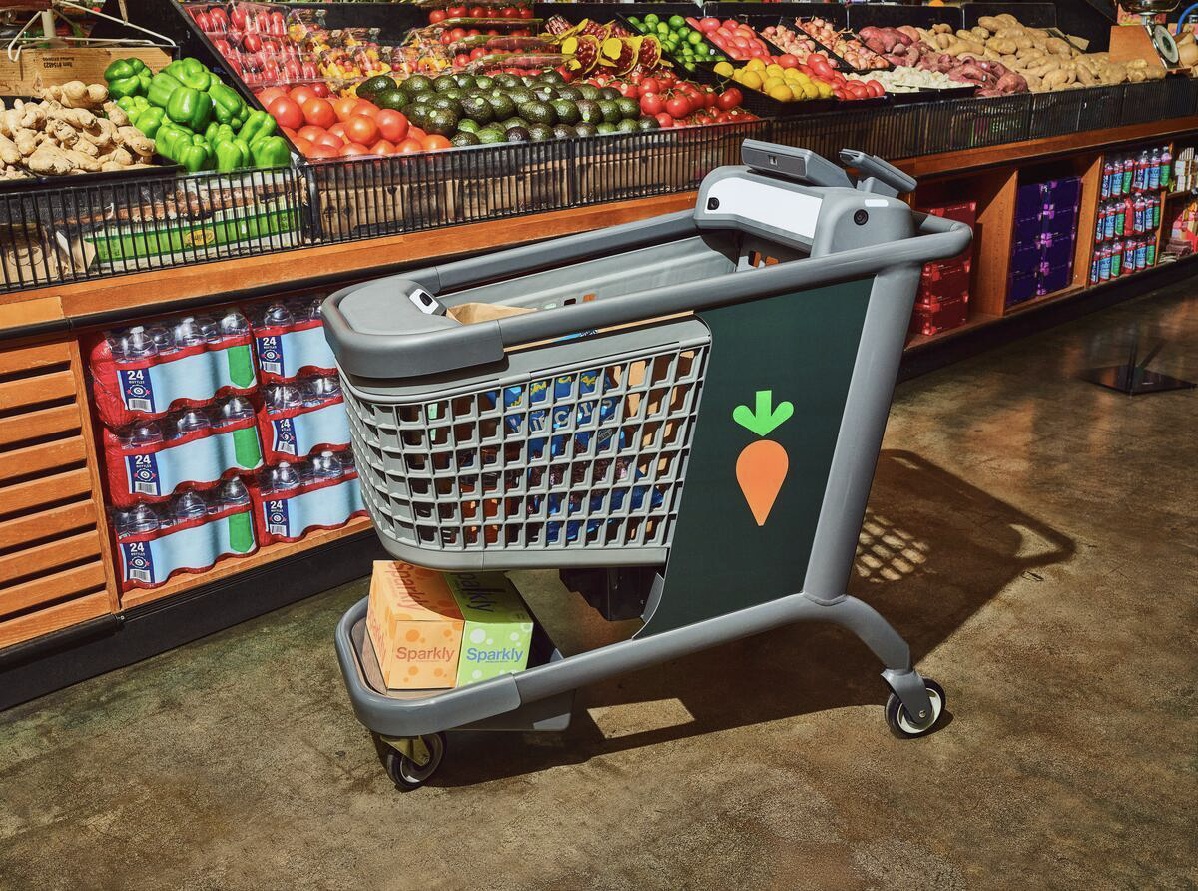
The acquisition also widened Instacart’s claim on a retailer’s technology budget. Storefront tools support a grocer’s own online presence. FoodStorm manages prepared-food and catering orders. On October 20, 2026, Big Y announced FoodStorm kiosks and online ordering for customized meals and catering. The supermarket’s deli counter now belongs in the same conversation as its delivery app.
Making this work requires less glamorous expertise than the phrase “AI shopping” suggests. Caper’s own team descriptions include retail project management, customer success, store training, and operational readiness alongside engineering. Cameras need a deployment plan. Store employees need to know what happens when a customer needs help.

The experiment customers rejected
The same reach creates awkward choices. In December 2025, Consumer Reports and its research partners documented different prices for identical products offered to customers shopping the same stores. Instacart said the tests were randomized rather than based on personal characteristics. The technical distinction did not settle the customer’s concern: was this a fair price?
“Our customers have high expectations for Instacart.”
Instacart / December 22, 2025
On December 22, the company ended all item-price tests on its platform, citing customer feedback and acknowledging that the tests had fallen short of expectations. Retailers could still set store-specific prices and apply markups; promotions continued. The reversal was narrower than a promise that every online price would match the shelf.
The failure here was confidence in the price. The useful lesson for another operator is concrete: measure whether customers understand an experiment, alongside whether it increases sales. A system can perform its assigned task while making the service harder to trust.
Dinner is now a prompt
September 2026 brought Clementine, an AI assistant available to most U.S. and Canadian Instacart customers. A conversation, recipe, or grocery list can become a cart. The interface starts earlier in the evening: with the problem of deciding what to cook.
Instacart competes with Walmart, Amazon, DoorDash, Uber Eats, and retailers’ own services. Its distinction is the combination of a consumer marketplace and technology sold to grocers. Even those boundaries overlap: Uber Eats also powers restaurant delivery inside Instacart.
What can another business copy? Start with assets customers already use, then solve adjacent problems for the same partners. The approach needs reliable inventory data, enough nearby demand, capable store teams, and fees customers will tolerate. Weakness in any of those makes the elegant software less useful. A cart can recognize the groceries. Someone still has to make the trip worth taking.