A grocery basket is a surprisingly crowded place. The customer wants the right tomatoes. The retailer wants the sale. The brand wants its label noticed. The shopper wants an order worth accepting. Somewhere in this small assembly of competing wishes sits Chris Rogers, the Toronto-based chief executive of Instacart, trying to keep everybody at the table.
Rogers became CEO on August 15, 2025, after six years inside the company. He arrived at the top through its commercial operation, where the essential work was persuading other businesses to participate. Before he was responsible for the whole enterprise, he was responsible for many of the relationships that made it possible. His promotion made a particular kind of sense: the person who had been working across the table from grocers would now speak for the company.
The intriguing part is how little of this resembles the familiar technology origin story. There is no garage required to explain Rogers's ascent. His route runs through Procter & Gamble, Apple and the patient business of distribution. Instacart's next act puts that experience under a bright light. A clever app can make ordering easier. Getting a supermarket to change its economics takes a different conversation. So does persuading a customer to come back next week.
An Apple education, with grocery roots
Rogers earned a Bachelor of Business Administration at Wilfrid Laurier University. He began his career at Procter & Gamble in account management, working with major Canadian grocery retailers. That early experience placed him on the supplier side of the relationship: a company with products to sell, negotiating with companies that controlled the shelves. It was an introduction to the space between what a brand wants and what a retailer will agree to do.
He moved to Apple in 2008 and stayed until 2019. His responsibilities included Canada's consumer retail business and carrier channel, followed by the managing director role for Apple Canada in 2018. These were jobs concerned with how products reached people, through retailers and telecommunications partners as well as through Apple's own commercial plans. The devices were different from groceries. The need to make a partnership work was familiar.
In July 2019 he joined Instacart as vice president of global retail. The sequence gives his career an unusually tidy shape: grocery suppliers, consumer technology, then a business connecting grocery stores to digital customers. It would be excessive to turn that sequence into a lifelong master plan. What it does show is a repeated responsibility. Rogers kept working where a product's promise had to survive contact with another company's priorities.
Three hundred signs above the door
When Rogers joined Instacart, its network included about 300 retail banners. By July 2022, when the company announced his elevation to chief business officer, that figure exceeded 800. A banner is a retail name, rather than an individual store. The distinction matters: this was a widening collection of businesses agreeing to work with Instacart, each with its own identity and commercial interests.
The chief business officer appointment brought retail and brand partnerships under his leadership. It put two sides of the shopping basket closer together inside the company. Retailers supplied the assortment and the store relationship. Brands supplied products and advertising budgets. Rogers's remit expanded across those connections, giving him a view of Instacart that extended beyond the order button.
In a 2023 BRAVE COMMERCE conversation with Rachel Tipograph and Sarah Hofstetter, he discussed the importance of aligning Instacart's interests with those of its retail partners. The company could provide technology for a retailer's own website as well as orders through its marketplace. For a grocer, that distinction carries weight. Investing in online shopping need not require handing every part of the customer relationship to somebody else's storefront.
This is where Rogers's background becomes useful to understanding his job. Partnership sounds agreeable until there is money, data and a customer involved. Then it becomes a negotiation over who benefits and who retains control. His work has repeatedly occupied that junction. The growing banner count was one visible result; the less visible work was making participation seem worthwhile to each additional partner.
A shopping cart develops other interests
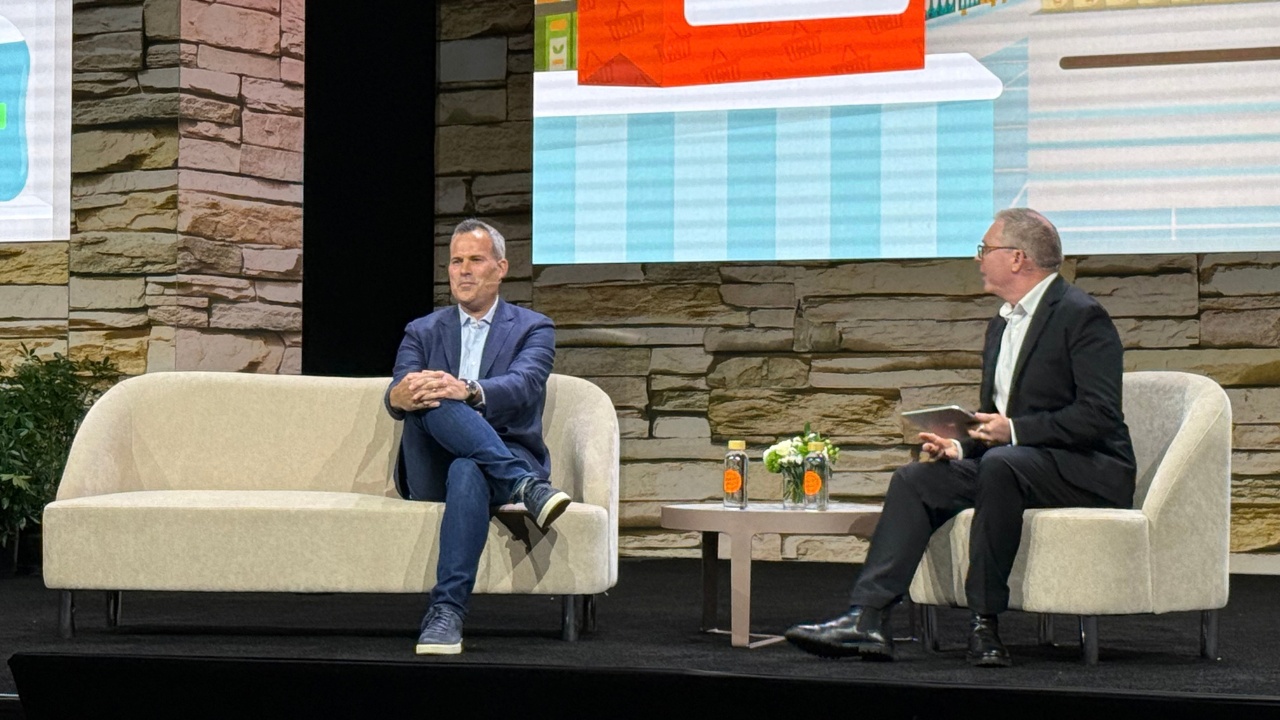
By 2024, the scope of those conversations had widened. Instacart was adding restaurant delivery through Uber Eats, expanding relationships beyond grocery and making recipes and video advertising shoppable. Rogers discussed the changes alongside chief marketing officer Laura Jones. A customer could encounter an ingredient in a recipe or a product in a video, then move it toward a purchase without starting an entirely separate search.
Inside physical stores, Caper Carts offered another point of contact. The smart carts brought screens and computer vision into the aisle, alongside opportunities for advertising. Rogers's interest included knowing what was in a basket while the shopping was still happening. A recommendation could arrive before the customer reached the checkout, when there was still time to act on it.
One detail from that discussion is wonderfully resistant to corporate solemnity. Instacart's shopping data showed dog food buyers were 1.4 times more likely to buy doughnuts. The correlation says nothing about whose breakfast was intended for whom. It does explain why a basket interests an advertiser: combinations can reveal opportunities that a product catalogue alone would never suggest. Even an ordinary shopping trip has its small mysteries.
The promotion came with a character reference
When Fidji Simo introduced Rogers as her successor in May 2025, she emphasized his understanding of partners, his operating experience and his ability to bring teams along. Her employee letter also offered a less conventional qualification. Rogers, she wrote, had “the patience of a saint.” In a business requiring retailers, brands, customers and shoppers to cooperate, patience sounds rather practical.
Simo described seeing him in many meetings and credited his judgment and work ethic. Those are a colleague's assessments, rather than a licence to invent a private personality. Still, they make the selection more legible. Instacart chose someone already involved in its retail, advertising and enterprise efforts, with relationships built over years. The handover emphasized continuity in both strategy and personnel.
Rogers's own announcement promised continued attention to quality, selection, affordability and convenience, alongside tools for retailers and flexible earnings opportunities for shoppers. On November 24, 2025, he also became board chair, succeeding Simo after the transition. By then, the commercial executive who had spent years connecting the company's constituencies held both the chief executive and chairperson roles.
“The patience of a saint.”
Fidji Simo on Chris Rogers, May 2025
The price of asking people to trust you
Affordability quickly became central to Rogers's public argument. In September 2025 he called it “probably the biggest unlock to online grocery adoption.” He also said it was the leading reason customers left Instacart. That is a plain problem for a convenience business. The service may save somebody a trip, but every subsequent order invites another comparison between the time recovered and the money spent.
The question became sharper in December 2025, when item price experiments attracted criticism. On December 22, Instacart ended all item price tests on its platform, including those using Eversight technology. The company acknowledged that customers had questioned the prices they saw. It said the tests were randomized and did not use personal information to set prices. Its new commitment was that customers shopping the same items, at the same time, from the same store location would see the same item prices.
Scrutiny continued. In January 2026, New York's attorney general requested information about pricing practices and compliance with the state's algorithmic pricing disclosure law. That request was an inquiry, rather than a finding against Rogers. In July, Instacart published pricing principles that reiterated its commitments on item prices, personal information and transparency before checkout.
For Rogers, this episode makes the partnership model's difficulty concrete. Retailers generally set their item prices, while customers experience the transaction through Instacart. The responsibility felt by a household does not divide itself neatly along a commercial contract. If the total feels confusing, explaining the organizational chart will only get a company so far.
Time saved + a basket you trust + a price you understand
An editorial illustration of the trade-off behind repeat orders.Dinner still has to make sense
At Groceryshop in Las Vegas in September 2026, Rogers described an ambitious future for AI-assisted shopping. A household would explain what it needed for a meal, and software would help assemble a basket around its preferences and budget. His argument concerned the work before checkout: remembering what is at home, considering promotions and deciding what everyone will eat. Even before the first item is picked, buying dinner involves a fair amount of administration.
He paired that technological ambition with a much older sales argument. Retailers without online markups, he said, were growing about 10 percentage points faster on Instacart. That was his reported comparison, rather than a guarantee for any individual grocer. He urged retailers to consider the business they might lose by keeping markups, alongside the cost of removing them. The future of shopping, in this telling, requires a spreadsheet as well as an assistant.
The business had momentum behind the pitch. In its second-quarter 2026 prepared remarks, Instacart reported 14% year-over-year growth in gross transaction value and 14% revenue growth. Rogers described progress across the marketplace, enterprise technology and advertising. Those are company results under his leadership, built by an organization and its partners, rather than a personal scorecard.
His route to this point helps explain the assignment ahead. The Procter & Gamble account manager learned the retailer relationship. The Apple executive worked through channels. The Instacart commercial leader brought more partners into the system. As CEO, he must make those arrangements add up to something convincing for the person holding the grocery list. The technology can grow more elaborate. Dinner retains a charmingly stubborn deadline.
Instacart, Q2 2026, year over year. Company performance under Rogers’s leadership.