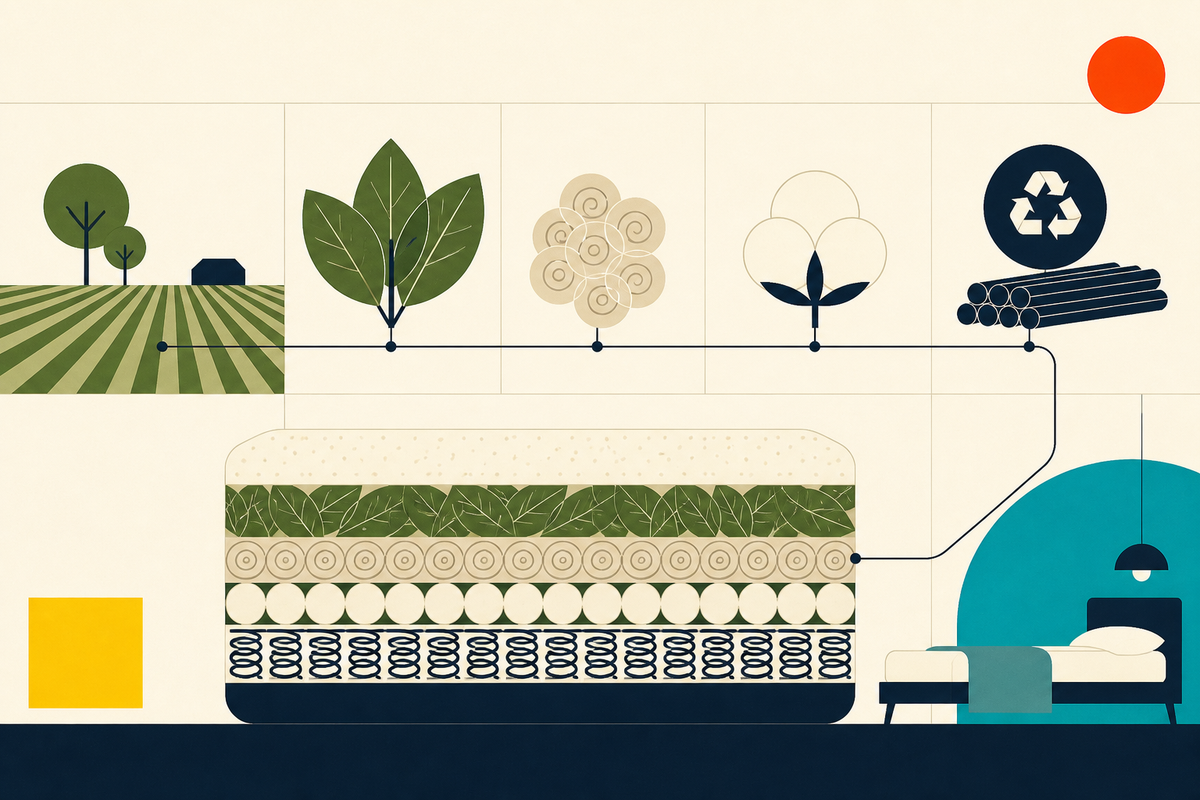
The modern mattress arrives in a box like an oversized piece of software: compressed, branded and sold with the promise that the difficult parts have disappeared. Avocado Green Brands chose the opposite trick. It made the difficult parts visible. Rubber trees in India and Guatemala. Wool from the Himalayan foothills. Cotton with certificates attached. Steel coils formed in-house. Bedmakers in Fullerton, California, pulling long needles through thick layers so the finished mattress can hold together without a fog of adhesives. In a category trained to sell comfort as a mystery, Avocado sells the itinerary.
The company began in 2016, when Mark Abrials, Jeff D'Andrea, Dan D'Andrea and Jay Decker looked at a crowded field of direct-to-consumer mattress startups and found a specific gap. Foam beds were plentiful; a mainstream mattress that was certified organic from the farm through the finished product was not. The founders financed the venture themselves. That decision spared them the familiar venture-capital timetable, but it also left them with an expensive question: how do you prove an organic claim when you do not control the hands, machines and paperwork behind it?
The factory was the strategy
Avocado's first mattresses were made by Brentwood Home, a California manufacturer whose factory history reaches back to 1987. In 2018, Avocado and Brentwood merged. Vy Nguyen, the second generation of the family behind the factory, became chief executive of Avocado Green Brands. The deal gave the young brand something most digital competitors lacked: direct control over the place where the promise became a product.
That control extends upstream. The company co-owns organic latex processing facilities and has invested in wool operations in India. Before rubber trees are old enough to tap, pineapple and coffee can grow around them. It is an oddly charming agricultural footnote, but also a useful picture of Avocado's operating model. A mattress starts years before the checkout button, and the empty spaces in a supply chain can be made productive.
The long route to the bedroom
This is vertical integration with an unusually domestic ending. Mattresses are handmade in Fullerton with domestic and imported materials. The company also directly operates an accessories and furniture facility in Tecate, Baja California, and a Los Angeles woodshop produces much of its furniture. Corporate offices and the original Experience Center are in Hoboken, New Jersey. The map is less tidy than a startup origin story, but considerably more useful.
“We built Avocado because we couldn't find a mattress that was truly certified organic and backed by real transparency.”Mark Abrials · Co-founder and chief marketing and sustainability officer
The product is proof
Many products borrow the halo of one attractive ingredient: a splash of aloe in a lotion, recycled thread in a shoe, organic cotton somewhere under a mattress cover. Avocado's sharper distinction is scope. Every mattress in its current lineup carries finished-product certification under the Global Organic Textile Standard, not merely certification for a component. The company layers that with five other finished-product checks covering restricted substances, ingredient disclosure, indoor-air emissions and formaldehyde.
No single badge can make the broad, unregulated word “non-toxic” magically precise. Avocado's system is more credible because the checks overlap and answer different questions. The result is not a perfect product, nor does the company claim its work is finished. It is a better set of receipts. For customers trying to distinguish organic from “natural,” that difference matters: one term comes with chain-of-custody rules and public license numbers; the other can be applied with much more freedom.
A ladder, not one luxury perch
The flagship Green Mattress established the formula: latex, wool, cotton and a pocketed-coil support system, hand-tufted rather than glued into place. Around it, Avocado built a price and preference ladder. The Eco Organic model addresses shoppers who want certification without the full flagship bill. Luxury and Grand Luxe models add deeper layers and softer finishes. Vegan models replace wool with organic cotton batting. A wool mattress serves buyers avoiding latex. Kids and crib lines bring the same material argument into rooms where chemical exposure receives special scrutiny.
Eco Organic lowers the entry point while retaining certified organic construction.
Green balances latex, wool, cotton and coils across multiple firmness options.
Deeper natural layers, alpaca and silk push comfort and price upward.
The assortment now reaches well beyond beds: pillows with adjustable latex and kapok fill, cotton and hemp sheets, protectors, duvets, robes, towels, bed frames, dressers, benches and tables. Some furniture uses reclaimed timber or scraps from the woodshop. Latex offcuts can become pillow fill. This turns waste reduction into both an operational project and a small product-development laboratory.
Customers are largely households willing to pay attention to what sits beneath the fitted sheet: families, people sensitive to odors or materials, sustainability-minded shoppers and buyers who prefer the buoyant, cooler feel of latex to the slow sink of memory foam. Comfort remains personal. The standard Green model is relatively firm, which can suit back and stomach sleepers better than some side sleepers. Softer pillow-top and box-top options exist because no certification can negotiate with a shoulder.
Direct-to-consumer grows doors
Avocado still uses the classic online mattress toolkit: ecommerce, financing, delivery, a sleep trial of up to a year and warranties of up to 25 years, depending on the product. It reports more than 45,000 verified reviews with a 4.6 average. Yet the business is becoming more physical. Its own Experience Centers let customers test firmness and inspect materials. A free video consultation brings some showroom guidance to a browser. Regional retail partnerships put selected products where shoppers already go to lie down in public under fluorescent lights.
In March 2026, a partnership with Sit 'n Sleep brought the brand to all 38 of that retailer's Southern California locations and pushed Avocado's reported reach beyond 600 retail doors. Partnerships in Pennsylvania, Ohio and Kansas followed. A planned New York City flagship, scheduled for fall 2026, is a 12,000-square-foot, five-story proposition with showrooms, a design center and an exhibit about mattress science. For a company born online, it is a large wager on touch.
Sell certified sleep and home goods through the web, owned stores and retail partners; use manufacturing control to defend quality, provenance and a range of price points.
The cost of saying “green”
Avocado operates where consumer wellness meets climate-conscious home goods. Its closest comparisons are natural-mattress companies such as Naturepedic, Birch, Savvy Rest and PlushBeds. Its broader competition includes Saatva, Casper, Purple, Tempur-Pedic and the legacy bedding groups. Against mass-market foam, Avocado is usually more expensive and heavier to move. Against smaller organic specialists, it offers a larger assortment, national stores and unusual supply-chain control.
The climate argument follows the materials. Petroleum-derived polyurethane foam is replaced with latex tapped from trees, while cotton and wool come through certified systems. Avocado measures Scope 1, 2 and 3 emissions from production through delivery. It reports a verified 48 percent reduction in absolute emissions since 2021 under Climate Label certification. Its 2025 impact report also says 92 percent of emissions sit in the value chain, making product design and sourcing more consequential than office recycling.
At the company level, B Lab gives Avocado Green Brands an impact score of 113.9, above the 80-point certification threshold. The company directs one percent of mattress revenue, not profit, to approved environmental nonprofits through 1% for the Planet. It reports more than $12 million in certified giving to over 60 partners since 2017. A return-donation network works on a more immediate waste problem: the company says 90 percent of returned mattresses and nearly all returned pillows go to nonprofit partners.
There is productive tension here. Shipping heavy products has a footprint. Global organic inputs travel. Plastic wrap still protects mattresses in transit while the company works on an alternative. Organic furniture and bedding remain expensive for many households. Avocado's strongest communication acknowledges the unfinished items rather than treating certification as absolution. Its reports describe sustainability as a practice with loose ends.
The moat is not “green.” It is the machinery required to make green claims specific, repeatable and difficult to copy.
What other builders can steal
Avocado offers a useful lesson for founders in crowded consumer categories. Differentiation does not always come from an invention. Sometimes it comes from accepting work rivals have chosen to outsource. Own the factory, and quality control becomes a product feature. Invest in traceability, and compliance becomes content. Design useful products from offcuts, and waste becomes an assortment. Publish the awkward parts, and transparency gains weight.
The strategy is not cheap or quick. It is also harder to imitate than a pastel website and a 100-night trial. Avocado's decade has been spent turning farms, factories, audits, stores and nonprofit logistics into one consumer promise: you should be able to know what you are sleeping on. The mattress is soft or firm according to taste. The operating system underneath it is deliberately rigid.