KITS sells the sort of thing people need but rarely enjoy buying: prescription eyewear. A contact lens is a regulated replenishment item. A pair of glasses is a fashion decision attached to a medical measurement. Insurance adds paperwork. Fit adds doubt. Delivery adds waiting. The Vancouver company has spent eight years treating each annoyance as a conversion problem, then pulling the solution inside one system.
The result looks simple from the checkout page. Choose contacts, upload a prescription, scan a face, try on a frame virtually, pick lenses, bill an insurer, and wait for the parcel. Underneath sits a more muscular operation: an acquired contact-lens platform, KITS-designed frames, a Vancouver optical lab, inventory, customer service, fulfillment software, insurance integrations, subscriptions, and a small but deliberate retail footprint.
That stack served 1.142 million two-year active customers by June 2026. In the second quarter, KITS reported C$58.4 million in revenue, up 17.8% from a year earlier. Repeat buyers supplied 65.5% of sales. Glasses were still only 18.9% of revenue, but grew 54%. There is the business in one sentence: contacts provide the rhythm; glasses provide the acceleration.

The company began with a purchase order
KITS was incorporated in 2018 by Roger Hardy, Joseph Thompson, and Sabrina Liak. Hardy already knew the category. He had built Coastal Contacts, the online eyewear business behind Coastal.com and Clearly, before Essilor bought it in 2014. Thompson brought large-scale retail experience from Amazon and brand training from Procter & Gamble. Liak brought finance and operating experience.
The founders spent about six months refining the plan and looking for a digital platform. Then they bought one. In April 2019, KITS acquired LD Vision Group for roughly C$42.7 million in cash and equity. LD Vision had been operating since 2002 and had shipped more than 8.7 million pairs of contact lenses. The transaction supplied customers, inventory relationships, software, and fulfillment history on day one.
That was the shortcut, but not a cheap one. Most founders cannot spend C$42.7 million to avoid a cold start. The copyable part is the sequence: acquire or partner for the boring, proven engine; preserve its recurring demand; then build the differentiated layer where the margin and brand can grow.

Free glasses, expensive lessons
In 2020 KITS added two growth engines: contact-lens Autoship and its own prescription glasses. It built a fulfillment facility and optical lab, then advertised an arresting offer - a first pair free for new glasses customers, subject to the offer's lens and price terms. The promotion made a difficult online purchase feel cheap enough to try. By June 2021, KITS had shipped 100,000 prescription pairs.
The IPO arrived in January 2021. KITS sold shares at C$8.50 and raised C$55 million in gross proceeds. Growth spending followed, but the income statement objected. The company lost C$14.6 million in 2021, compared with C$6.6 million in 2020, although both years included IPO-related items. Adjusted EBITDA fell from positive C$3.5 million in 2020 to negative C$8.7 million in 2021.
What failed first was not demand. It was the economics of chasing it. Management's later disclosures describe the change plainly: promotions were moderated to prioritize higher-margin orders, customer-acquisition and retention spending came down, and returning customers carried better margins. The net loss narrowed to C$4.6 million in 2022. By 2023, KITS produced C$2.3 million in adjusted EBITDA. By Q2 2026, it had logged fifteen consecutive adjusted-EBITDA-positive quarters.
Annual revenue · C$ millions
Reported revenue. Growth alone did not settle the story: adjusted EBITDA moved from negative C$1.8 million in 2022 to positive C$11.7 million in 2025.
The promotion was the invitation. Repeat behavior became the proof.KITS' operating turn, in one line
A retailer with an optical operating system
KITS now spans basic readers, sunglasses, designer frames, single-vision prescriptions, progressives, transitions, polarized lenses, blue-light options, and contacts from major manufacturers. It also sells its own daily silicone hydrogel and colored contacts. Customers can subscribe to contact-lens replenishment; by Q2 2026, Autoship represented a C$24.6 million annualized revenue stream.
The company's strongest distinction is the way these products connect. Contacts bring customers back on a schedule. Their accounts contain prescriptions and order histories. Glasses invite more personal expression and premium upgrades. In Q2 2026, 45.2% of glasses revenue came from premium lenses. The lab makes those orders quickly enough to support the promise made online.
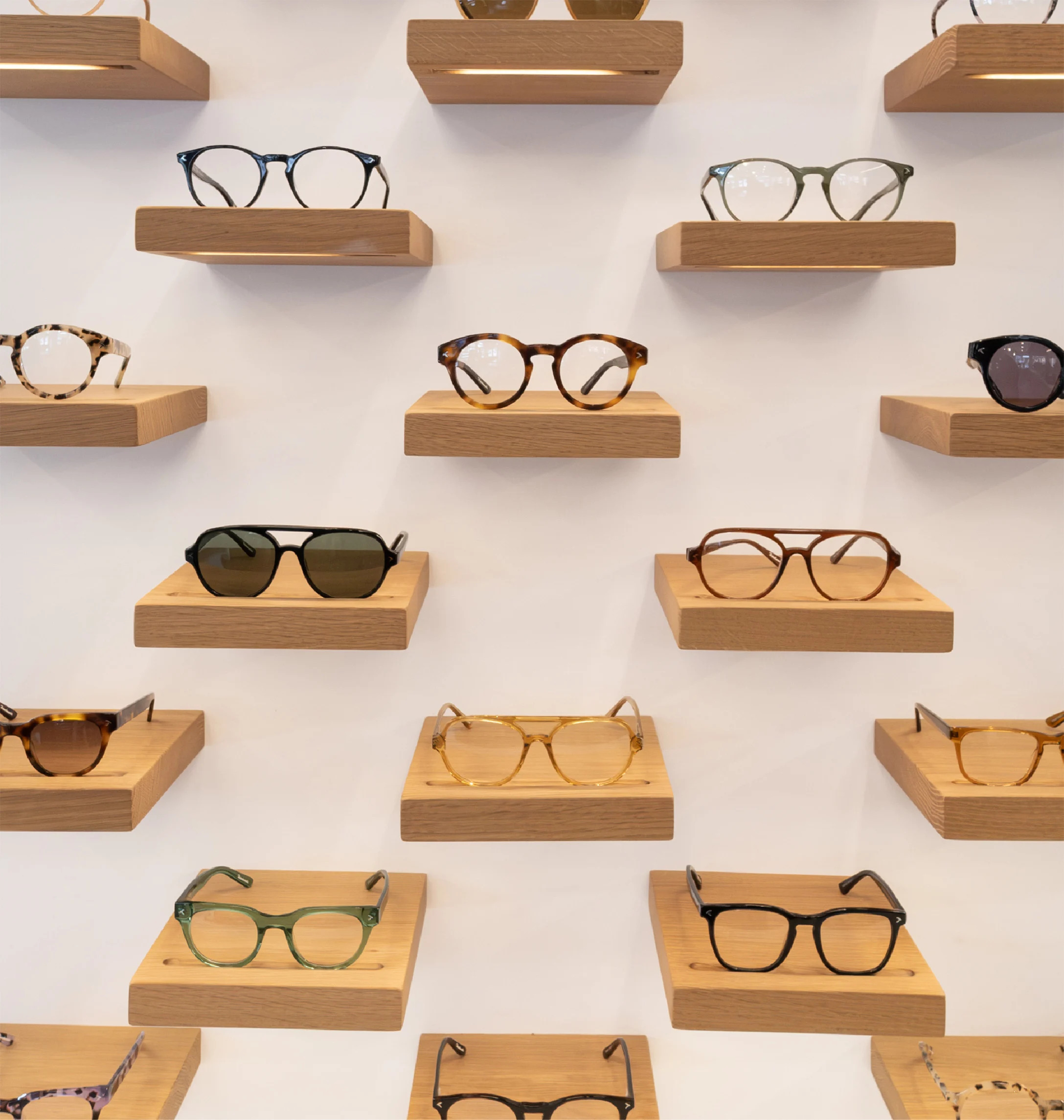
OpticianAI, launched in beta in July 2025, tries to shrink the remaining uncertainty. It combines a selfie fit scan, facial and pupillary-distance detection, prescription analysis, visual matching, voice interaction, and side-by-side virtual try-on. KITS says it was trained on more than one million customer interactions. The useful claim is not that software replaces an optician. It is that better guidance may prevent an overwhelmed shopper from abandoning a wall of thousands of frames.
Insurance is another unromantic feature with real leverage. A TELUS Health integration introduced direct billing across 38 insurers, which KITS said covered more than 70% of Canadians at launch. Instead of paying first and filing later, eligible customers can verify coverage during checkout. Medavie Blue Cross, Green Shield Canada, and Sun Life relationships extend the same strategy: turn administration into a product feature.
Why stores entered an online story
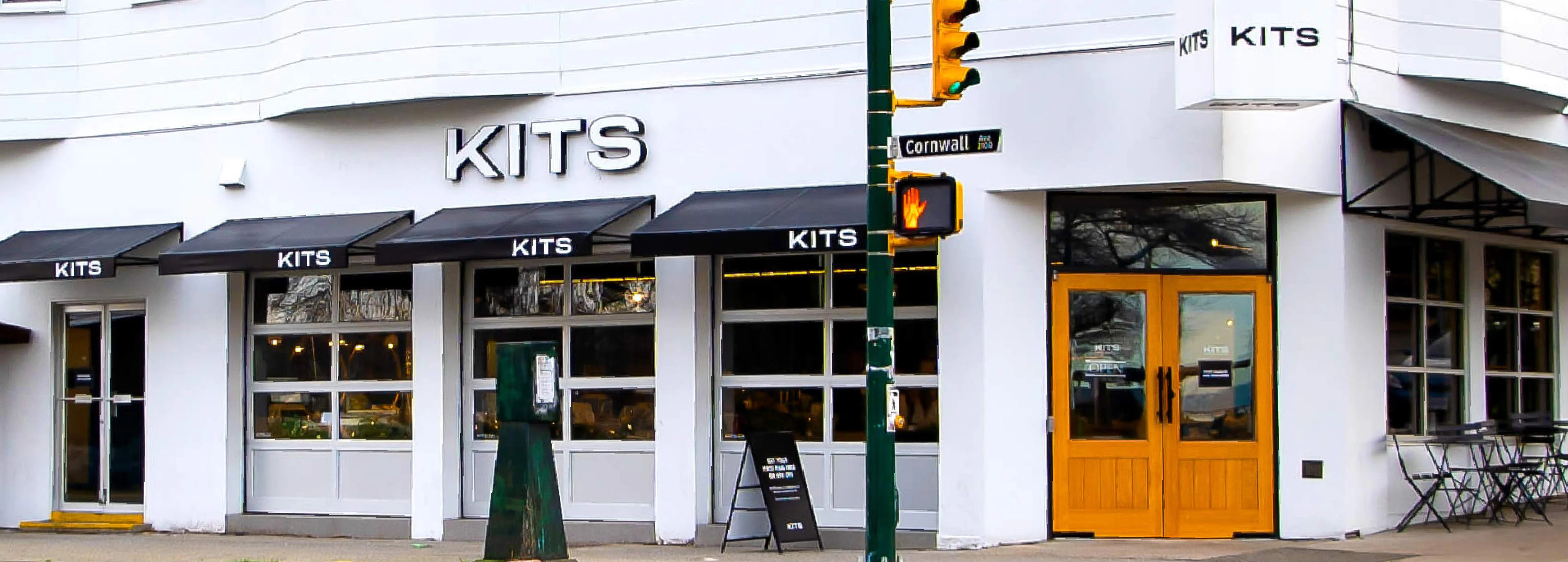
Pure ecommerce is efficient until a customer wants an eye exam, a frame adjustment, or the confidence of a mirror. KITS opened its Vancouver flagship in 2021, pairing optical retail with a cafe. By late 2025, the store had sold more than 23,000 pairs. About 35% of customers selected premium lenses, and the location was averaging 300 frames per week in the reported quarter-to-date period.
Those numbers changed the company's mind about physical retail. KITS announced a second flagship for Toronto's Queen Street West: more than 2,500 square feet, an onsite optometrist, online-order pickup, and same-day service on select prescriptions. This is not a retreat from digital. It is a showroom attached to the same inventory, data, and lab logic.
Pangolin smart glasses push the same logic into hardware. The first 2024 model bundled voice connectivity and prescription lenses. Gen-3 added cameras, photo and video, and visual AI features. Earlier generations sold out, according to KITS. Plenty of technology companies can put electronics in a frame; fewer can insert the customer's actual prescription and ship the finished object quickly. KITS' advantage is not the gadget alone. It is optical completion.
What to steal - and where it breaks
The five-part KITS playbook
- Begin with a frequent, necessary purchase that naturally brings customers back.
- Use an aggressive entry offer only when the next purchase and upgrade path are visible.
- Own the operational bottleneck that determines speed, quality, and customer trust.
- Remove uncertainty in sequence: fit, prescription, insurance, production, delivery.
- Add physical touchpoints only after the digital engine can supply demand and evidence.
The playbook works when the initial product recurs, the adjacent product has better economics, and the company can use shared data or infrastructure across both. It also requires enough gross profit to pay for service failures, returns, regulated processes, and customer acquisition. KITS had experienced founders, public capital, an acquired platform, and a real lab. Those conditions matter.
Likely to work
Repeat purchases, trustworthy customer data, adjacent high-margin products, measurable fulfillment advantages, and a credible reason to own production.
Likely to fail
One-off novelty purchases, promotions without retention, low switching costs, outsourced quality nobody controls, or infrastructure built before demand is proven.
There are obvious constraints. Clearly has the scale and brand portfolio of EssilorLuxottica behind it. Warby Parker, Zenni, EyeBuyDirect, 1-800 Contacts, optical chains, optometrists, Costco, and Walmart all attack different parts of the same wallet. Prescriptions are not T-shirts; a poor fit can produce headaches as well as a refund. Smart glasses add hardware support and privacy questions. Direct insurance arrangements can also create professional or regulatory friction, as public criticism of the Medavie Blue Cross relationship showed.
Still, the operating evidence has improved. KITS ended Q2 2026 with C$27.4 million in cash and no debt after generating C$7.8 million in quarterly operating cash flow. It also repurchased C$1 million of shares. The company is no longer funding every new experiment with faith alone.
KITS fits awkwardly and usefully between health care, ecommerce, manufacturing, fashion, and consumer technology. Its mission, “make eyecare easy,” sounds modest because it is. Ease is the product. Frames, lenses, subscriptions, insurance links, stores, and AI are the parts required to deliver it. The company works when customers barely notice the machinery. Investors and imitators should do the opposite: look directly at it.