The first trick John Fluevog learned in shoes was how to sell an old object as a new idea. In 1970, he and Peter Fox opened a shop in Vancouver's Gastown with inventory found in a Mexican warehouse: unworn footwear made decades earlier. Their ad called it “brand new 50 year old shoes.” The phrase was cheeky. It was also a blueprint. For the next half-century, Fluevog would raid Victorian straps, Edwardian boots, platform clogs, punk hardware and Space Age curves, then remix them until the result looked less like nostalgia than a friendly dare.
Today John Fluevog Shoes is an independent designer and retailer of premium footwear and accessories. Its shoes are designed in Vancouver, sold online and through boutiques in Canada, the United States and Europe, and aimed at people for whom “nice shoes” is an insultingly small ambition. A current assortment can run from roughly US$349 for a low shoe to US$799 for a towering statement pair. The company also sells bags, socks, insoles, laces and shoe care. The catalogue is broad; the point of view is narrow.
The useful part of nearly failing
The mythology can make this sound preordained. It was not. Fox and Fluevog split amicably in the early 1980s. John bought his partner out, then met a recession while trying to repay the obligation. By the middle of the decade, in his blunt account, “I ran out of money.” He was left with two Vancouver stores. One moved south to Seattle in 1986, a risky piece of geographic editing that put the business in front of a receptive American counterculture.
The rescue cost real money and identity. Fluevog has described securing a $100,000 bank loan to open two stores. More important, he changed the company name from Fox & Fluevog to John Fluevog. The move made a retailer read as a designer. A single human name told customers there was a single taste behind the merchandise. Seattle performed well. The company kept going.
“Suddenly there was one name, the Fluevog name, and therefore I became a designer.”John Fluevog, recalling the mid-1980s turn
A second squeeze arrived in the late 1990s, when expansion and the churn of fashion again tested the company. The lesson was not to smooth out the products. It was to hold a clearer center and grow with restraint. Fluevog told Forbes in 2019 that he had never taken outside investors and built the company “one step at a time.” This is slow capital paired with loud merchandise.
Behind that restraint is specialist knowledge that does not photograph as easily as a sculpted heel. The design team works in recurring “families,” each organized around a last, sole, heel or construction idea. A successful family can accept new colors and uppers, disappear, then return years later with its lineage intact. That lowers the creative cost of novelty: the company does not have to invent a new grammar every season. It can write a new sentence with familiar parts. Manufacturing has historically been distributed among specialist factories in countries including Portugal, Brazil, Peru, China and Vietnam. This is design expertise joined to sourcing and fit expertise, not a claim that every eccentric sketch can simply be sent to a factory and wished into existence.
The Fluevog flywheel - what another founder can copy
A shoe is the admission ticket
The customers include artists, performers, collectors, office dressers with a rebellious streak and people shopping for a wedding shoe nobody else will wear. Madonna, Beyoncé, Lady Gaga and Jack White have worn the brand, but celebrity is evidence, not the customer definition. The practical job is self-expression: a Fluevog makes a plain outfit intentional, supplies a conversation starter and helps a wearer find other people who enjoy the same visual volume.
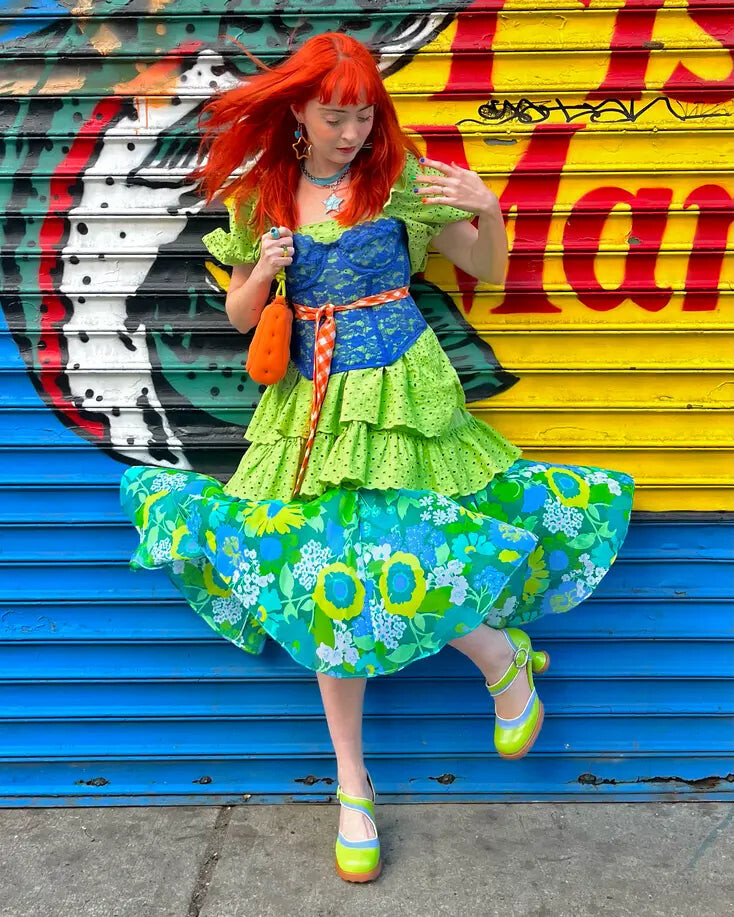
Fluevog does not leave that connection to chance. Customers are “Fluevogers.” Sales associates are “Fluevogologists.” The community is the “Flummunity.” Cute words alone would be unbearable; here they label actual behavior. Fans attend Flummunity Fest, join store knitting nights and poetry events, swap gifts, hunt discontinued styles and share outfits. At the 2025 festival, parties ran on the same night in Victoria, Denver, Brooklyn and Halifax. Some guests could even get permanent Fluevog-themed tattoos. Loyalty points feel emotionally underdressed beside a tattoo.
The stores matter because the product presents a practical obstacle: unusual shapes need interpretation. A trained salesperson can explain why one family fits differently from another, find the right size and give a hesitant shopper permission to try the louder color. That service turns a potential ecommerce return into a fitting-room story. It also makes each boutique a local media channel. A poetry night in Chicago, knitting in Seattle or an artist pop-up in Montréal draws people who may not have arrived intending to buy shoes. The store earns attention before asking for a transaction. For a premium retailer with a limited audience, that is more useful than paying to interrupt everyone.
In 2002, Open Source Footwear invited customers to submit shoe ideas, with selected concepts becoming products. In 2011, Fluemarket gave owners a dedicated place to sell, swap and search for old pairs. Relaunched with Treet in 2026, the marketplace added faster listings and requests for elusive styles. Resale does more than make a sustainability argument. It gives retired designs a visible price, turns the archive into a treasure map and reassures a buyer that a strange purchase has a second life.
Collaboration without costume
The company stays culturally current by borrowing other people's worlds without surrendering its own. Anna Sui has collaborated with Fluevog since the early 1990s; their Resort 2025 release revived a butterfly-appliqué boot from 1993 and added a Mary Jane. Third Man Records got a black, croc-embossed Jack boot with electric-yellow straps in 2025, sold in limited quantities for CAD$599 or US$499. Comedian Sarah Sherman drew her dream patchwork clog boot; Fluevog produced it and directed 15 percent of sales to Trans Lifeline.
These partnerships work because each side is already legible. Jack White's black-and-yellow world meets Fluevog's buckles. Sui's romantic maximalism meets the archive. Sarah Squirm's comic discomfort meets a wooden platform. A generic brand cannot create that chemical reaction. It can only borrow reach.
The same logic powers the company's $10,000 emerging artist grant, launched in 2017. The grant is open to visual artists in Canada and the United States and includes a pair of shoes plus exposure to the Fluevog audience. In 2026 it went to multidisciplinary artist Christy Kunitzky for sculptural work about labor, family history and failure. The expense is modest beside a national ad buy. The signal is sharper: artists are not decoration around the brand; they are the neighborhood.
The business hiding under the heel
For all the language and theater, the engine is recognizable. Fluevog sells premium-priced, designed goods directly through ecommerce and company-operated stores. Seasonal families create novelty. Returning silhouettes create familiarity. Limited runs and collaborations create urgency. Physical shops provide fitting help for unusual lasts, turn tourism into discovery and host the events that make the vocabulary real. Accessories increase basket size. Resale stretches the relationship between new releases.
The competitive set is split. Dr. Martens owns a broader uniform of subculture. Irregular Choice and United Nude also sell visual shock. Camper offers design credibility with more everyday restraint. Vintage marketplaces offer oddity for less money. Fluevog's defense is that a pair is recognizable as a Fluevog before a viewer can name the model. Product shape carries the logo's work.
That recognition also changes the economics of a small brand. A conventional brown boot competes on leather, comfort, price and distribution against companies with much larger budgets. A Fluevog competes first on whether the buyer wants that Fluevog. The addressable market gets smaller, but the comparison set gets shorter. Limited quantities then become credible rather than theatrical, because unusual materials and specialized constructions really are harder to repeat at scale. The company trades mass relevance for a higher density of intent.
Where this playbook breaks
Do not copy the whimsy if the product is forgettable, disposable or purchased mainly on utility. Community language feels forced without repeat customers and real gatherings. Scarcity irritates when fit is inconsistent or service is weak. Premium pricing also narrows the audience, while leather and international manufacturing complicate any broad environmental claim. Durability and resale are useful; they are not a free pass.
That is the condition behind the strategy: the object must earn attention before the community can compound it. Fluevog shoes are expensive, visually demanding and sometimes hard to style. Those are not hidden defects. They are the filter. A customer who wants an invisible black pump has better options. A customer who wants a purple heel shaped like punctuation has fewer.
The copyable lesson is therefore smaller than “be weird” and more operational than “build community.” Make a product identifiable at a glance. Give it recurring forms people can learn. Name the customers only after they start behaving like a group. Create rituals outside the checkout. Let old products circulate. Choose collaborators whose audiences understand the same joke. Protect the point of view long enough for yesterday's oddity to become tomorrow's archive.
Fluevog began by selling old shoes as new. It endured by making new shoes that people expect to grow old with. In fashion, where novelty expires on schedule, that may be the cleverest inversion in the shop.