Before Gibson was a lifestyle brand, a media producer or a destination retailer, it was one restless man in Kalamazoo trying to make a mandolin behave better. Orville Gibson carved tops and backs from solid wood, borrowing an idea from violin construction at a time when guitars were not yet the center of American popular music. His 1890s workshop supplied the useful origin story. The company incorporated in 1902 supplied the useful machine: skilled labor, repeatable production and a name that could outlive its inventor.
That machine now operates from Nashville, with major acoustic production in Bozeman, Montana, and a portfolio that runs from Epiphone starter instruments to five-figure Custom Shop recreations. Gibson sells electric and acoustic guitars, basses, mandolins, pickups, strings, cases and merchandise. It also owns MESA/Boogie amplification, KRK studio monitors, Kramer guitars and Maestro effects. Add two operating Gibson Garage stores, a third announced for Miami, plus a video channel, record label, publishing arm, app and editorial site, and the outline looks less like a factory than a compact music ecosystem.
The shape is the shelf space
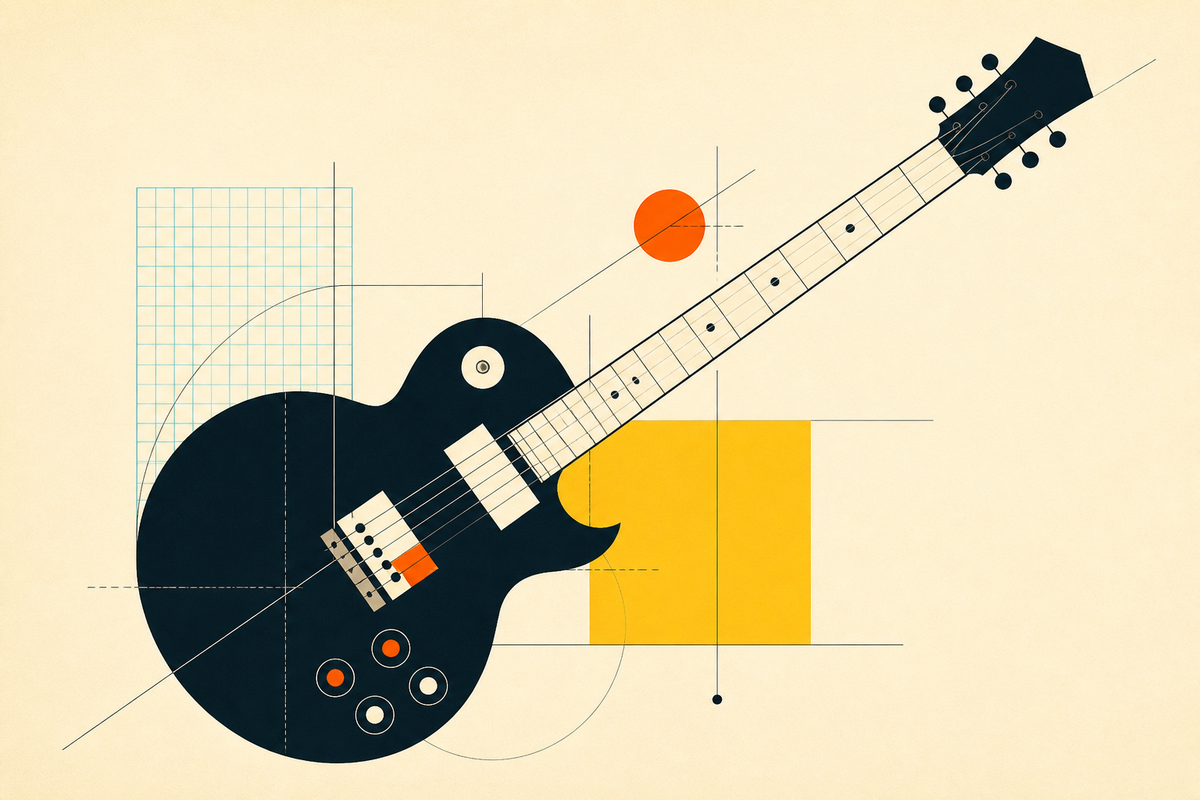
A Les Paul can be recognized before its finish, pickups or price tag become visible. The single cutaway, carved top and angled headstock do marketing work at stadium distance. So do the twin horns of the SG, the sloped shoulders of a J-45 and the waist of an ES-335. These are not merely model names. They are silhouettes with memories attached: records heard in adolescence, musicians watched from the cheap seats, the first serious instrument glimpsed behind a shop counter.
That recognition is Gibson's central advantage over technically capable rivals. Fender has its own formidable archive and emphasizes modular, bolt-on construction and many single-coil sounds. PRS competes on finish, precision and a more contemporary design language. Martin and Taylor are powerful acoustic alternatives. Thousands of smaller builders can offer exquisite craft. Gibson's distinction is not that nobody else can make a good guitar. It is that few companies can make a new object feel as though it has already appeared in your record collection.
The archive is not a room behind the factory. It is an active product-development system.Reissues, signature models and certified vintage all begin with memory
This creates a delicate constraint. Change too little and the company becomes a reissue house. Change too much and buyers complain that the object no longer carries the promise they came to buy. Gibson manages the tension through parallel collections. Original models preserve familiar specifications. Modern models add weight relief, switching options and ergonomic changes. Artist editions translate a working musician's preferences into a finite release. Murphy Lab instruments reproduce the lacquer checking, softened edges and hardware wear of an old guitar on a new one. Made to Measure lets a customer push further.
One dream, several price tags
Gibson's customers range from a teenager choosing a first Epiphone to a collector comparing the aging patterns on a Murphy Lab reissue. Between them sits the working musician who needs a reliable stage instrument, the hobbyist marking a promotion, the producer choosing KRK monitors and the touring guitarist buying a MESA/Boogie amplifier. The portfolio is broad, but the aspiration stays legible.
Epiphone is crucial here. It offers licensed access to the Les Paul, SG, ES and acoustic vocabulary at prices below American-made Gibson instruments. Kramer catches players drawn to high-output, hard-rock designs. Gibson USA occupies the premium center. The Custom Shop sells historical specificity, scarce finishes, artist associations and labor. Certified Vintage puts the company inside the resale conversation, where authenticated age and condition are the product.
The business makes money by selling instruments and adjacent gear through independent dealers, major retailers, its own ecommerce operation and Gibson Garage locations. The supplied company data estimates annual revenue at roughly $366.6 million and headcount around 2,800, although the privately held company does not publish audited results. What is observable is the architecture: wide distribution for reach, direct channels for margin and customer data, and premium limited products for scarcity.
This is also why an old Gibson can help sell a new one. In many durable-goods categories, the used market is a nuisance. Here it verifies the promise. A playable guitar from the 1950s demonstrates longevity, while auction prices turn craftsmanship into a visible store of cultural value. Gibson responds with accurate reissues, its own vintage certification and stories about original production. The secondary market becomes evidence, content and product roadmap.
The problem under the lacquer
At the simplest level, a Gibson solves physical problems for musicians. The adjustable truss rod, invented at the company in 1921, strengthened necks against string tension and made thinner profiles practical. The P-90 pickup gave electric players an assertive voice after World War II. The humbucker attacked the 60-cycle noise of single-coil pickups by pairing coils out of phase. Body shapes changed balance, fret access, projection and feedback behavior. These innovations disappeared into the instrument until the solution felt inevitable.
The emotional problem is harder to diagram. A player wants an instrument that responds, stays in tune, survives the road and records well. But a purchase can also be permission to inhabit a sound. Gibson offers a shortcut between the player and an enormous musical lineage. That shortcut is powerful, occasionally conservative and never free. A Gibson customer often pays for American labor, material selection and setup, but also for the right outline on the stage.
Playability, tuning stability, pickup response, acoustic projection, repairability and a tool sturdy enough for repeated use.
A recognizable form, artist lineage, finish language, resale market and the feeling of joining a continuing musical argument.
Culture as distribution
Signature models show the system in miniature. Gibson works with an artist on neck dimensions, pickups, hardware, finish and sometimes a peculiar piece of personal history. The artist receives a tool and an edition. Fans receive specifications with a story. Gibson receives product research, credible promotion and an image of the guitar being used rather than displayed. Recent collaborations have ranged from Warren Haynes and Jake Kiszka to Serj Tankian, while a Marc Jacobs project put custom Joy graphics on four Les Pauls. Music culture and fashion culture met on the same maple top.
Gibson TV and the Gibson Gazette extend that logic. Factory films explain how a burst finish is sprayed. Interviews turn builders and players into characters. Buying guides make the product catalog educational. Gibson Records, launched in 2021 with BMG and Slash as the first signing, puts the company closer to the music made with its tools. These operations may be modest next to instrument sales, but they reduce dependence on rented attention. A guitar maker becomes its own specialist media outlet.
The Garage is the physical version. Nashville opened in 2021 with more than 400 instruments, memorabilia and a stage. London followed in 2024 and reported more than 200,000 visitors and 70 performances during its first year. Miami is next. These spaces let a high-consideration purchase unfold slowly: hold the neck, hear the pickups, compare the burst, watch a performance, then buy. Calling it a store is accurate in the way that calling a guitar six strings and some wood is accurate.
“Gibson is committed to the fundamental need of putting people and music together.”Cesar Gueikian, chief executive
A company that already had a comeback
Heritage did not protect Gibson from a strategic wrong turn. After expanding deeply into consumer electronics, the company filed for Chapter 11 in 2018. It emerged under creditor ownership, with KKR-affiliated funds in control, and narrowed its attention back toward instruments. César Gueikian, a guitarist, collector and former financier, joined in late 2018 and now serves as chief executive. The reset has been framed around instruments, sound and media - close enough to reinforce one another.
The acquisition of MESA/Boogie in 2021 fits that test: guitar and amplification are adjacent parts of the same signal chain. So do KRK monitors and Maestro pedals. A sprawling electronics conglomerate asks the brand to travel too far. An ecosystem for making, shaping, recording and discussing guitar music keeps the center visible.
Kalamazoo beginningsOrville Gibson sells carved solid-wood instruments from his workshop.
The adjustable truss rodA hidden metal rod makes slimmer, more stable necks possible.
Les PaulGibson's first solidbody electric arrives at the dawn of rock and roll.
SGThe light double-cutaway form begins its life as a Les Paul successor.
ResetGibson exits Chapter 11 and returns its strategy toward instruments.
Miami GarageA third destination store takes the format to another music city.
Where Gibson sits now
Gibson occupies the premium, heritage-led end of a global musical-instrument market crowded with excellent alternatives and inexpensive copies. Its manufacturing expertise matters. Its artist network matters. Its dealer relationships and direct commerce matter. Yet the hardest asset to reproduce is accumulated association: thousands of stages, album sleeves and bedroom walls teaching people what this shape means.
The risk is that cultural shorthand can stiffen into cliché, or that limited editions can make players feel secondary to collectors. The opportunity is the reverse. Every beginner who enters through Epiphone, every visitor who handles a guitar at the Garage and every builder who finds a practical improvement can renew the archive. Gibson works when an old outline becomes a useful object again.
That is the compact lesson inside the large history. Durable brands do not preserve their past by freezing it. They build channels that let new customers touch it, products that let working people alter it and enough discipline to know which curves should remain exactly where they are.