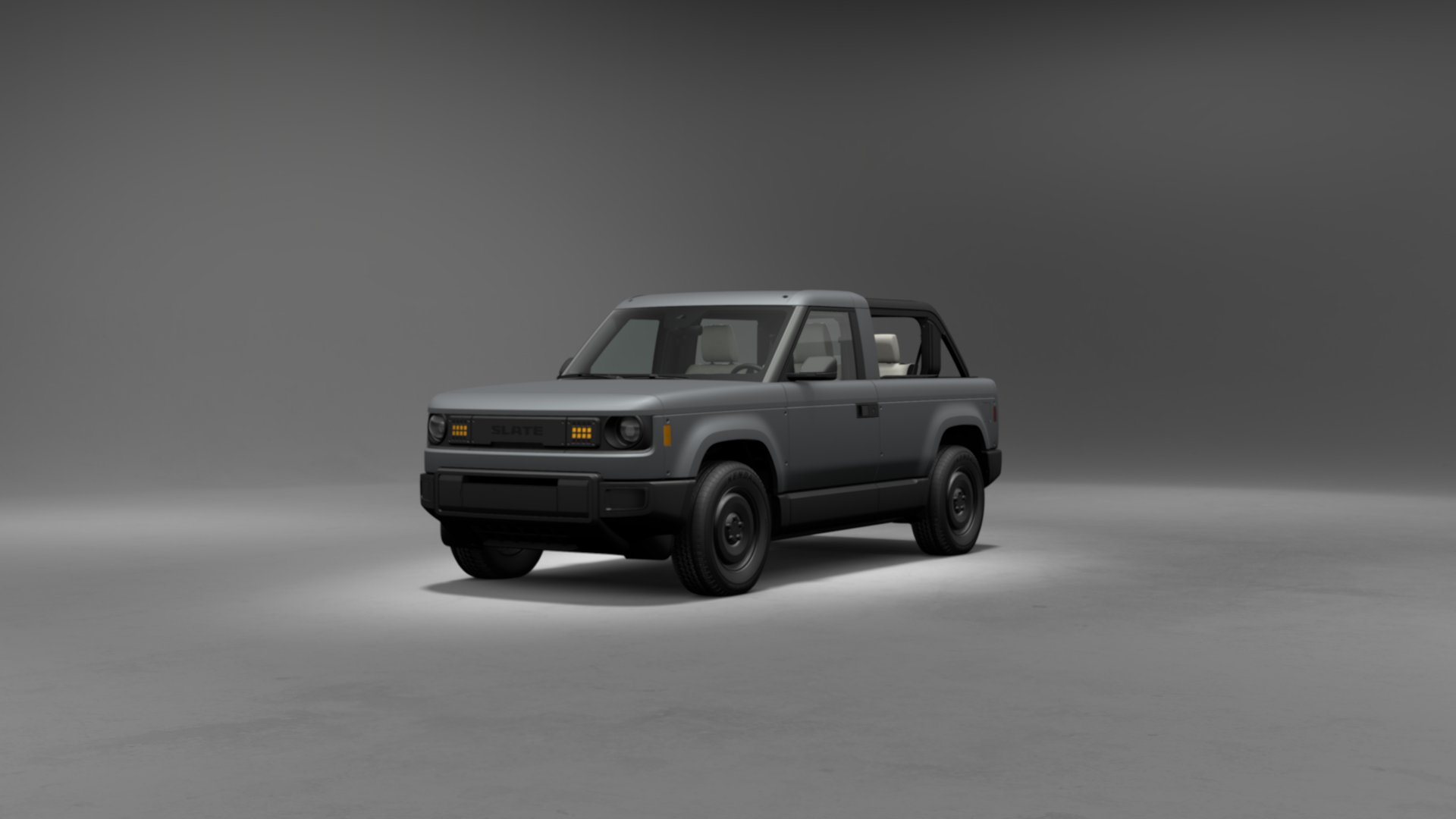
The most conspicuous feature in Slate Auto’s electric truck is the one directly to the driver’s right: nothing. No glossy infotainment panel rises from the dashboard. There is a phone mount, a charging point and room for a Bluetooth speaker. The windows crank by hand. The body leaves the factory gray because it is not painted. In an industry trained to launch new models by counting screens, motors and cupholders, Slate has made absence into its product pitch.
The Blank Slate Truck is a compact, two-seat electric pickup priced at $24,950 before a $1,450 destination charge, taxes and options. It stretches 174.6 inches, carries a projected 205-mile range and sends power to the rear wheels through one motor. Its five-foot bed can haul a projected 1,550 pounds; towing is capped at 2,000. These are intentionally everyday numbers. Slate is not chasing a drag-strip time or a cross-country battery brag. It is chasing the American who looks at the average new-car price and retreats to the used lot.
The expensive art of doing less
Slate began in 2022 as Project Re:Car inside Re:Build Manufacturing. Co-founders Miles Arnone, Will Barker and Jeff Wilke asked where the American equivalent of the Model T, Volkswagen Beetle or simple old Jeep had gone. The answer was not hard to see. Cars had become safer and cleaner, but also larger, more electronic and more expensive. Features moved from options into bundles. Buyers who needed basic transportation paid for complexity they might never choose by itself.
The team attacked cost before styling. One platform. One battery. One motor. One unpainted color. Slate says the truck uses fewer than half the parts of a typical pickup. Its molded composite exterior panels avoid a paint shop, one of the costliest and most environmentally demanding areas of a conventional auto plant. Because scratches do not expose metal beneath paint, a work-truck scar can remain a scar. Damaged panels are designed to be removed and replaced.
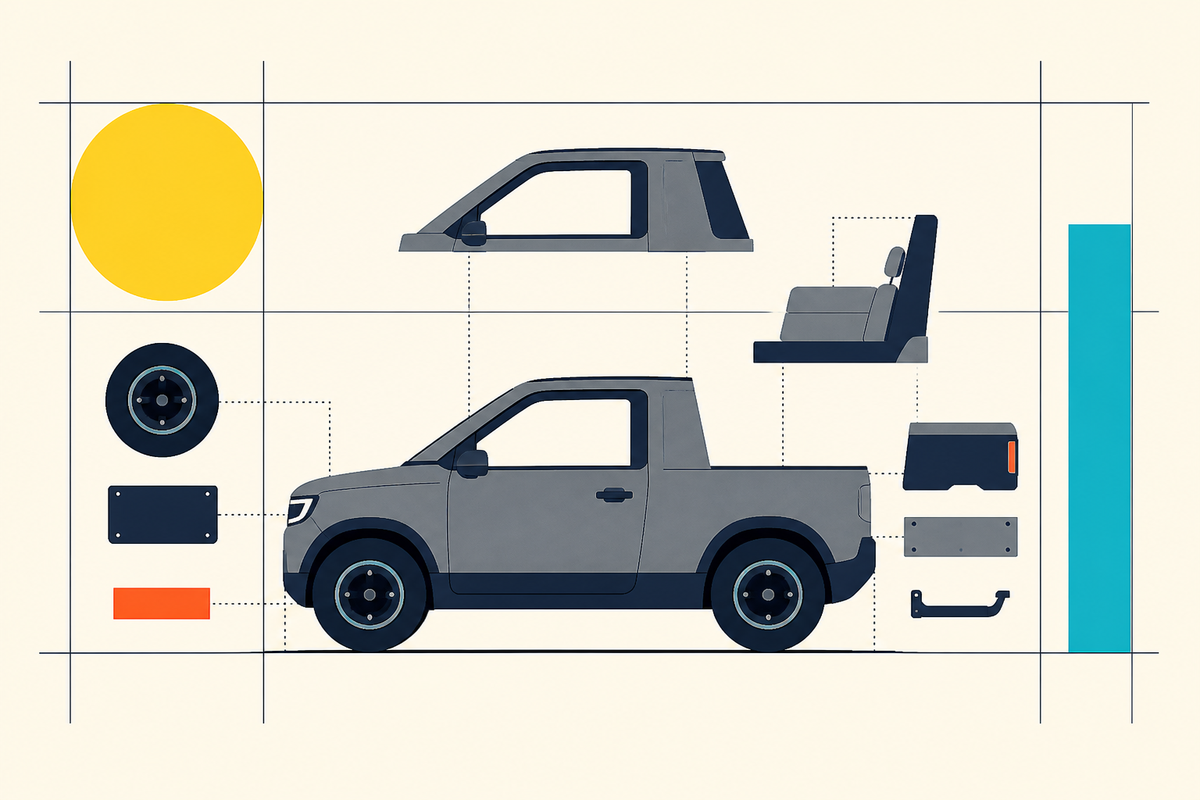
That austerity is not cosmetic. Factory variety is expensive: more paint colors, option combinations and trim levels create more tooling, inventory, scheduling and opportunities for error. Slate shifts much of that variety past the production line. The Warsaw, Indiana factory can concentrate on repeating the same basic object. Customers create the permutations later.
“We believe that car buyers - not car companies - should call the shots.”Slate Auto
One vehicle, several future selves
The clever trick is that “basic” does not mean fixed. Every Slate begins as a pickup, but an owner can add a rear bench, roll structure and roof to produce a five-seat Squareback or Fastback SUV. An Open Air kit exposes the rear compartment. The conversion can be ordered for delivery or added later, then reversed. Racks, wheels, lighting, audio, interior storage, work equipment and wraps extend the menu.
The platform equation
This is useful for a first-time buyer whose life is likely to change. A commuter might buy the least expensive truck now, add speakers after payday, install a wrap when the gray grows dull and buy an SUV kit when two seats stop being enough. A landscaper can fit a rack without buying an upscale trim. A fleet can standardize vehicles while adjusting equipment by job. Slate is trying to make the car behave less like a sealed appliance and more like a durable base layer.
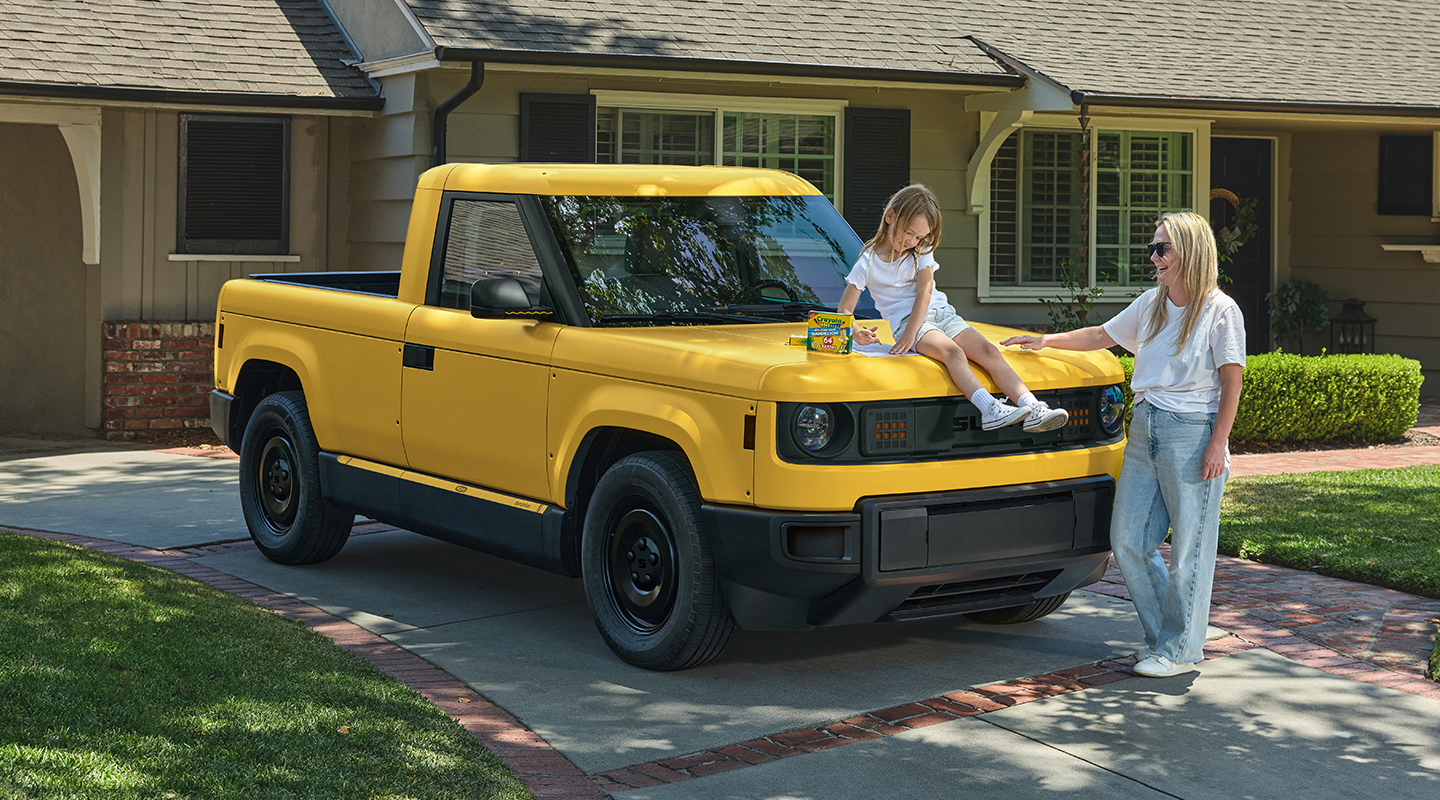
The July 2026 Crayola collaboration turns that theory into a bright pink, yellow, green, blue or red object lesson. Five wrap packs use Crayola colors including Razzmatazz and the retired fan favorite Dandelion. Starting at $1,549.99, each pack adds matching dashboard and key-fob pieces. It is Crayola’s first automotive partnership, but for Slate it is also a template: creators and brands can supply new looks without forcing the factory to spray another color.
The truck is the front door
Slate’s business has two transactions hiding in one driveway. First comes the deliberately affordable vehicle, sold directly online. Then comes the marketplace, where owners can buy from more than 175 planned accessories, with more than 80 priced below $500 as of the June reveal. The second transaction may recur for years. A roof conversion is around $5,000. A wrap, sound system or set of storage modules adds more. Installation can be DIY or paid.
That makes Slate less comparable to a traditional stripped trim than it initially appears. A cheap trim usually exists to advertise a low starting price while nudging shoppers toward a better-equipped model on the lot. Slate says the plain truck is the product. The owner can keep it plain. The company’s wager is that enough buyers will voluntarily add profitable pieces, at their own pace, to support the thin economics of an inexpensive vehicle.
The competition is therefore scattered. Ford’s Maverick is the obvious compact-pickup alternative, but it burns gasoline and cannot become an SUV. Used Tacomas and Frontiers offer proven utility without a new-car price. Chevrolet’s Bolt addresses affordable electric commuting, not hauling. Telo is developing a small electric truck at a higher expected price. Rivian, Ford and Tesla sell electric pickups in another financial neighborhood. No rival combines Slate’s price, size and reversible body concept.
The repair problem before the repair
Launching a car company is an exercise in discovering that the car is only one of the things customers need. They also need charging, collision work, parts, insurance and a human to call when a warning light appears. Slate has no dealer network, so it is assembling an ownership system from partners.
RepairPal is onboarding independent shops for service and accessory installation. Its network exceeds 4,000 certified locations, though the number equipped for high-voltage work is smaller. Every truck has a native NACS port and access to Tesla’s Supercharger network. Treehouse handles home-charging installation. Slate U videos are meant to teach routine maintenance and do-it-yourself repairs. A 10-year, 110,000-mile battery and powertrain warranty supplies reassurance that a new brand cannot borrow from decades of history.
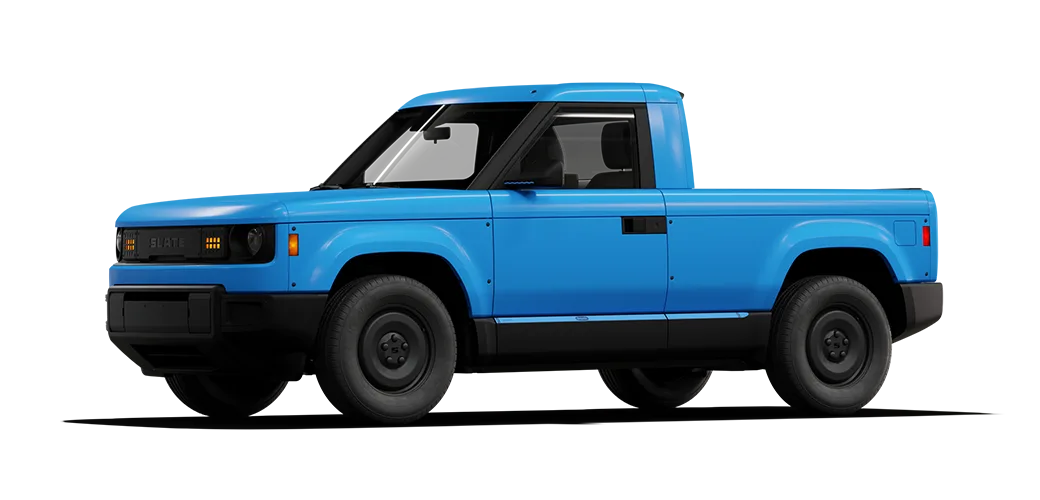
The phone-first cabin is part of the same philosophy. Built-in infotainment adds chips, screens, software maintenance and a component that ages faster than the truck. Slate provides mounting and power for a device the customer already upgrades. The tradeoff is real: a phone can be distracting, portable audio is less integrated, and buyers accustomed to modern convenience may view manual windows as theater. Simplicity is only valuable when it removes cost without exporting too much inconvenience to the owner.
Who is this actually for?
First-car buyers, short-range commuters, small businesses, fleets, hobbyists and households that need occasional pickup utility are the cleanest fit. Long-distance drivers, people who tow heavy loads and buyers who want luxury technology are not the target.
A factory-sized proof
The capital behind this modest truck is immodest. Slate raised at least $111 million in its 2023 Series A and roughly $589 million in a 2024 Series B. An April 2026 Series C led by TWG Global added $650 million, bringing total funding to about $1.4 billion. Backers have included Jeff Bezos’s family office, General Catalyst, Slauson & Co. and former Amazon executive Diego Piacentini. Bezos’s involvement has been described by former CEO Chris Barman as hands-off.
The Amazon influence is more operational than ornamental. Co-founder Jeff Wilke once ran Amazon’s consumer business. Current CEO Peter Faricy previously led Amazon Marketplace. Slate’s direct sales, digital configurator and expanding catalog all treat commerce as core product infrastructure. Barman, a Chrysler veteran and Slate’s first hire, moved from CEO to President of Vehicles in March 2026 to focus on getting the truck launched.
Now the thesis has to pass through a 1.4-million-square-foot former printing plant in Warsaw. Slate plans to invest nearly $400 million there and create more than 2,000 jobs. First customer deliveries are scheduled for the fourth quarter of 2026, with a production ramp intended to reach 150,000 vehicles annually by the end of 2027. More than 180,000 people placed refundable reservations before preorders opened. That is evidence of curiosity, not guaranteed demand. A $300 nonrefundable preorder is a sterner test, and a completed purchase is sterner still.
Automotive history is crowded with persuasive prototypes and empty factories. Slate must certify the truck, control quality, train service partners, supply parts and manufacture at a price that leaves room for a business. Its projected range is not yet an official EPA result, and production specifications can change. The feature Slate cannot delete is execution.
The blank space in the market
Still, the company has found a neglected question. The auto industry has spent decades asking what else it can put into a vehicle. Slate asks what a buyer can live without today, then choose tomorrow. That reframes affordability from a cheaper bundle into the absence of a bundle.
The distinction matters beyond cars. Products become expensive when every edge case hardens into a standard feature and every customer receives the resulting complexity. Slate’s portable lesson is to simplify the costly core, design clean interfaces for add-ons and move variation closer to the customer. Its constraint - one truck from one line - produces a surprising kind of freedom after the factory gate.
Whether the economics work will not be known when the first gray truck rolls into a driveway. It will be known later, when owners decide if they are content with the blank Slate or return for a roof, a rear seat, a yellow wrap and whatever comes next. The company has removed nearly everything it can. What remains is the experiment.