The most revealing thing about Janji is not that its half tights have seven pockets. It is that the company changed the cause printed into its identity. For 13 years, the Somerville running brand sent a portion of sales toward clean-water work. The tally passed $1 million. Then Janji stopped. Its new program gives $10,000 every month to grassroots groups bringing more people into trail and ultra running. In the purpose-business universe, where old claims tend to calcify into permanent packaging copy, this is borderline impolite. It is also the point.
Janji, pronounced john-jee, means “promise” in Malay. Former Washington University cross-country teammates Dave Spandorfer and Michael Burnstein formed the company around an idea they had on a bus to the 2010 Division III outdoor track championships: running could connect a private obsession to a public need. The early concept tackled food and water insecurity. The early clothes borrowed from national flags. The early name was Edele, which customers could not pronounce and frequently confused with Adele. Purpose did not spare them a basic branding failure.
The cost of getting taken seriously
The founders did not begin with a glossy venture round. They began with two business-plan competitions. Their student team won $15,000 from the YouthBridge Social Enterprise and Innovation Competition and another $20,000 from the University of Colorado Colorado Springs Sports/Outdoors contest. That $35,000 is the clearest public figure for the company's starting capital, though it is not a complete accounting of launch costs. More useful than the money was the forced contact with reality. They pitched, wrote a plan, recruited teammates, and asked runners and store owners where the holes were.
The first national products arrived May 3, 2012, at Big River Running in St. Louis. Launch parties followed in cities from Philadelphia to Anchorage. Janji moved to Boston for its running culture, startup density, socially active community, and proximity to family. By 2014, Washington University reported the apparel in 90 stores. This was decidedly analog distribution: shake a retailer's hand, explain the odd name, then hope a shirt built around Haiti or Kenya looked good enough to survive after the mission speech ended.
We tried to get as much feedback as we could from runners, from running-store owners, from people who have supported entrepreneurism.Dave Spandorfer, recalling the student-company years
The product had to outrun the paragraph
Janji now makes men's and women's shorts, tights, tops, bras, merino layers, pants, shells, packs, caps, and small accessories. It sells directly online, through REI, and through specialty running shops. Two main seasonal collections arrive as smaller limited drops, padded by capsules and collaborations. The scarcity keeps inventory and creative cadence tight; it also means popular sizes can disappear and a print may never return.
The competitive difference lives in mildly obsessive details. The Trail Half Tights use seven pockets so a runner can carry a phone, fuel, keys, a soft flask, and a hat without adding a vest. Runner's World has named the line a Gear of the Year winner. The Rainrunner Pack Jacket pairs waterproof stretch ripstop with a 360-degree vent, addressing the ancient running-jacket problem of being dry from rain and soaked from yourself. The Multipass Sling sits between a belt, a cross-body bag, and a tiny two-liter pack. Reviewers keep admitting they use it for cycling, errands, and travel.
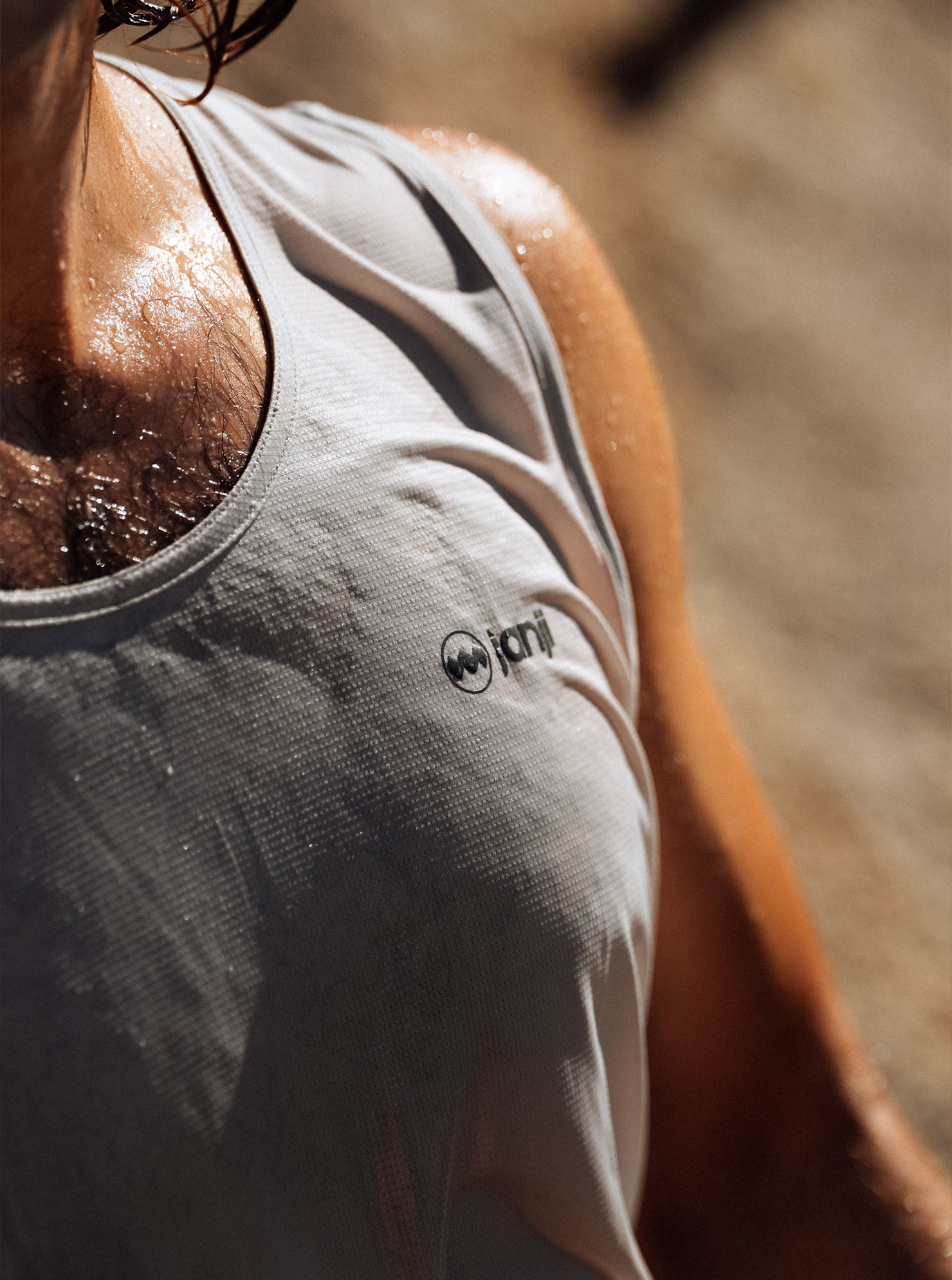
Then comes durability. If a defect in materials or workmanship makes a Janji product rip, tear, or break within five years, the company promises repair, replacement, or store credit. That guarantee makes “responsibility” more concrete because failure can cost Janji money. The environmental record is still a work in progress. The company says its apparel has been PFAS-free since 2023, uses recycled synthetics where possible, and removed polybags from more than 90 percent of products beginning in 2022. It does not currently offer a general repair or take-back program. Its own estimate put 2023 emissions at 4,822 metric tons of carbon dioxide equivalent.
Pockets, ventilation, packability, weather resistance, and fabrics that dry quickly.
Limited collections and artist collaborations give seasons a reason to exist.
A one-time fee buys lifetime discounts, early access, exclusives, and a gear swap.
A seasonal passport, minus the airport carpet
For years, Janji's visual system moved around the globe. A season would focus on a region, pair the in-house design team with artists connected to that place, and adapt the work into limited-run prints. The better collaborations avoided turning geography into souvenir graphics. For a Southwest collection, Pueblo artist and runner Christian Gering brought mountains, stars, and Indigenous visual references. For a Chile-inspired collection, designer Leanna Griffith helped translate artists' pieces onto moving bodies. The in-house team still designed the garments; collaborators changed the point of view.
That system solved a recurring brand problem: how do you release another short without merely changing the color and inventing a weather-based excuse? Janji gave each season a narrative engine. But the method has conditions. It requires artists with real relationships to the represented culture, compensation and editorial room for those artists, and enough humility to let their perspective alter the work. Without those, “global inspiration” shrinks quickly into pattern tourism.
The promise changes address
The original giveback sent a percentage of purchases to clean-water organizations tied to the places inspiring collections. In Kenya and Uganda, Janji-backed work with Evidence Action helped provide 25,000 people with a year of safe water. Over 13 years, total clean-water donations exceeded $1 million. This was not an overnight campaign or a checkout round-up. It was the organizing idea behind the name.
Collection-linked giving to clean-water initiatives in regions that informed the brand's designs.
$10,000 monthly grants to grassroots groups widening access to trail and ultra running.
What changed their mind? Janji's explanation is plain: after 13 years, it saw a chance to move giving closer to the heart of the company by investing in people expanding access to running. Janji Grants now names organizations such as Born to Adapt, Youth Run NOLA, Native Women Run, Runners for Public Lands, Friendship Miles, and Women In Ultrarunning. The selection criteria favor community impact, local leadership, financial stewardship, and actual reduction of barriers. Clean water was globally coherent. Running access is operationally intimate.
The risk is obvious. A brand can always redefine its mission until the beneficiary looks suspiciously like its customer-acquisition funnel. The defense is equally obvious: publish the amount, publish the recipients, and make the checks regular. Ten thousand dollars each month is a claim that can be audited without decoding an impact calculator.
Purpose is not the product. It is the constraint that decides which products, partners, and promises survive.
The strange logic of the Oiselle merger
In February 2023, Janji merged with Oiselle, the Seattle running brand built by and for women. Digsbury Ventures facilitated the deal; terms were not disclosed. The companies called it a partnership of equals and kept separate names, design, marketing, and manufacturing. The useful number was not a valuation. It was 4 percent - the share of Oiselle customers who said they also bought Janji. Shared values plus barely overlapping buyers offered cross-pollination without requiring either brand to be poured into beige corporate oatmeal.
The arrangement also acknowledged a less glamorous founder problem: independent apparel can be lonely and operationally heavy. Sister brands can share knowledge, capital access, and omnichannel muscle while protecting the communities that made them worth buying. It would not work if one side were merely an audience to strip-mine, or if shared back-office decisions flattened product identity. So far, the public promise has been “more Janji” and “more Oiselle,” not a new portmanteau stitched onto both.
What to steal, and what not to fake
Janji sits in premium running apparel between technical outdoor incumbents such as Patagonia and polished niche labels such as Tracksmith, Bandit, Rabbit, Saysky, and Ciele. Its defense is not scale. It is a bundle: storage-first product design, limited visual stories, credible community work, and a five-year guarantee. Any one element is copyable. The accumulated consistency is harder.
The copyable Janji playbook
- Give each release a reason to exist beyond a new shade.
- Turn values into a financial rule with a visible amount and cadence.
- Design for one annoying, physical problem customers can demonstrate.
- Use a guarantee to make durability expensive enough to be believable.
- Offer membership as belonging and access, not another monthly bill.
Janji Collective is the neatest commercial example. A customer pays $25 once and receives 15 percent off for life, priority access to releases, member-only products, and entry to a community gear swap. The arithmetic encourages an early second purchase; the scarcity gives the access value; the swap quietly extends garment life without requiring Janji to operate a full resale platform. It is retention dressed as a club, with no recurring-fee resentment.
This playbook breaks when margins cannot carry discounts, guarantees, and grants; when the product is too generic to earn repeat use; when limited supply feels like chronic unavailability; or when borrowed cultural stories outrun the company's relationships. A mission amplifies trust already earned. It cannot manufacture trust on demand.
The culture supporting all this is unusually design-forward for a company founded by a history and international-business major alongside an urban-studies major. Spandorfer has said their first hire was a designer and that most hires have been creatives. The company prizes travel, care for teammates, personal growth, and what it calls Perpetual Forward Motion. That phrase is conveniently corporate, but Janji's public record gives it some teeth: imperfect fits get revised, plastics get removed, emissions get measured, a merger preserves two identities, and even the founding cause can be retired.
The lesson is not that every purpose brand should change causes after a decade. It is that a promise should remain specific enough to cost something and flexible enough to stay honest. Janji began by asking runners to carry someone else's water crisis in the meaning of a shirt. It now asks them to help widen the trail. The pockets, thankfully, remain overqualified.