A pair of golf trousers can announce your afternoon before you have said a word. Charlie Schaefer found that irritating. The loose silhouettes, the plastic-like technical fabric, even the noise of the material: the clothes solved a sporting problem while creating a social one. What if you wanted to play eighteen holes and then go somewhere that did not have a putting green?
- Golf performance, with the proportions of everyday tailoring.
- A former Ralph Lauren designer’s answer to his own wardrobe complaint.
- Direct sales, stores and wholesale, backed by a $20 million Series A.
- Now stretching into a broader wardrobe, with footwear in development.
The trouser that refused to stay on the course
Greyson’s answer was the Montauk. Its origin story is unusually concrete: Schaefer disliked blousy golf pants and wanted something he could wear anywhere. He chose Italian fabric, narrowed the fit and added mobility. A trouser, a jogger and a short followed. That is a useful starting point for understanding the company. The objection came before the brand mythology.
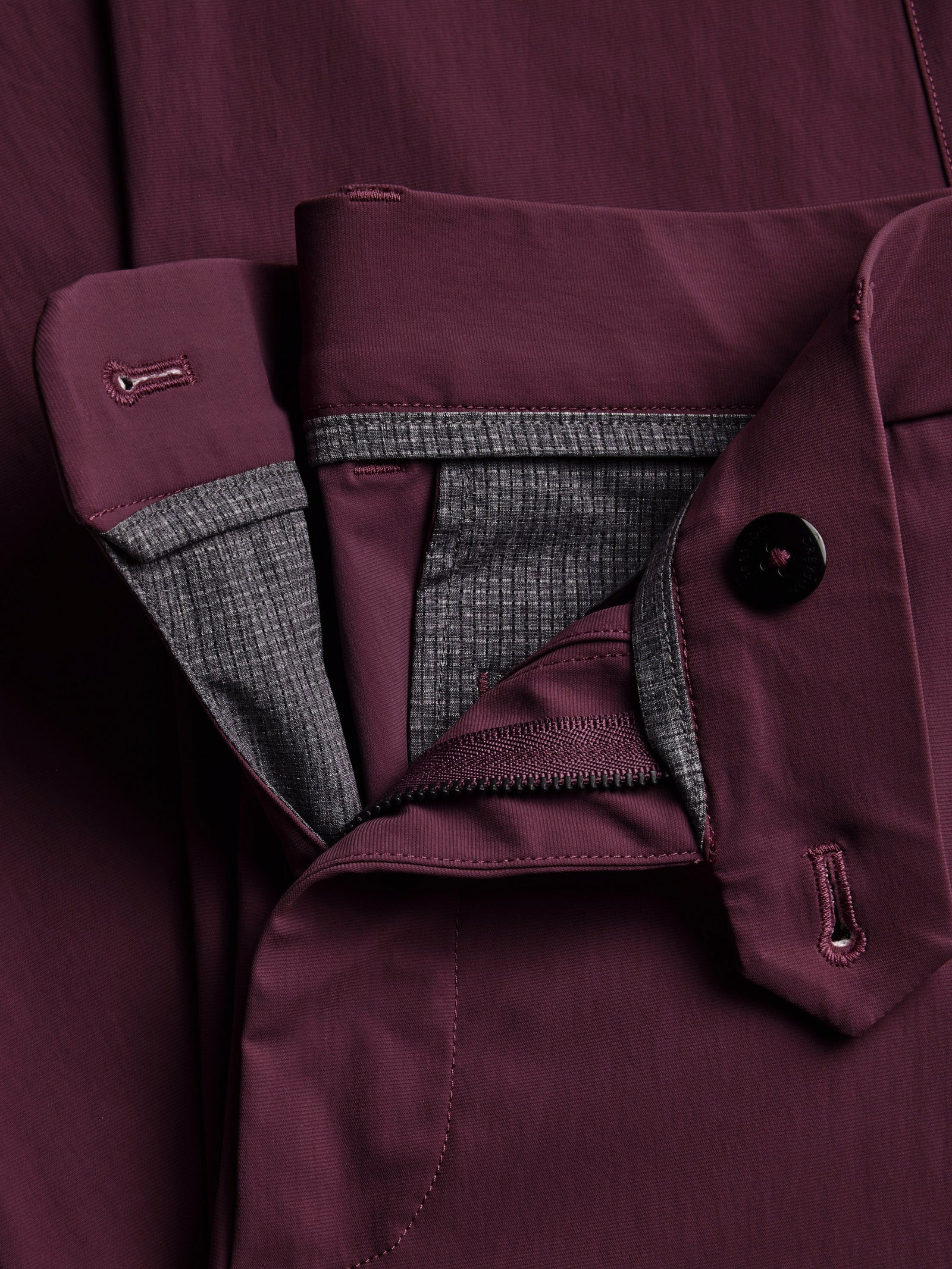
The current Montauk Performance Trouser uses 71 percent polyamide and 29 percent elastane, with a sport waistband and perforated camouflage pocket bags. Greyson lists quick-dry, stretch and antimicrobial properties. A version was priced at $160 when reviewed in October 2026; prices vary by selection. This is premium wardrobe spending. The proposition depends on the buyer finding several uses for one garment.
Augusta first. The samples, just in time.
Schaefer had spent thirteen years at Ralph Lauren before starting Greyson in 2015. Professional golfer Morgan Hoffmann helped introduce it at that year’s Masters, wearing camouflage and tropical prints. The setting mattered. Augusta provided a conspicuous stage for an unfamiliar label with an opinion about how golfers should dress.
Behind that composed appearance was less comfortable machinery. In a 2016 interview, Schaefer recalled driving through a blizzard to reach the PGA Show, samples arriving the night before it opened, and personally delivering Hoffmann’s clothes to tournaments. The immediate weak point was logistics. A designer could imagine the collection; getting it into the right hands at the right time required a different competence.
“The only option we had was to show samples.”Charlie Schaefer, recalling Greyson’s early trade-show scramble
Greyson identifies 2016 as its first collection’s launch year. The distinction between the 2015 sporting debut and a collection available to customers is telling. Visibility can arrive before a business has mastered delivery. Anyone copying the celebrity launch should pay equal attention to the late samples.

A wardrobe, rather than a uniform
Look closely at Greyson’s polos and the argument gets smaller, and more interesting. There are contrast plackets, four-button English plackets and cutaway collars borrowed from the vocabulary of dress shirts. Color appears in places that ordinary sportswear might leave alone. The customer is buying a shirt that performs, but also a set of decisions someone bothered to make.
Greyson therefore belongs in the premium golf conversation alongside Peter Millar, Ralph Lauren RLX, G/FORE and J.Lindeberg. That is an editorial comparison, rather than a market-share ranking. Stretch and moisture management are familiar promises in this company. Greyson’s recognizable territory is the meeting of those promises with tailoring, expressive prints and a wardrobe intended to continue after the round.
The assortment has widened to women’s golf and tennis, activewear, youth clothing, knitwear and everyday layers. Its fabric library makes the design vocabulary visible: the Sequoia double knit combines nylon and cotton; the women’s Phoenix program uses Italian nylon-elastane fabric. Customers can shop by activity, but the materials connect activities that retailers usually keep on separate racks.
fabric+02Tailored
shape=03More
occasions
A design proposition, not a claim that trousers improve your score.
There is an ordinary practical benefit here: fewer costume changes between a sporting afternoon and a casual evening. For the customer who values that transition, the clothing offers convenience. For someone who wants only an inexpensive polo for occasional play, the argument has less force.
How the pack becomes a business
The wolf is Greyson’s organizing metaphor. Schaefer named the company after his first-born daughter; his daughters Greyson and Scarlett are both cited as inspirations. The animal supplies another language, of loyalty and belonging. The company calls its community the Pack, and its stores wolf dens. Apparel retail has always sold affiliation. Greyson is unusually consistent about the vocabulary.
The mechanics are straightforward: ecommerce, company stores and wholesale, including golf shops. In February 2025, Greyson reported more than 2,500 distribution points. Its current locator lists eleven retail locations, including Detroit, New Orleans and Seoul. Those figures measure different things. A wholesale stockist gives the label access; its own shop gives it control over the encounter.
Capital for international expansion, stores, direct sales and wholesale.
NewBound Ventures and New Era chief executive Chris Koch led that funding round, with Tom Nolan and David Chu participating. The announced plans included expanding womenswear. Earlier investors included Justin Timberlake, Larry Fitzgerald and Justin Thomas. Famous names help tell the story; distribution still determines whether customers can buy it.
Membership adds a retention mechanism. Purchases earn two points per dollar, and lifetime totals unlock Stalking Wolf, Howling Wolf and Spirit Wolf tiers. Black Wolf is a paid tier offering additional access and experiences. The clever detail is that belonging becomes cumulative. Another purchase moves the customer through a named social world.
The next argument is below the ankle
In June 2026, Greyson announced that Mossimo Giannulli and NNO.VATION LAB would support footwear and accessories development. Giannulli founded Mossimo and G/FORE. This is an announced direction, rather than proof of a completed shoe collection. The commercial question is whether customers will carry their affection for the clothes into another category.
For founders, the transferable idea is precision. Begin with an annoyance a customer can describe, put the answer into a visible product detail, and demonstrate it in a setting that matters. Expansion works best when the new occasion preserves that answer. At Greyson, the useful test remains beautifully mundane: after the sport is over, would you still choose to wear it?