The useful thing about an impossible promise is that it reveals the machinery you wish existed. In 2012, the Democratic National Convention came to Charlotte, North Carolina, and someone called the family transportation business where Armir Harris worked. They needed 60 buses. The company had a few party buses, including one with a pole in the middle. Sixty sober, convention-ready coaches were not waiting around the corner.
Harris said yes. Then he began dialing. Local operators were booked, so he widened the circle and found a few buses in one state, a few more in another. For days, he slept three or four hours a night. In the shower, amid the least digital part of the operation, the idea arrived: a national supply of buses existed, but no efficient system could see or reserve it. The vehicles were real. The market connecting them was mostly telephone calls.
“I made a split-second decision and said, ‘I can get you 60 buses.’”Armir Harris, recalling the call that changed his direction
Many founders go searching for a problem. Harris had just spent several sleepless days being chased by one. He launched Shofur in 2013 with $800. By 2017, it had passed $12 million in revenue and appeared on the Inc. 5000. But the original irritation remained. Booking was only one side of the puzzle. Independent operators, most of them small, still had inventory, dispatch, marketing and pricing scattered across separate systems - or no system at all.
Before the marketplace, the miles
Harris did not meet transportation as an abstract “legacy industry.” He met it early in the morning. As a teenager, he helped his uncle’s limousine-and-bus company by fueling and cleaning vehicles around 5 a.m. before school. He worked through reservations, dispatch, invoices and accounting. The fleet eventually grew to 25 vehicles, enough to teach him that a transportation company is a constantly rearranging grid of people, machines and time.
His route there was longer than most. Harris grew up in Vlorë, Albania. When violence overtook the country in 1997, his mother left at 3 a.m. with Harris and his older sister. The next years took them through four countries, interrupted his formal schooling and included nights in makeshift outdoor beds and an Amtrak station. At nine, he rode nearly three days from the south Texas border to Boston, holding three action figures he had carried along the way.
There is a neat narrative available here: child refugee rides a bus, then grows up to remake the bus business. Harris himself is less interested in the neatness. Friends have known him for years without hearing the history. He tells it quickly and returns to the work. His instinct is motion, not memorial. It may be the most revealing continuity in his story.
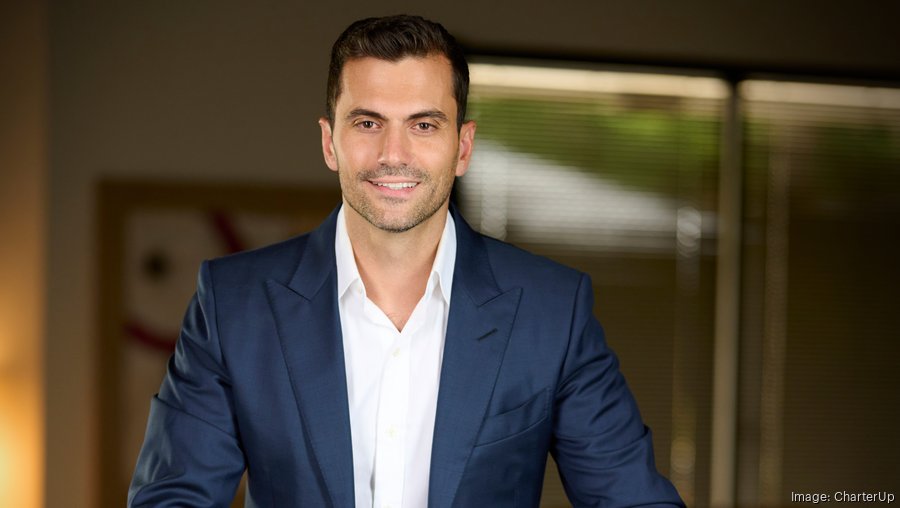
A controlled experiment gets the wheel
While running Shofur, Harris assembled a small engineering team to test a different idea. He kept it deliberately contained so the experiment would not distract the entire company. Could software gather live bus availability, price it, rank operators and give travelers the comparison experience they already expected when booking flights or hotels? Could that same system help a local operator sell an idle Tuesday without hiring a national sales force?
CharterUP emerged from that work in 2018. Its promise was less cinematic than 60 buses on demand, but more useful: show what is available, what it costs and who operates it. Give the customer control without pretending the difficult physical work has vanished. Underneath the interface sit driver standards, maintenance, routing, backup vehicles and thousands of judgments that cannot be hand-waved away by a pleasant checkout screen.
That balance matters because the supply side of charter travel is unusually local. Nearly seven in ten operators own fewer than ten buses, according to the industry figures Harris cited while building the marketplace. A small fleet can deliver excellent service without having the budget for sophisticated sales software, national advertising or a round-the-clock pricing desk. CharterUP’s proposition was to aggregate those capabilities while leaving the actual transportation with the operators who know their vehicles and roads. The model turns fragmentation from a booking nuisance into the raw material of selection: different fleet sizes, amenities and locations become comparable inventory. The website is the visible bit. The difficult product is getting hundreds of independent businesses to speak enough of the same digital language that a traveler can trust the answer on the screen.
The pandemic made the abstraction brutally tangible. Charter bookings fell to zero. Bus companies closed by the hundreds. CharterUP used the pause to strengthen software that could become an industry system of record when travel returned. Then, in September 2021, the job became personal. Tens of thousands of Afghan refugees were arriving at Dulles Airport, and CharterUP was asked to coordinate their transportation to government sites around the country.
Harris spent days at the Dulles Expo Center amid rows of coaches, talking with drivers and emphasizing that the passengers be treated with respect. He understood the cargo in a way no dashboard could express. His own vice president of strategy had also been a refugee. A marketplace measured in inventory and utilization suddenly held a mirror up to the boy on the bus to Boston.
The discipline beneath the urgency
Harris often speaks about urgency, but his version is not indiscriminate haste. He pairs it with three words: focus, clarity and execution. People need to know the outcome, the priority and the responsibility. He argues for ambitious targets because incremental ones invite familiar solutions. A 10-times goal forces the room to consider a different machine.
The philosophy has a softer companion: vulnerability. Harris says leaders must admit mistakes because the behavior a leader tolerates becomes the environment everyone inhabits. His “two-minute rule” for meetings grew from the same concern. Before a final decision, participants who have spoken less are given uninterrupted time. The practice is a small brake on the loudest voice winning by endurance.
Howard Bornstein, CharterUP’s president and a former Bain Capital and McKinsey executive, has described Harris’s ability to absorb new information and turn immediately when the existing direction stops making sense. It is a useful distinction. Speed is not stubbornness with better shoes. The operator who loves execution must also be willing to discard yesterday’s plan.
“A sense of urgency really drives action and creates forward momentum.”Armir Harris on the habit he wants an organization to share
In 2022, after years of avoiding outside capital, Harris accepted a $60 million Series A led by Tritium Partners. CharterUP reported a $150 million annual revenue run rate that year. In 2023, the company ranked second on the Inc. 5000, with three-year growth of 111,130 percent, and Harris won the EY Entrepreneur Of The Year Gulf South Award. The numbers are large enough to tempt a long victory lap. Harris tends to treat yesterday’s win as yesterday’s property.
The bus learns new tricks
The next chapter is not about squeezing another booking form onto a phone. In February 2026, CharterUP and autonomous mobility company HOLON announced a partnership to bring electric, Level 4 autonomous shuttles into North American group transportation. The HOLON urban is designed for up to 15 passengers. Early use cases center on campuses, airports, municipalities and other places where routes repeat and demand is legible.
For Harris, this is an extension of the same coordination problem. CharterUP’s platform has accumulated route histories and demand patterns; those data can inform where shuttles run, when they arrive and how autonomous vehicles mix with human-driven fleets. The futuristic object is the vehicle. The work remains scheduling, utilization, trust and getting a group to the right place.
He has long stated a larger ambition: a travel platform that improves passenger safety and lets people explore the world without producing carbon emissions. An electric autonomous shuttle does not complete that vision. It makes the aspiration operational enough to argue with. Routes have to be chosen. Systems need oversight. Regulators, manufacturers and operators must cooperate. Public trust must be earned one uneventful ride at a time.
Away from the company, Harris travels, invests, works out and still plays tennis, the sport he competed in at Boston University before transferring to UCLA. Tennis suits the public version of him: recover quickly, read new information, keep the point alive. Yet his more durable education came from fleets and borders, from cleaning vehicles and finding beds, from watching an industry’s tiny operators try to make a nationwide map out of isolated dots.
The bus is easy to overlook. It is neither the romance of a train nor the magic trick of an airplane. It waits outside a convention center, carries a team after the cameras leave, or moves a newly arrived family toward a city whose name is still unfamiliar. Harris sees the humble vehicle and then sees the invisible system around it. His career has been an attempt to make that system visible - and, finally, to make it move.