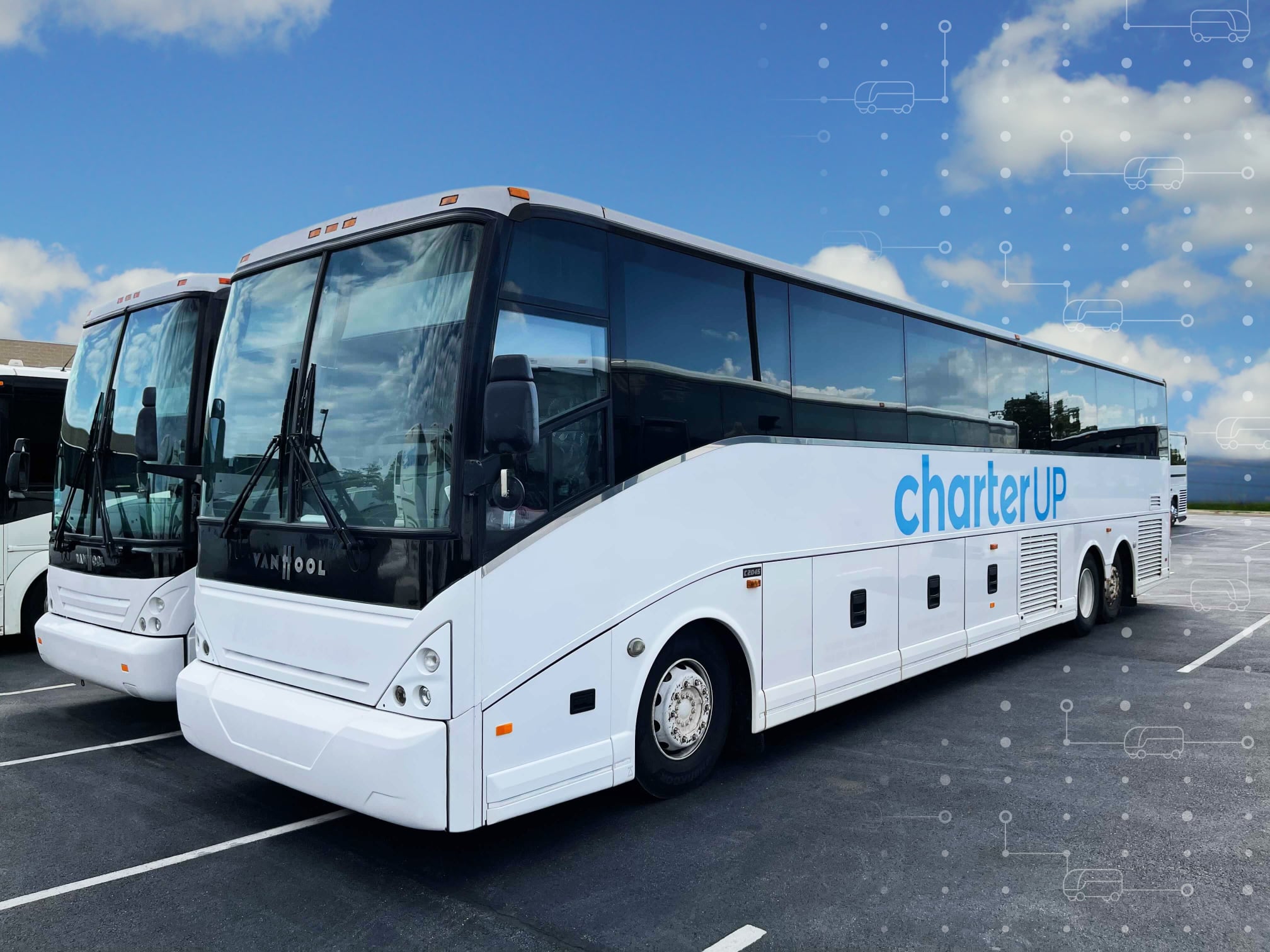
An Austin-headquartered marketplace pulled charter bus booking out of fax machines, three-day quote cycles, and the ambient suspicion that the bus might just not come. Then it convinced the Department of Defense, Delta, and every kid going to state finals to use it.
It is 9:14 a.m. somewhere in Texas. A school district has 800 kids who need to be in a stadium by Friday. A corporate travel manager has 320 new hires landing at LAX and one shot at a smooth Monday. A government contractor needs eleven vehicles with no logos for a deployment that nobody is supposed to talk about. All three of them open the same website. None of them pick up a phone.
That is the small, deeply unsexy miracle CharterUP has built. For decades, chartering a bus meant calling six operators, sending a Word doc to each, waiting two to four business days for quotes that never matched, and then handing your credit card number to a stranger named Gary. CharterUP looked at this and decided to do something almost rude: make it work like the internet.
The charter bus industry in the United States is enormous, fragmented, and quietly essential. Tens of thousands of small operators, mostly family-owned, mostly with one to fifteen vehicles. They move school children to away games. They move Microsoft engineers to off-sites. They move soldiers, sports teams, festivalgoers, and the occasional bachelorette party that nobody wants to talk about on Monday.
And yet for most of the 21st century, the booking experience belonged to the late 20th. There was no national pricing standard. No central availability. No reviews you could trust. If your bus didn't show, the only number you had was Gary's cell phone, and Gary was already on a different route. The result: a market worth billions of dollars annually, transacted by spreadsheet and prayer.
Because nobody outside the industry understood it. Charter bus operators are not Uber drivers. They have CDLs, DOT inspections, insurance riders, and routes planned in advance. You cannot just slap a consumer app on the side of the industry and call it disrupted. The supply side had to be courted, integrated, and - this is the unfashionable part - respected.
CharterUP's founder and CEO, Armir Harris, did not arrive at the charter bus industry through an MBA. He arrived through an asylum case. Harris came to the United States as a political refugee from Albania. There were nights in homeless shelters. There were nights on park benches. There were also, eventually, an uncle in Charlotte, North Carolina, with a limousine company that needed help.
Harris worked the dispatch board. He learned the routes. He helped the family business expand from limos into buses, which meant he learned the operator side of the industry - the part most software founders never bother to look at - from the inside out. By the time he founded CharterUP in 2018, he had spent more than a decade understanding why operators don't trust marketplaces, why customers don't trust operators, and why the entire system runs on bandwidth that has been deprecated since dial-up.
The bet was simple, almost suspiciously so. Build a real-time marketplace. Integrate live operator data. Show prices that don't change after you commit. Track the bus. Hold the operator accountable, but pay them fairly and on time. Promise customers a backup vehicle if anything goes wrong, and actually mean it.
Armir Harris launches the platform after more than a decade inside the family's Charlotte-based transportation business.
Hundreds of independent operators integrate live availability. The marketplace starts answering the question 'is this bus actually free on Friday' in seconds rather than days.
Annual revenue run rate crosses $150M. David Lack and Brett Shobe - veterans of HomeAway and RVshare - join the board.
The second-fastest-growing private company in America is, improbably, a bus marketplace.
Microsoft, Amazon, Meta, Apple, Google, Delta, the Department of Defense, K-12 districts in every state, and hundreds of universities all running through the same booking rail.
From the customer's side, CharterUP looks like every modern booking site: enter your trip, see real buses with real prices, pick one, pay. The boring magic is on the other side of the screen. Each operator in the network shares live fleet data, real maintenance status, real insurance information, and real driver records. The platform vets, scores, and ranks them. If a bus breaks down, the marketplace can dispatch a backup from a neighboring operator before most customers notice.
Real-time pricing and availability across 4,000+ vehicles. Pick a bus, get a confirmation, close the tab.
Fleet management, dispatch, pricing, and bookings in a single cloud console for the small operators that run America's buses.
Roster, stops, communications, and live tracking for corporate shuttles, campus programs, and event logistics.
If a bus fails, the network dispatches another. A promise the legacy industry could not structurally make.
The customer list is the part of the company that should not exist. CharterUP claims more than 100,000 customers per year, tens of thousands of K-12 schools across every U.S. state, hundreds of universities, federal agencies including the Department of Defense, Fortune 500 companies including Microsoft, Amazon, Meta, Apple, Google, and Delta Air Lines, plus professional sports organizations and major airports. Roughly the kind of buyer list you do not get by sending cold emails.
The growth numbers help explain why. The company has reported more than 100% annual growth since founding and an annual revenue run rate north of $150 million by 2022. In 2023, Inc. ranked it the second-fastest-growing private company in America. Tritium Partners led a $60M Series A on the back of all of this, and two of their partners - veterans of HomeAway (now Vrbo) and RVshare - joined the board, which is a tell. Marketplace investors invest in marketplace founders. They had seen this movie before, only with vacation rentals and motorhomes.
Coverage of how CharterUP rewired the operator side without breaking it.
The investor announcement. The number is real. The board seats are real. The category got its first capital.
An award that does not usually go to a bus company. This time it did.
The company's own three-word framing - accessible, accountable, transparent - sounds like a mission statement written by a committee. Mostly because it is. But unlike most mission statements, it has the unusual property of being checkable. Accessible: can a stranger book a bus in under a minute? Accountable: if the bus doesn't show, is there a replacement, a refund, and a recorded operator review? Transparent: do you see the price before you commit? Three yeses gets you a marketplace. Three nos gets you the old industry. CharterUP picked a side.
There is also a quieter mission underneath. Most charter bus operators in the United States are small businesses. Family-run. First-generation immigrants in many cases. The dominant booking model before CharterUP funneled them through brokers who took the customer relationship, the data, and a meaningful chunk of the margin. CharterUP's pitch to operators is that they keep the relationship, see the demand, and finally compete on service rather than on whoever picks up the phone fastest.
The interesting thing about a marketplace that already moves millions of passengers a year is what it can do next. Charter buses are only the beginning of group ground transportation. There are campus shuttles. Corporate commute programs. Disaster relief logistics. Government deployments where discretion matters more than branding. Emergency response. Event-by-event sports travel. All of it currently lives in spreadsheets and phone trees. All of it could live in an API.
The harder bet underneath the company is that the future of moving large groups looks less like a fleet you own and more like a network you call. Electrification favors the network model, because operators - not customers - shoulder the capital cost of new vehicles. Sustainability reporting favors the network model, because corporate customers want auditable emissions, not vibes. And the labor side of the industry favors the network model, because small operators want flat fees and dependable demand, not yet another broker taking a slice.
If CharterUP keeps adding operators and customers at the pace it has, the question stops being whether the marketplace works. The question becomes whether anyone outside the marketplace can keep up.
The school district has its receipt. The corporate travel manager has live GPS. The government contractor has an unmarked motorcoach with a backup vehicle on standby. None of them spoke to Gary. None of them had to.
Somewhere in Austin, a Series A funded company is quietly making sure of it. The bus is a Volvo, or a Prevost, or a forty-foot something with Wi-Fi and seventeen kids arguing about a playlist. It was booked in the time it took the kettle to boil. It will arrive in the time the route promises. And then it will do the whole thing again, six thousand more times that day, in ninety-something cities, with a slightly amused founder watching the dashboard and wondering, reasonably, why this took until 2018.
This is what an industry looks like when somebody finally answers the phone.