Consider the back of a freight trailer. It is a narrow room with one useful entrance. A forklift goes in, retrieves a pallet, reverses out and repeats the exercise. The choreography is familiar enough to disappear into the background. ArcBest looked at it and proposed a different arrangement: put the freight on a mobile platform, then pull the platform out. In March 2023, its Vaux Freight Movement System made a wonderfully concrete promise: a trailer unloaded in minutes. Three years later, the company announced it would discontinue the system.
- ArcBest combines an owned freight network with outside carrier capacity.
- Its celebrated trailer platform met a costly commercial reckoning.
- The current bet joins shipping visibility with warehouse automation.
That reversal is a useful place to begin. ArcBest is a logistics company whose history reaches back to 1923, and its job is to make goods arrive where customers need them. Yet its recent history suggests a more demanding question: which improvements deserve to survive contact with the invoice?
The trailer is only the beginning
The original Vaux idea addressed a handoff. Freight spends part of its life travelling, but it also waits while people load, unload, count and rearrange it. The platform could leave the trailer as a unit, allowing workers to approach its contents from four sides. Software coordinated the activity. TIME included the system in its 2023 Best Inventions list. Here was an old freight operator making a physical argument about where time goes.
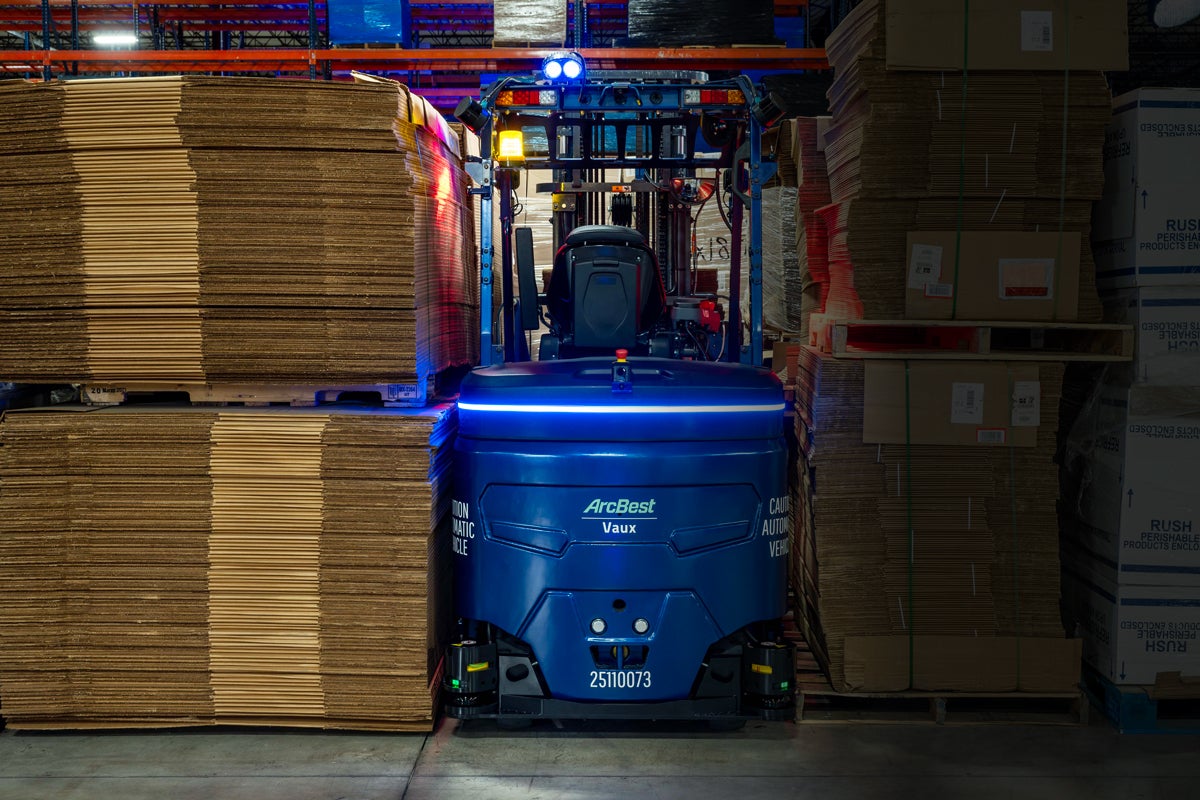
The distinction matters. Vaux became a family of technologies, including autonomous forklifts and perception tools. Ending the mobile-platform offering did not end the warehouse business. It narrowed the experiment. That is less photogenic than a launch, but considerably more informative for anyone buying equipment.
Own the network. Borrow the reach.
ArcBest’s underlying business makes such experiments possible. ABF Freight, its owned less-than-truckload carrier, combines shipments from customers who do not need an entire trailer. ArcBest also arranges truckload capacity through outside carriers, handles urgent freight and manages transportation for businesses that want help coordinating the whole operation. International and specialized services extend the menu. U-Pack serves households: customers pack and load; transportation is handled for them.
These services earn money through transportation charges and logistics arrangements. The owned network carries equipment, labor and facility costs; brokerage purchases capacity from others. Customers include manufacturers, retailers, healthcare businesses and automotive companies. SOLE Fitness and Lutron appear among its public customer stories. The common problem is practical: the shipment must fit the route, the deadline and the receiving operation.
Buying capabilities helped expand that reach. Arkansas Best acquired Panther Expedited Services for approximately $180 million in 2012. ArcBest bought truckload broker MoLo in 2021, with $235 million in closing cash and potential additional consideration. The logic was access to more carrier relationships and a broader service offering. A logistics company can grow without putting its name on every truck.
Old Dominion offers an alternative for LTL and related transportation; C.H. Robinson competes across brokerage and managed services. ArcBest’s appeal lies in its particular combination of owned capacity, purchased capacity and operational knowledge. Buyers still have to compare prices, lanes and service commitments. Breadth alone cannot tell them which provider will handle Tuesday’s delivery properly.
The invoice for changing direction
The first conspicuous setback in this technology sequence arrived outside ArcBest. It announced a $25 million investment in remote-operation software company Phantom Auto in January 2022. Phantom ceased operations in early 2024 after failing to secure financing. ArcBest wrote off the investment’s $28.7 million carrying value. This was an investment failure; it does not establish why the separate Vaux platform was later discontinued.
Phantom investment carrying value written off in 2024
Vaux freight movement system assets impaired in Q2 2026
In July 2026, ArcBest announced a broader restructuring: approximately 2% fewer positions, proposed consolidation of ten smaller ABF service centers, brand simplification and discontinuation of the Vaux Freight Movement System. The rationale was lower costs, a simpler operating structure and less investment in lower-priority areas. The Vaux asset write-off was $50.8 million. The company projected approximately $40 million in annual cash savings from the overall plan.
Those savings were expectations, not money already earned. Nor was the write-off a published total for inventing Vaux. Keeping the numbers separate prevents an attractive story from becoming bad arithmetic. The awkward lesson is that an award and a workable demonstration answer different questions from commercial returns.
A freight desk with fewer tabs
Another 2026 development addressed a quieter inconvenience. ArcBest View launched publicly in May, bringing quotes, bookings, shipment visibility, documents, billing and reporting into one platform. A shipping team can compare options, organize watchlists and review cost and service patterns. Customers still have access to people when a shipment becomes complicated. The product’s attraction is wonderfully unromantic: less hunting for information.
“Execution, reliability and visibility matter.”
Seth Runser, on the launch of ArcBest View, May 2026

Runser’s progression offers a concrete glimpse of company culture. ArcBest promotes mentorship and leadership development; its CEO came through the operating business. In August, MoLo and Panther operations adopted the ArcBest brand, while ABF Freight and U-Pack retained theirs. The direction is consistent: customers should encounter fewer organizational seams when they need several services.
Copy the sequence, then check the fit
The current Vaux offering starts with warehouse understanding: establish a baseline, identify problems and measure changes before expanding automation. That sequence is worth borrowing. Map where work stops. Separate a transport problem from a handling problem. Test a change against ordinary shifts and awkward loads. Then ask whether the improvement pays for its equipment and disruption.
For a shipper, ArcBest becomes useful when several modes, deadlines or facilities need coordination. A simple shipment may need only a competitive quote. Warehouse automation requires compatible workflows and convincing economics. The trailer’s single entrance remains a good clue: before buying speed, look carefully at what is making everyone wait.
Follow the freight
TOOLS, STORIES & DEMONSTRATIONS