It is 6:17 a.m. in a refrigerated warehouse outside Cincinnati, and a forklift driver named Andre is having an unusually quiet morning. Three months ago he would have been hunched over a clipboard, squinting at a smeared bill of lading, scribbling a count he half-trusted. Today the pallets roll past him and a ceiling-mounted black tower watches them go - reading every label, weighing every claim, logging every dent before the truck has finished backing out. Andre waves at the dock door. The dock door waves back, more or less.
The tower is a Kargo Tower. The company that built it is not, despite the slightly confusing name, a Turkish parcel service. It is a six-year-old San Francisco AI company that has decided, with admirable single-mindedness, that the most important camera in logistics is the one pointed at a loading dock.
The ProblemThe supply chain's most expensive blind spot
For a global industry obsessed with optimization, logistics has a strangely analog soul. Trillions of dollars in goods move through warehouses every year, and the moment that matters most - the seconds when freight crosses the threshold of a loading dock - has historically been documented by a tired human with a marker. Counts are wrong. Damage gets blamed on the next guy. ASNs arrive in inboxes hours after the pallet they describe has already been forklifted into Aisle 12.
The result, depending on which trade publication you read, is somewhere between "a $50 billion annual claims problem" and "the reason your couch arrived in two boxes." Either way, the dock is where good supply chain data goes to die. Or used to.
The Founder's BetFrom neurons to pallets
Sam Lurye, Kargo's founder and CEO, did not start his career planning to film freight. Before Kargo he worked at Stanford's Neural Prosthetic Systems Lab, helping develop brain-computer interfaces - the kind of work that involves implanting electrodes in primate motor cortex and watching them, eventually, control a cursor on a screen. It is a long way from a refrigerated warehouse in Cincinnati. And also, weirdly, not.
Both problems share a structure: you have a physical system spitting out enormous quantities of signal, and a digital system that desperately wants to understand it. In neural prosthetics the signal is a thicket of spikes from individual neurons. At a loading dock it is forklifts, shrink-wrap, scuffed labels, and a guy named Andre. The technique - high-bandwidth sensing plus machine learning trained to find the structure inside the mess - is, on paper, the same.
In 2019 Lurye founded Kargo to apply that idea to the most under-instrumented square footage in commerce. The pitch was not subtle: install a camera that never blinks, train a model to read what's on every pallet, and pipe the results straight into the ERP. The first three customers signed in 2022. By 2025 there were forty-five.
The ProductOne camera, two opinions, a thousand pallets a day
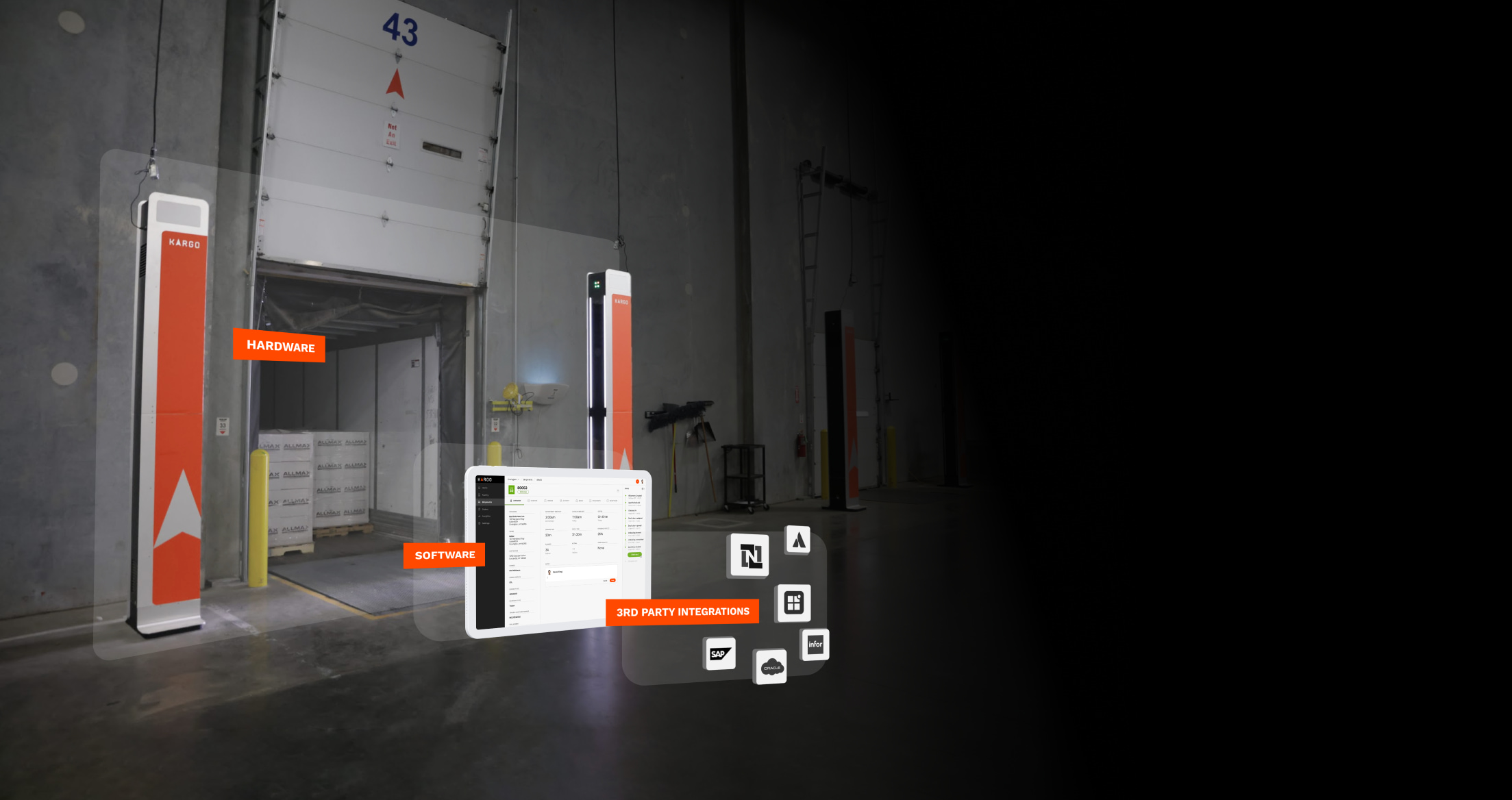
Kargo's product comes in two flavors. The Kargo Tower is the original: a ceiling-mounted column packed with cameras and a stout little computer, installed over a dock door. It reads labels and barcodes, captures video of each shipment, flags visible damage, and pushes structured events into the customer's WMS within seconds. The Kargo Lift, introduced in August 2024, takes the same idea and bolts it onto a forklift or AGV - 80 megapixels of multi-camera array staring at the pallet on the tines. The company claims label-reading accuracy of 99.9%, which is the kind of number you only quote when you've spent a long time arguing with shrink-wrap.
On top of the hardware sits the software: real-time dashboards, automated ASNs, vendor scorecards graded on actual evidence rather than self-report, FSMA-friendly lot-code traceability for food customers, and a claims module that lets a 3PL settle a damage dispute with a 4K video clip instead of a phone call.
MilestonesA short history of a long ambition
Kargo: a timeline
- 2019Sam Lurye founds Kargo in San Francisco. The thesis: build a universal interpreter for the physical supply chain.
- 2022Series A closes at $25M, led by Sozo Ventures with Founders Fund and Flexport. Three named customers.
- 2024Launches the Kargo Lift - 80MP computer vision purpose-built for forklifts and AGVs.
- 2025 · Jun$18.4M strategic round from Matter Venture Partners, Lineage, and Armada. Customers turn into investors.
- 2025 · Dec$42M Series B led by Avenir. 45+ enterprise customers. 1,000+ towers in the wild. ARR triples year over year.
The ProofCustomers who voted with their checkbooks
There is a particular flavor of validation in enterprise software, and it is this: your customer offers to give you money on the way in and then more money on the way out. Both Lineage, the cold-storage giant, and Armada Supply Chain Solutions did exactly that, joining Kargo's June 2025 funding round after years of running its towers in their facilities. Kagome and Wise also turn up on the customer roster. Most of the rest are quietly enormous food, beverage, and 3PL operators who would prefer their warehouse dashboards stay out of the press.
The Kargo curve
The MissionA common language for stuff in motion
Lurye describes Kargo's mission as building "a common language for the supply chain." It sounds slightly grand for what is, on a Tuesday, a company that helps you find a missing pallet of yogurt. But it is also accurate. The reason logistics is so hard to model is that the language is fractured: every warehouse, every carrier, every ERP describes the same physical reality in slightly different dialects. Kargo's bet is that the camera, properly trained, can act as a translator - producing one structured stream of evidence that everyone in the chain can read.
It is a deliberately unromantic mission. There are no autonomous robots in Kargo's pitch deck, no humanoid figures politely loading trailers. There is, instead, a camera. And the conviction that if you point enough of them at the right places, the supply chain will quietly become legible for the first time.
Why It Matters TomorrowThe boring revolution
The most interesting AI companies right now are not the ones writing essays. They are the ones quietly putting eyes on parts of the physical economy that nobody has bothered to instrument. Loading docks are an excellent example. So are factory floors, hospital supply rooms, and the back of every grocery store in America. The economics of computer vision finally cleared the bar where it makes sense to deploy a camera that watches one specific thing, very carefully, forever.
If Kargo is right, the next decade of logistics is not about self-driving trucks. It is about every meaningful event - a damaged pallet, a wrong SKU, a late driver - getting captured as a structured fact at the moment it happens, instead of as a sad email three days later. Insurance companies will price freight differently. Retailers will know what's on the truck before the driver knows. Andre, in Cincinnati, will spend less of his Tuesday arguing with a paper form.
Back at the dock, the sun has come up. Andre is on his fourth coffee. The tower is on its eight thousandth pallet. The two of them - one carbon, one silicon - have settled into a quiet, mutually skeptical rhythm. The yogurt is accounted for. The bill of lading is, miraculously, correct. The shrink-wrap, as ever, is putting up a fight. But the dock door, for the first time in its long industrial life, can finally tell you exactly what just happened.