Antonio Carrillo went to Wharton with a factory already in his past. An MBA offered plenty of respectable ways to leave it there. He spent a summer at McKinsey, tried banking briefly, and discovered that neither appealed to him. A former boss offered a suggestion: come back to the plant. Carrillo did. Among the decisions that followed him into the chief executive’s office, this one has the advantage of being wonderfully easy to understand. He liked making things.
Years later, he would lead Arcosa through a more complicated exercise in choosing what to keep. The Dallas infrastructure company began its independent life in November 2018 with businesses inherited from Trinity Industries. By October 23, 2026, when CRH completed its approximately $8.5 billion acquisition, Arcosa had become a different collection of assets. Carrillo’s career connects those two kinds of judgment: choosing work, then choosing the businesses in which to do it.
The return ticket
His factory education began with a family disagreement. His father, a chemical engineer, objected to his preference for mechanical engineering and would not help pay for college. Carrillo worked in a friend’s father’s factory, advancing to supervisor and plant manager before his MBA. He learned the awkward position between employees and management, where instructions travel downward and problems travel back up. Both directions require translation.
“Today, I still feel most at home when I’m in a plant.”
Antonio Carrillo, 2023
The formal education added two ways of looking at a business. At Universidad Anáhuac, he studied mechanical and electrical engineering. At Wharton, where he graduated in 1993, his MBA concentrated on finance. Together, those subjects offer a useful vocabulary for industrial leadership: how an operation works, and whether the money committed to it earns its place.
Consulting and banking would have made perfectly legible choices for an MBA graduate. Returning to manufacturing required explaining a preference that some people around him did not share. That is part of the appeal of the episode. The sensible career decision was personal enough to look peculiar to someone else.
A company arrives with a past
Carrillo joined Trinity in 1996 and spent sixteen years there, eventually leading its Energy Equipment Group and taking responsibility for Mexican operations. In 2012, he left to become chief executive of Mexichem, the specialty chemicals and construction materials business later renamed Orbia. His experience was already crossing the border between operating factories and changing a company’s portfolio.
Trinity brought him onto its board in 2014. At the time, Mexichem manufactured in 31 countries and conducted commercial activities in more than 50. The appointment reunited his knowledge of Trinity with experience running a broader international enterprise. He also served on Dr Pepper Snapple Group’s board from 2015 to 2018. His working life increasingly involved judging businesses from more than one seat.
In April 2018, he returned to an executive role at Trinity. That November, Arcosa separated from the parent. Trinity shareholders received one Arcosa share for every three Trinity shares they held. Carrillo became the new company’s president and CEO. There was a fresh stock-market identity, but the products, facilities and operating histories had arrived with it.
A spin-off creates an immediate question for its leader. Why should these businesses belong together? Arcosa’s answer would develop through transactions. The inherited portfolio was a starting position. Carrillo and his colleagues still had to decide where additional investment would go and which operations might fit better elsewhere.
The arithmetic of owning less
The $1.2 billion purchase of Stavola’s construction materials business, completed in October 2024, gave that answer a substantial New Jersey accent. Stavola brought five hard-rock quarries, twelve asphalt plants and three recycled aggregates sites, primarily serving the New York-New Jersey metropolitan area. It was an expansion into an established construction market through an operation with its own long history.
At the same time, Arcosa sold its steel components business. The combination mattered. One transaction expanded construction materials; the other reduced exposure to a different set of products and customers. Counting the purchases alone would miss half the management decision.
The barge business supplied another test. On April 1, 2026, Arcosa completed its sale to Wynnchurch Capital for $450 million in cash, subject to transaction adjustments. The company planned to direct the net after-tax proceeds toward expanding its core platforms and reducing debt. Its remaining reporting structure centered on Construction Products and Engineered Structures.
A barge is a tangible object. Complexity is less photogenic. Yet reducing complexity was one of the explicit purposes Carrillo attached to the sale. There is a practical appeal to having fewer distinct businesses competing for management attention. The trade-off is equally real: selling an operation gives up its future earnings along with its demands.
Arcosa continued buying selectively. A central Florida natural aggregates operation cost $60 million in March 2026. In the second quarter, two more Construction Products acquisitions, together costing $24.9 million, included recycled aggregates operations in New Jersey and an expansion into Colorado. The overall direction remained visible even when individual transactions were smaller.
When Washington came to the plant
For a day in August 2023, that industrial world became the backdrop to a national political argument. President Joe Biden visited Arcosa’s wind tower manufacturing site in Belen, New Mexico. Carrillo hosted him at a facility intended to serve renewable energy demand in the Southwest. A business built around large physical products suddenly had a presidential audience.
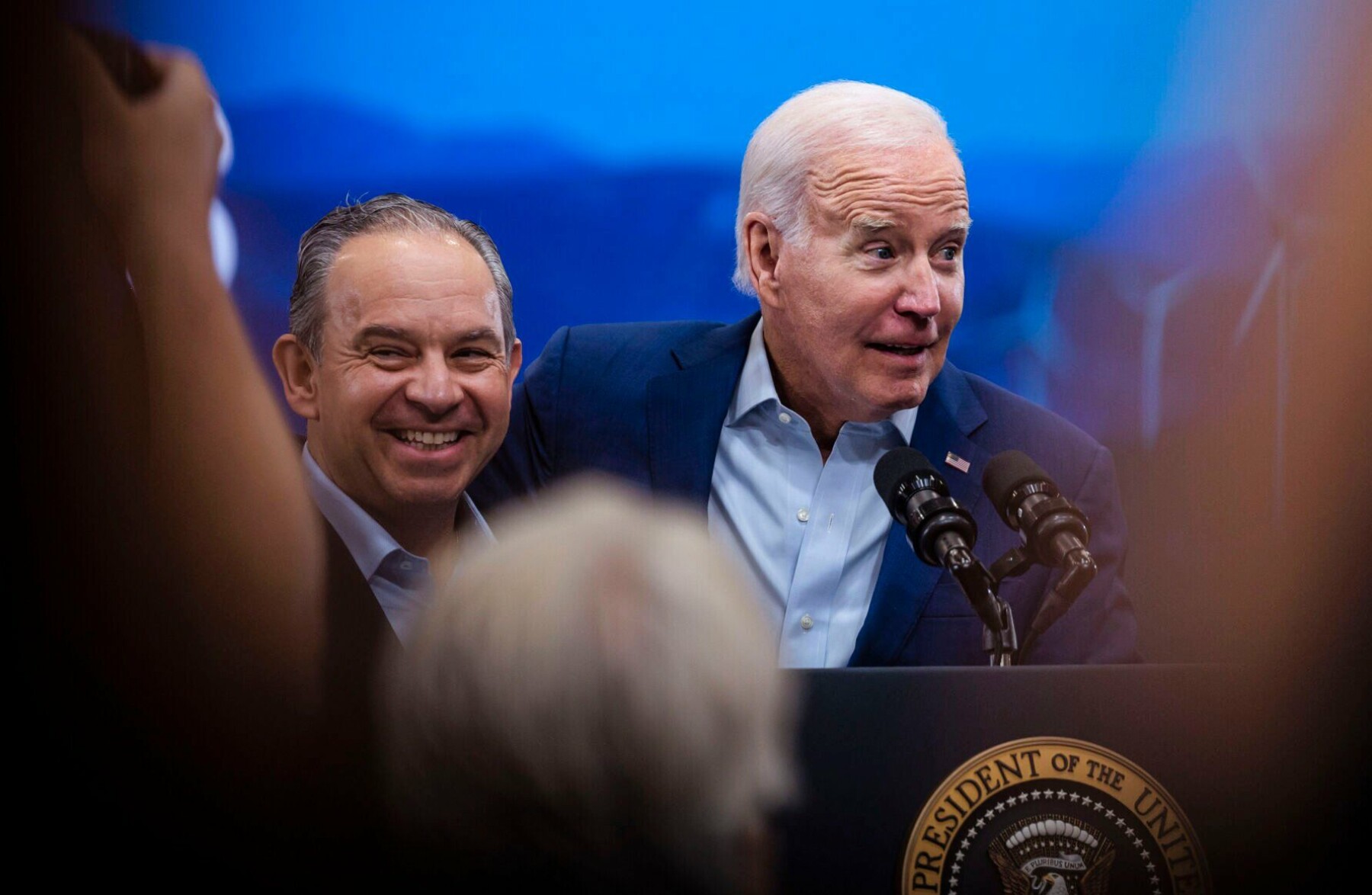
The planned facility was expected to create 250 jobs. Arcosa linked its investment to the Inflation Reduction Act and the demand for new wind projects. Those expectations were part of a particular moment, with an order book and policy framework behind them. They help explain the visit without turning an investment announcement into a promise that industrial demand will proceed in a straight line.
For Carrillo, the occasion brought several parts of the job into the same room. A plant has to serve customers, employ people, justify investment and operate within public policy. A presidential visit makes the intersections conspicuous. The operating work continues after the microphones leave.
The other side of the boardroom table
Carrillo joined NRG Energy’s board in 2019 and became its non-executive chair on April 30, 2026. Robert Gaudette became NRG’s CEO on the same date. The separation of the roles gave Carrillo an oversight position at an energy business while his executive background remained rooted in industrial operations.
His published views on boards emphasize agreement about strategy, clarity about responsibilities and room for directors to disagree respectfully. Communication should prevent important developments from arriving as surprises. He has also argued for separating the chair and CEO roles, with a lead director taking on particular importance when the positions are combined.
That distinction has a certain discipline of its own. An executive accustomed to solving operating problems must recognize when the task is to question, evaluate and oversee. Experience is useful at the table; so is knowing whose decision it is.
Carrillo has connected diversity on boards with seeing risk from more than one perspective. His own cross-border career supplied a practical example of experience becoming relevant to a board’s needs: knowledge of Mexico helped explain his invitations to join Trinity and Dr Pepper Snapple. The connection was specific to their businesses.
The next owner, the same physical world
In June 2026, CRH agreed to acquire Arcosa for $150 a share in cash, an announced enterprise value of approximately $8.5 billion. By then, Arcosa’s construction materials platform included 109 quarries and yards, nine asphalt plants and nineteen terminals. Its aggregates shipments in 2025 totaled about 35 million tons. The engineered structures operation added exposure to energy transmission and related infrastructure investment.
Those figures describe the business CRH wanted to own. They also show where years of purchases and sales had taken Arcosa. Carrillo described the agreement as recognition of the effort to simplify the portfolio and build a more resilient company. The buyer’s rationale focused on aggregates and critical infrastructure products, the areas toward which that effort had been directed.
Shareholders approved the transaction in September. Completion followed on October 23, ending Arcosa’s run as an independent public company less than eight years after the separation from Trinity. The factories and quarries entered a larger organization. Roads still required materials, and electrical networks still required structures. Ownership changed around work that remained stubbornly physical.
A different subject next semester
There is another destination Carrillo has discussed: the classroom. He has taught finance at Instituto Tecnológico Autónomo de México. Asked in 2022 about his future, he mentioned eventually serving on more boards and teaching again, perhaps strategy, finance or mergers and acquisitions. His preferred arrangement included a different teaching subject each semester, so preparing the class would keep him learning.
That ambition gives the career an ending more interesting than another title. He once returned to a factory because he knew the work suited him. Teaching would ask him to take what he had learned there, and elsewhere, and make it intelligible to someone beginning. After years deciding which businesses belonged together, there would be a fresh problem to solve: what belongs in the next lesson?