There are several ways for a chief operating officer to test whether employees are paying attention. Eric Ashleman chose an electric guitar. In 2018, he played more than 20 songs while teams of IDEX employees competed to identify them. The repertoire included Deep Purple, AC/DC, and Led Zeppelin. For once, recognizing “Stairway to Heaven” counted as a workplace accomplishment.
The episode is a useful introduction to a business leader whose public vocabulary usually concerns focus, operations, and talent. Here was a different kind of demonstration: something learned through practice, performed in front of colleagues, with an invitation to join in. The guitar supplied its own introduction.
Ashleman became IDEX’s chief executive in December 2020, after years running its businesses and then its operations. His career offers a practical question for anyone responsible for a complicated organization: how do you give people a common way to work without making every decision for them?
Detroit before the portfolio
He grew up in Detroit, with automobile manufacturing all around him. At the University of Michigan, he studied economics and later earned an MBA. His working life took him through Lincoln Brass Works, AlliedSignal and Honeywell, and Danaher. The continuity is industrial work; the progression is toward responsibility for the people and processes that make it function.
At Danaher, Ashleman led operations and management teams across three business units, including turnaround assignments. Those situations helped develop his approach to concentrating effort on a small number of consequential business decisions. A turnaround makes prioritization an immediate problem. Attention, like money or production capacity, has a limit.
From 2006 to 2008, he was president of Schutt Sports, whose products included American-football protective equipment. Then he moved to IDEX. The industries changed, but the responsibilities remained tangible: products to make, teams to organize, customers whose requirements could not be satisfied by a handsome presentation alone.
One business, then the whole operation
Ashleman arrived at IDEX in March 2008 as president of Gast Manufacturing, a pneumatics business. Global Dispensing joined his responsibilities in 2010, adding automated color-tinting equipment for architectural coatings. It is an appealingly literal expansion of a manufacturing career: first moving air, then getting the paint right.
His assignments widened through group leadership roles. By the time IDEX appointed him chief operating officer in July 2015, he had been overseeing businesses representing more than half of company revenue. The new position made him responsible for operations across all IDEX business units, reporting to chairman and chief executive Andrew Silvernail.
The promotion announcement credited him with helping develop the operating model and the leadership bench. That pairing matters. A process can be written down quickly; preparing people to use judgment takes longer. In a company made up of specialist businesses, the second task determines how much useful freedom the first task can support.
Silvernail’s 2015 explanation also described how their jobs would fit together: Ashleman would oversee operations while the CEO concentrated on accelerating growth. It was a division of responsibility with consequences for both. One executive could spend more time on the company’s direction because another had responsibility for the recurring work across its businesses.
In February 2020, the board added the title of president. That October, it announced that he would succeed Silvernail as CEO on December 15. William Cook became nonexecutive chairman. The succession made an existing working relationship consequential: Ashleman had helped build the system he was now being asked to lead.
- 2008Joins IDEX to lead Gast Manufacturing
- 2010Adds Global Dispensing
- 2015Becomes chief operating officer
- 2020Named president, then chief executive
The arithmetic of attention
The shorthand is 80/20. At IDEX, it means examining which markets, products, and customer opportunities deserve the greatest share of resources. The point is to reduce complexity and direct effort toward work with greater value. It is a method for making choices, rather than a claim that every business produces an exact mathematical split.
That distinction saves the idea from becoming office numerology. A manager still has to identify what customers value, understand the work involved, and decide where resources will help. Printing two numbers on a slide does none of those jobs. The difficult part begins when choosing a priority requires giving something else less attention.
Ashleman and his teams developed and piloted elements of the IDEX Operating Model. Alongside 80/20, it includes talent reviews, daily management, monthly business reviews, and goal deployment. Together, those practices connect decisions about direction with recurring conversations about people and performance. The organization gets a rhythm; local teams still have work to interpret and execute.
The talent cycle makes that framework personal. IDEX describes reviews in which business leaders assess workforce needs and individual development goals. Monthly reviews, meanwhile, examine individual and product-line scorecards. These are different conversations, but they meet at a practical point: a strategy requires both someone prepared to carry it out and a way to see whether the work is progressing.
The attraction is understandable. A collection of specialist manufacturers needs some shared language, particularly when it adds businesses. It also needs people who understand particular customers and products. The operating model supplies a framework for that tension. Its usefulness depends on whether a review produces a better decision when the meeting is over.
A conceptual guide to IDEX’s operating practices, not a chart of measured results.
What the new chief executive talked about first
On the February 2021 earnings call, analyst Deane Dray asked where Ashleman would put his own imprint on IDEX. It was an invitation to describe a new chief executive’s priorities. Ashleman began with culture and the ability of people throughout the company to adjust course without waiting for extensive direction from the top.
“I would actually start with the cultural aspects.”
Eric Ashleman · February 2021 earnings call
He also described a $6 million commitment to the IDEX Foundation and plans to use employee focus groups to help shape the company’s inclusion work. Those were specific organizational choices: funding, listening, and assigning leadership responsibility. They made his answer more concrete than the familiar executive promise that people would always come first.
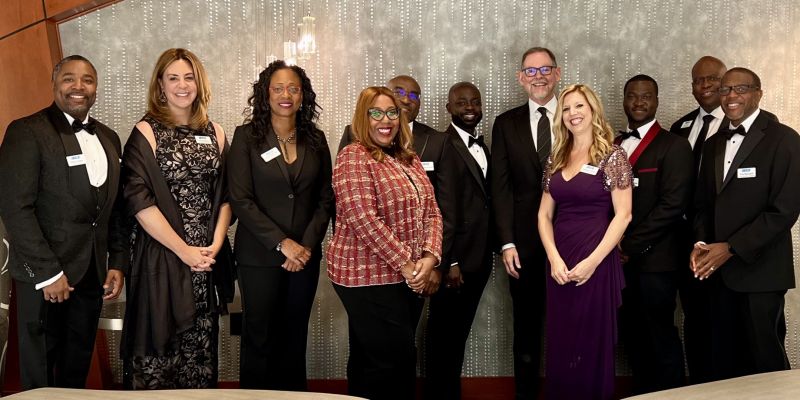
In 2023, Ashleman attended Executive Leadership Council events with IDEX colleagues, including members of the executive team and director Lakecia Gunter. The photograph from that gathering shows another part of a chief executive’s working life: being present alongside colleagues outside the quarterly reporting routine. His accompanying public post expressed gratitude for sharing the events with them.
A billion-dollar test of the method
The acquisition of Mott put a larger sum behind Ashleman’s operating argument. In July 2024, IDEX announced an agreement to buy the company for $1 billion in cash, subject to customary adjustments. The acquisition closed on September 5. Mott brought expertise in porous materials and flow control, extending IDEX’s capabilities in applied materials science.
Its potential applications included semiconductor manufacturing equipment, energy, water purification, and space. These are fields where a component’s value depends on the demanding job it performs inside a larger system. Ashleman’s stated rationale emphasized technical capabilities and opportunities to work with customers, alongside the expected benefits of applying IDEX’s operating practices.
There is an important difference between acquiring expertise and making it useful across a company. By October 2024, Ashleman was reporting that teams from other IDEX businesses were already designing prototypes with their new Mott colleagues. IDEX leaders had also moved into Mott’s leadership. Those early actions gave the integration story something more substantial than a closing announcement.
The question for his leadership is how far that collaboration can travel while specialist teams retain their judgment. A larger portfolio offers more possible combinations, and more demands on management attention. The same discipline that helped him run individual businesses now has to guide decisions about which connections are worth pursuing across them.
Announced cash consideration, subject to customary adjustments.
Agreement: July 23 · Completion: September 5
The work beyond the quarterly call
Ashleman joined Modine’s board in February 2019, adding an outside directorship in another industrial company. He also chaired the Manufacturers Alliance Executive Committee. In July 2026, Rick Bucher succeeded him as chair; Ashleman remained on the committee as immediate past chair. His involvement extends his work into the wider community of manufacturing leaders.
When Modine appointed him, its board expanded from nine members to ten. The company’s announcement set out his experience across IDEX and earlier employers. The appointment gave his operating background a different use: contributing as a director rather than running the company. It added another perspective on manufacturing to a career already spanning several kinds of industrial products.
His public ambitions for IDEX include applying its capabilities to intelligent water, semiconductor fabrication, space technologies, rescue equipment, and energy transition. In his message for the 2024 sustainability report, he connected those opportunities with customer demands for speed and efficiency. Digital tools for pump and valve selection and greater automation in fire-and-safety systems were among the examples.
As of October 23, 2026, the next scheduled public checkpoint is the October 28 earnings call, with Ashleman and chief financial officer Sean Gillen. It will bring the usual questions about results and prospects. Behind those numbers sits the continuing management problem that has followed him from operating assignments to the chief executive’s office: what deserves the next hour, the next hire, the next investment?
A different sort of practice
Outside work, Ashleman plays and records music, reads history and literature, and enjoys travel and the arts with his wife. They have four grown children and a house dating from the 1920s that keeps generating maintenance and restoration work. An old house has a reliable talent for supplying its owners with fresh priorities.
These details give the operating executive some welcome texture. His public story contains a succession plan, an acquisition, and a management system. It also contains someone willing to bring an electric guitar to work. The employees in that 2018 competition had a fairly straightforward assignment: listen carefully, recognize what matters, and name the tune.