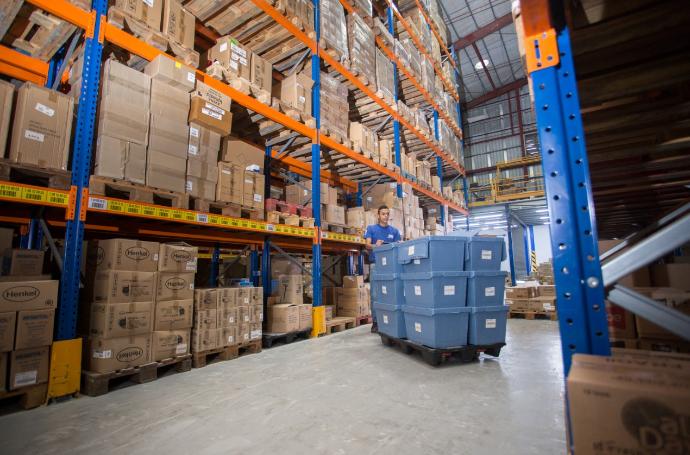
Consider a jar of hair relaxer. Its label has one job: persuade someone to pick it up. Behind that small decision sits a much less visible sequence: ingredients tested, packaging checked, stock counted, an order taken, a delivery made. In Panama, Agencias MOTTA S.A. works across that sequence. The company that began with perfume distribution also belongs to a group that makes personal-care products. Looking at its warehouse and laboratory together explains more than either picture alone.
- Represents consumer brands and supplies retailers across Panama.
- Makes personal-care products through sister company Envasadora Comercial.
- Combines outside brands, factory brands and private-label services.
A purchase, then a different bet
In October 1967, Roberto Motta Jr. bought a perfume-and-cosmetics distribution business from his uncles, Arturo and Alberto Motta. Three years later, he established Envasadora Comercial. The first business moved products someone else had made. The second developed and manufactured products of its own. That gave the group a place on both sides of a commercial relationship: bringing brands to market and creating goods to sell.
The range widened. The company dates its move into nutraceutical distribution to 1989. Today its published categories include health and wellness, personal care, hair care, household cleaning, school and office supplies, and pet care. A school notebook and a hair treatment make odd neighbors in a shopping basket. They make more sense beside each other in a distributor’s catalog, where the shared problem is reaching buyers.
The customer behind the customer
AMSA serves two constituencies. A brand owner wants a route into Panama. A retailer wants goods available to sell. The company’s chamber-of-commerce recruiting profile describes exclusive distribution of more than 50 brands and coverage from Paso Canoa to Darién. Its services page lists supermarkets, pharmacies, wholesalers, department stores, mini-super stores and corporate buyers. Those channels put its work behind many different kinds of checkout.
For a supplier, the offer combines national representation, commercialization and distribution. For a shop, the useful result is access to a portfolio of goods through a local commercial operation. AMSA also lists an online store and its I AM... retail outlet. But the wider story is the relationship between manufacturers and the businesses that put products in consumers’ hands. That is where a distributor earns its place.
A public brand-manager vacancy makes the relationship unusually concrete. Alongside developing brands, the role watches budgets, margins, inventory rotation and commercial performance. In that job description, marketing has to live with the stock. A persuasive campaign cannot settle the question of how much merchandise should be sitting in a warehouse. Someone has to reconcile the promise with the order book.
or makeInternational brands
+ ENCOSA products
and sellInventory, orders
and delivery
the buyerRetail, wholesale
and direct channels
The factory changes the conversation
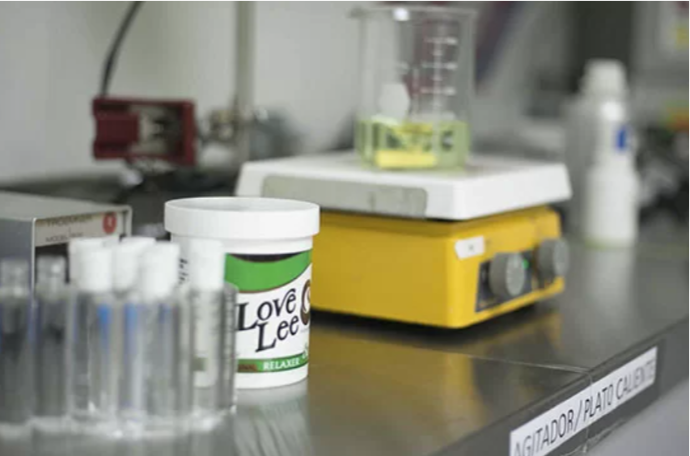
Envasadora Comercial, often called ENCOSA, gives the group another capability. It develops and manufactures personal-care, skin-care and hair-care products. Love Lee, Fresh Hands and Naturals by Nutrine appear in AMSA’s own account of its factory brands. The manufacturer describes inspections of inputs and packaging, plus laboratory work covering raw materials, physical and chemical analysis, microbiology, stability and pilot tests.
That list matters because making a cosmetic involves more than choosing a scent and printing a bottle. A product has to survive the journey from formulation to use. AMSA also advertises private-label development and filling. For a business exploring its own brand, those are specific services to discuss: what can be formulated, how it will be packed, how it will be tested and how it might reach the market.
The manufacturing story extends beyond Panama. The company’s history names Colombia, Puerto Rico, Costa Rica and Nicaragua as export markets. Spain’s ICEX also included ENCOSA among Panama’s local cosmetics and personal-care producers in its 2021 market study. AMSA therefore occupies overlapping positions: a distributor for outside brands, a route to market for its group’s products and a provider of manufacturing services.
Growth made the plumbing matter
The distribution center opened in 2010. AMSA’s services page now describes facilities in the capital, Chiriquí and Divisa, with cross-docking capability. In practical terms, cross-docking allows goods to pass through a facility toward their next destination with less intervening storage. The company’s published network addresses a straightforward problem: products have to get beyond the capital to reach a national market.
In 2015, according to its history, growth in its consumer categories prompted a strategy review and a decision to concentrate on mass-market goods. The operational changes have their own chronology. AMSA dates SAP implementation to 2015, the SAP warehouse-management module to 2018 and a Tableau business-intelligence update to 2021. These were additions across several years, each attached to a different part of running the business.
- 2015SAPCompany operations and records
- 2018SAP WMSWarehouse activities and inventory
- 2021TableauDashboards across business functions
Its current tools list also includes Pepperi for sales activity, Nash for inventory and replenishment, Forecast Pro for demand planning, and SimpliRoute for delivery routing. The useful lesson is to identify the decision each system supports. What should be bought? Where is it? Who ordered it? How will it arrive? Software becomes easier to understand when its job is that specific.
“Nuestra mayor inversión es en el equipo de gente que ejecuta e implementa...”
Roberto Motta III, on the company website
What another business can borrow
The copyable idea is the connection between market access and operating capacity. A supplier considering Panama can use AMSA’s published services to frame a practical discussion about channels, brand representation, manufacturing and delivery. A retailer can start with the catalog. Neither conversation needs to begin with a grand theory of growth. It can begin with the product and the buyer it needs to reach.
The model also has conditions. As a business inference, a broad distribution operation needs enough demand to justify inventory and delivery work; a small, specialized launch may need a narrower arrangement. Manufacturing adds testing and packaging obligations of its own. AMSA’s story makes those tasks visible. The jar on the shelf is a tiny object. Keeping it there is a substantial business.