At sixteen, Scott Barbour was washing dishes at Jesse’s Steaks, Seafood & Tavern in Hanover, New Hampshire, when the prep cook failed to appear. The manager promoted him on the spot. Training consisted, as he remembered it, of changing his shirt. Dinner still had to happen. Somewhere between the sink and the kitchen counter lay an early lesson in how organizations actually function: eventually, someone has to do the work.
Barbour would go on to study mechanical engineering, earn an MBA and run businesses across continents. Since September 2017, he has been president and chief executive of Advanced Drainage Systems, the Ohio company whose pipes and underground chambers give rainwater somewhere to go. His subject has changed considerably since the restaurant. His interest in the machinery of getting things done has proved rather durable.
A drainage business offers a particular education in usefulness. Its work is often buried. People can enjoy a school, a road or a parking lot without sparing a thought for what sits underneath. A CEO in this business must persuade customers to care about the system before they need it.
A southern accent in New England
Barbour was born in Pine Bluff, Arkansas, and grew up with a family willing to move for work. New England meant new people and a conspicuous accent. He has described those moves as an education in dealing with different cultures, an apprenticeship that later made a much longer journey feel possible.
In 2008, he moved to Hong Kong with his wife and three children for an Emerson assignment. The financial crisis began soon afterward. His family stayed until 2011. He remembered the experience warmly: the business challenges were considerable, and so were the possibilities of living somewhere unfamiliar. Moving a family overseas is a fairly thorough way to test whether curiosity survives the packing.
He later connected his experience in Asia with the daily work of a chief executive. Often the only Westerner in a meeting, he had to learn to work through other people. It is a useful correction for an engineer accustomed to solving a problem himself. An organization requires more hands than one person possesses.
The engineer who liked the accounting
His formal training began with a mechanical engineering degree at Southern Methodist University. His early professional work was as a product engineer at Colt Industries. Engineering supplied a way to understand products; business school broadened the room.
At Vanderbilt’s Owen Graduate School of Management, where he earned his MBA in 1989, Barbour deliberately pursued manufacturing and product work while many classmates pursued consulting. He valued the exposure to people from other industries. Accounting turned out to be particularly useful, giving him the confidence to debate details with a controller.
There was another kind of lesson in his last semester. Asked to tutor a first-year student named Cami, he helped her through unfamiliar economics and finance material. When she reported her successful exams, the meeting ended in tears. For someone whose later career would involve considerable sums, it is a telling memory to keep: another person learning to do something she had found difficult.
Emerson became his professional school for the next 27 years, from 1989 to 2016. He worked through product, commercial and operating responsibilities, including leadership of air conditioning and Asia Pacific businesses. In 2011 he took responsibility for Network Power, ultimately serving as president and CEO of a business with roughly $4.5 billion in sales.
Those jobs gave him experience with engineering, markets and international operations. They also brought him into the difficult business of a divestiture. Helping execute the sale of Network Power was part of his preparation for leading ADS. His route to the chief executive’s office included learning how a business changes hands.
Fifteen facilities and a standing lunch
At ADS, Barbour succeeded Joe Chlapaty, who had spent 37 years with the company. A long-serving predecessor leaves knowledge, loyalties and habits that no appointment letter transfers automatically. Barbour kept a monthly lunch with Chlapaty and called him with questions. Experience remained available across the table.
He also visited about fifteen of the company’s forty-eight facilities in his first nine months, including operations in California, Texas and Florida. Being visible meant letting employees hear what he was learning and asking them questions. A new chief executive can have a crowded diary and still learn remarkably little if every appointment is in the same office.
Arriving in the middle of a fiscal year, he first helped the team pursue its existing plan. A budget and a three-year strategy followed. Growth, margins and cash were central. The sequence matters: he began with obligations already on the calendar, then worked on what the business could become.
“You control your own destiny.”
Scott Barbour, on generating cash
Rainwater has a route
To understand Barbour’s decisions, follow the water. A drain captures runoff. Pipe carries it. Storage holds it when a site needs to control its release. Treatment removes pollutants before the water returns to the watershed. ADS sells across these stages; its Infiltrator business also supplies onsite wastewater systems.
That gives Barbour a larger set of questions than how to sell another length of pipe. Where does a customer’s project begin? Which component follows the last one? What can the company make, acquire or improve so that more of those components work together?
The 2019 purchase of Infiltrator Water Technologies made this thinking concrete. The businesses had worked together for more than fifteen years, including a joint venture called StormTech. Infiltrator brought onsite wastewater products and expertise in recycled polypropylene, adding capabilities alongside ADS’s established work with recycled polyethylene.
The deal closed on July 31, 2019. Infiltrator’s management stayed to run the business. There is a recognizable practicality here: buy something you understand, preserve the knowledge inside it, and make use of what each side knows. The purchase expanded a product range and a materials toolkit at the same time.
A laboratory with room for the rain
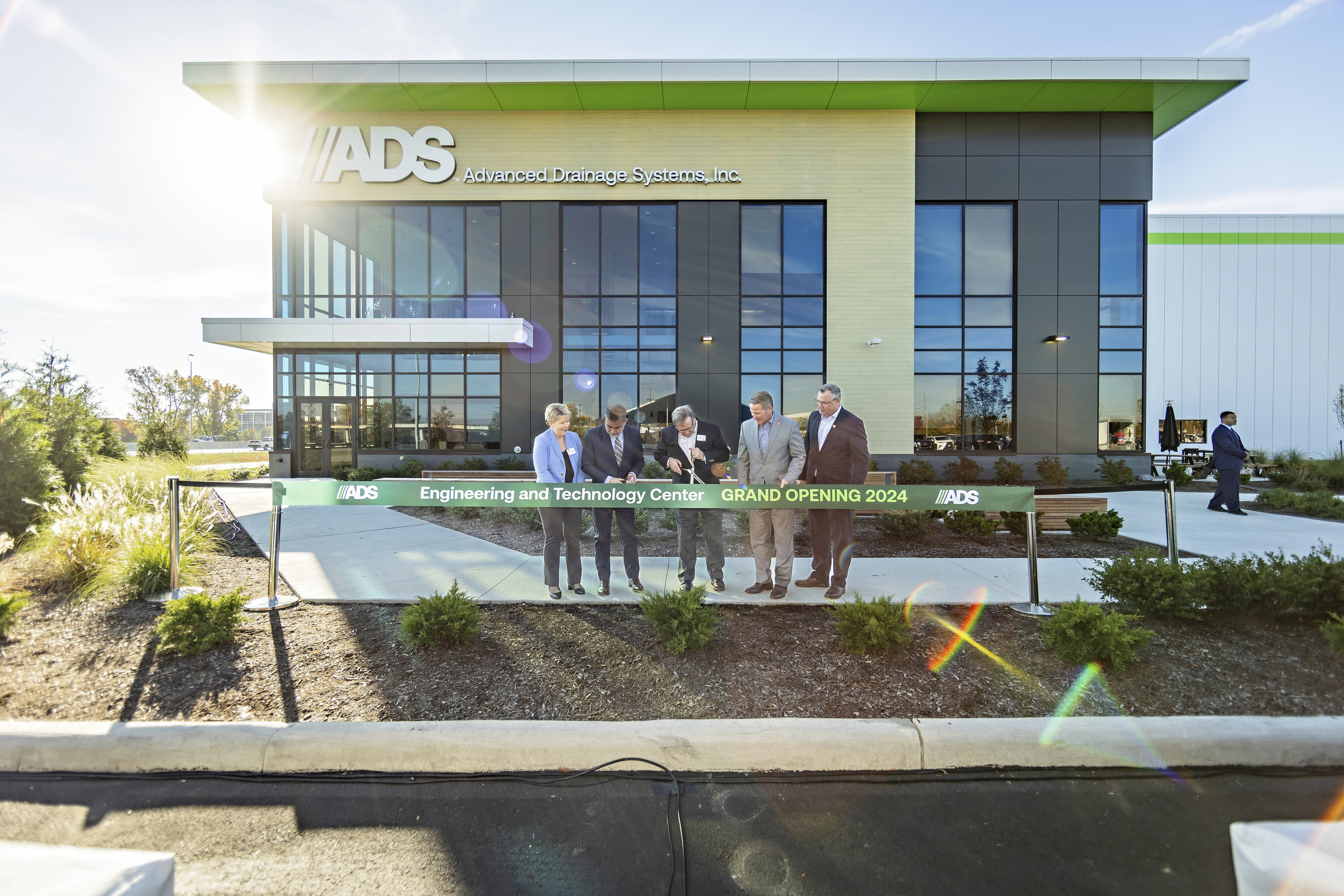
In October 2024, ADS opened a $65 million Engineering and Technology Center in Hilliard. Its 110,000 square feet brought together product engineering, materials science and manufacturing technology. A 90,000-gallon closed-loop water system allows products to face controlled tests that reproduce conditions outside.
For Barbour, the building put related skills in one place: the people who understand materials, the people who design products and tools, and the people who know how to manufacture them. A pipe leaves the factory as one object. Producing it reliably draws on several kinds of knowledge.
The investment also supports the complicated work of using recycled plastic. ADS reported purchasing 540 million pounds of recycled material in fiscal 2024. Recycled feedstock accounted for half its material mix that year. Those numbers describe a manufacturing requirement as much as an environmental ambition: incoming material must become a dependable finished product.
A detergent container’s second career in drainage pipe is an appealing image. The laboratory supplies the less picturesque work behind it. Materials have to be understood, blends tested and performance checked. Barbour’s engineering background gives him a direct connection to that work, even as his own job increasingly involves deciding how to fund it.
Knowing what to keep, and what to buy
In February 2026, ADS completed its acquisition of NDS, adding residential stormwater and irrigation products. The company said the purchase was financed primarily with cash on hand. It is a tangible consequence of Barbour’s longstanding attention to cash generation: money produced by the business can pay for the next piece of it.
The results have also grown. For the quarter ended June 30, 2026, ADS reported sales of $1.001 billion, up 20.6 percent from the previous year. The acquired NDS business contributed $94.7 million. Within stormwater, organic sales rose 9.7 percent. Both the purchase and the existing operations mattered.
On October 5, ADS announced an agreement to acquire StormTrap for approximately $530 million. The proposed transaction would add capabilities in large-volume stormwater storage, including projects with tight space constraints. It was expected to close in the fourth quarter of calendar 2026, subject to regulatory approvals and other customary conditions.
StormTrap also brings relationships with precast concrete suppliers. For a company identified with plastic pipe, that is an interesting extension. The customer’s problem is water storage; the answer depends on the site. Barbour’s expanding portfolio follows that practical question into a broader range of projects.
A plan with permission to change
In May 2026, Barbour returned to Vanderbilt to address Owen’s graduating class. Before accepting the invitation, he had let the email sit for several days. His daughter persuaded him, with the sensible qualification that he should avoid talking too long. Every speaker should have access to such an adviser.
He told the graduates: “Your plan will not happen in a straight line.” His own working life supplies the illustration: restaurant shifts, engineering, business school, international assignments, a divestiture, then responsibility for a company whose work largely disappears underground.
A plan gives decisions a direction. It still needs people who can change a shirt, enter an unfamiliar meeting, learn a new subject or make an old product better. Barbour has spent a career among them. The rain, meanwhile, keeps providing assignments.