A swimming pool has two lives. One is photographed: blue water, a chair, someone deciding whether to get in. The other hums behind the landscaping. Water moves through a pump, a filter, a heater and a sanitizing system. The postcard depends on the plumbing. Hayward Holdings, Inc. has spent decades making that second life easier to run, and turning its upkeep into a business that continues after the construction crew leaves.
- The product: the machinery and controls behind residential and commercial pools.
- The engine: replacement and upgrade demand from pools already in the ground.
- The catch: dependable maintenance needs still meet unpredictable distributor orders.
01 / The pool is already there
Consider the distinction between selling a pool and selling what keeps it working. A household can postpone construction. An existing pool still needs circulation and clean water. In July 2026, Hayward estimated that the aftermarket represented approximately 85% of its North American residential pool net sales. That includes repair, replacement, remodeling and upgrades. It is a management estimate, but it explains the company's center of gravity.
Still buying.
North American residential pool net sales. Company estimate, July 2026.
Its customers include distributors, retailers, builders and service professionals; homeowners and commercial operators use the equipment. A technician's recommendation matters because the purchase involves plumbing, electrical connections and compatibility. Hayward calls this a prescriber model. The person who understands the equipment can strongly influence the person paying for it. A useful product therefore needs an installer willing to recommend it.
02 / First, change the material
The business traces its roots to Irving Hayward's metal foundry, established in 1925. Oscar Davis bought it in 1964. Davis had worked with plastics and saw an opening: pool equipment could be made from plastic. Hayward's own history presents that material change as a route to performance, reliability and affordability. The breakthrough began with how ordinary components were manufactured.
A trade-publication account adds an excellent detail. Earlier in his career, Davis worked with hard rubber, a material that tolerated harsh chemicals but smelled unpleasant. He explored thermoplastics such as PVC and polypropylene. At Hayward, he saw room to mass-produce products that had often been custom-made. Manufacturing knowledge supplied the commercial idea.
Expansion required capital. In 1969, Davis briefly took the company public to finance plants and injection-molding equipment, later buying back the shares. Hayward returned to public markets in 2021 at $17 a share. That offering totaled about $684.7 million, including shares sold by existing holders; Hayward itself offered $377.4 million of new shares before fees. Those are different pots of money.
03 / Give the pump a phone
Today's catalog covers pumps, filters, heaters, cleaners, sanitizers, lighting and water features, alongside industrial flow-control products. The central proposition is coordination. Variable-speed pumps let operators adjust circulation; connected controls make schedules and settings easier to manage. The benefit is practical: fewer separate tasks between wanting a swim and having a pool ready for one.
“The Omni platform is all about simplicity.”
Matt Kimball, Hayward vice president of marketing, 2022
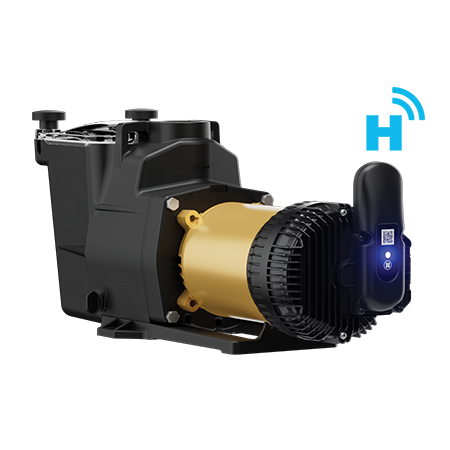
OmniX pushes intelligence into compatible equipment rather than requiring a central automation panel. An owner can start with one smart product and expand. Local control uses Bluetooth; an optional, separately sold gateway connects the system to home Wi-Fi for remote access. Compatible XE Series pumps can receive retrofit kits. It gives an equipment replacement a second purpose: an entry point into automation.
There is a real purchase price. Hayward's minimum advertised price schedule, effective April 1, 2026, lists the Super Pump VS 615 with OmniX at $1,699 and the TriStar VS 2.7 at $2,699. Those are advertised equipment-price benchmarks, not installed quotes. Labor, plumbing changes and accessories change the bill. Buyers should ask an installer to check hydraulic requirements, existing controls and gateway needs before selecting a model.
- 01ReplaceChoose compatible equipment.
- 02ConnectSet schedules in the app.
- 03ExpandAdd devices as needed.
Hayward competes with Pentair and Fluidra, whose brands include Jandy. Connected equipment and efficiency are contested territory. Hayward's particular pitch combines its equipment range, professional relationships and gradual upgrades. Its 2022 Savant integration also brought OmniLogic control into that home-automation system. Compatibility remains specific to the product and platform; a smart label alone does not establish that everything will work together.
04 / The warehouse gets a vote
The replacement argument has limits. In 2023, net sales fell 24% to $992.5 million. Hayward attributed the decline primarily to softer end-market demand and distributor destocking. Pools still existed. Distributors could nevertheless order less while using inventory already on their shelves. Repeat demand at the pool did not translate into steady orders at the factory.
The company responded with cost controls and continued work on connected products. By 2025, annual net sales reached $1.122 billion, up 7%. Second-quarter 2026 sales rose another 6% year over year to $318.4 million, although Europe and the rest of the world declined. Recovery was uneven. The latest announcement schedules third-quarter results for October 28, 2026.

05 / Sell the next useful improvement
Commercial water treatment adds another route. Hayward acquired ChlorKing in June 2024; its subsequent investor presentation put the acquisition at $55 million. ChlorKing brought saline chlorination, on-site chlorine generation and ultraviolet disinfection systems. At the announcement, ChlorKing reported more than 17,000 commercial swimming-pool and water-park installations worldwide. The deal bought specialized technology and a customer base with ongoing operating needs.
The transferable lesson is specific: make the next necessary purchase improve the whole system. Hayward can sell a replacement pump that also adds control, then offer further compatible equipment. That approach needs an installed base, trusted technicians and benefits that justify the bill. It becomes harder when existing equipment works well, installation costs overwhelm savings, or a buyer's preferred controls cannot connect. The ordinary pump is a surprisingly good place to study repeat business.
Take a closer look
Watch the equipment: VS Omni overview · AquaRite S3 overview · Official YouTube channel