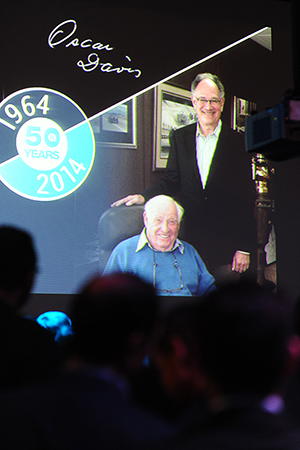
At the Hayward anniversary party in Lyon, Robert Davis brought family photographs. Around him, the entertainment included musicians inside giant bubbles, soap-bubble performers and an underwater-themed room. A swimming-pool equipment company had allowed itself a little theatrical excess. After fifty years of family ownership, perhaps the pumps could have the evening off.
Davis had come from the United States to look back at a business his father, Oscar, bought in 1964. The celebration, held alongside the Piscine Global exhibition in November 2014, gathered 250 customers and partners. His presentation traced the company's development through pictures from the family archive. He thanked employees, distributors and customers, putting faces and relationships alongside the equipment.
Three years later, the family would agree to sell. Davis, by then co-chairman, would speak publicly about approaching retirement. The anniversary and the sale make useful bookends: one evening devoted to remembering how a family business grew, followed by a decision about who should own its future.
A surname behind somebody else's name
Hayward was already a company before the Davises arrived. Founded in 1925, it kept the name of its earlier owner. Oscar bought it in 1964 and developed its pool-equipment business. Robert eventually succeeded him as chief executive in 2002. He had a long apprenticeship in the enterprise: by his own later account, father and son worked together for 42 years.
Robert remembered visiting the old offices as a boy, a place whose accountants wore visors and sleeve bands. It was an unusually vivid introduction to manufacturing administration. In his recollection, the rooms belonged to an earlier cinematic age. The business he would later lead became international, but his account of its beginnings stayed close to a particular workplace.
He also remembered a family joke about spending. A new desk could be a difficult purchase to get approved; a new machine could receive a much warmer reception. The explanation was short: “Furniture doesn't make money.” It is an economical description of a manufacturing household's priorities, and a useful warning to anyone arriving with an expensive office-furniture catalogue.
“Furniture doesn't make money.”A family-business adage recalled by Robert Davis
The machinery mattered because Hayward's business involved producing the working parts behind a pool: equipment whose contribution is usually easier to notice when something stops working. Robert inherited a company already shaped by his father's interest in plastics, production and expansion. His own period of leadership would add further businesses and a wider geographic reach.
The swimming pool has a supply chain
A pool presents a pleasantly simple surface. Underneath that impression sits a collection of separate jobs: moving water, filtering it, heating it, cleaning the pool and controlling the equipment. Hayward's acquisitions during Davis's leadership make more sense when read as additions to those jobs. The purchase announcements describe particular capabilities and particular markets, rather than an abstract appetite for size.
In September 2008, Hayward announced the acquisition of Summit Pool Heaters, a Canadian heat-pump manufacturer. The plan was to bring Summit's products into Hayward's worldwide sales and marketing organization before the 2009 pool season. That timetable attached the transaction to a familiar commercial deadline: the next season's customers.
Davis described the acquisition as part of a strategy to expand the company's international presence. He also pointed to opportunities for heat pumps in newly built pools and in the aftermarket. The distinction is practical. A manufacturer can sell into a pool being constructed, then encounter another customer improving equipment around a pool that already exists.
Summit's manufacturing operations in Quebec and its management team were part of the announcement, too. The people running the acquired business were to remain in important roles. Growth here involved bringing an existing product organization into a larger selling network. A pool heater would travel farther because the company behind it had acquired new routes to customers.
Different transactions added different things: heating, market access, cleaning technology and manufacturing capacity.
Ten years before the paperwork
In 2011, Hayward bought a majority interest in Clevaquip, a Melbourne distributor. Davis's remarks emphasized the decade-long business relationship that preceded the deal. He named managing director Tony Sharpe and the team that had represented Hayward in Australia, explaining that familiarity had produced respect for their work.
Sharpe would continue leading the operation, which would trade as Clevaquip, a Hayward company. The announcement credited him with more than 25 years in Australia's pool market. This was a transaction with a local memory: the distributor had knowledge and relationships Hayward already knew through experience.
The ten years are worth pausing over. Acquisition stories often begin with an agreement. This one had a substantial first act before anyone announced a majority shareholding. Davis could describe the prospective relationship by referring to a working relationship that already existed.
Australia also helps explain the international character of his job. A New Jersey manufacturer could expand by adding a business with its own regional understanding. The ownership changed; the local leader remained. That combination gave the announcement a human center, in the person expected to carry on serving the market.
The deal that stayed a proposal
Expansion did not make every proposed combination inevitable. In February 2012, Hayward confirmed that discussions to acquire Maytronics had ended. The companies had signed a letter of intent and were negotiating, but the transaction needed approval from Maytronics shareholders.
Maytronics sought an early view from its controlling shareholder, Kibbutz Yizrael. The kibbutz's general membership voted against the proposal. Davis expressed disappointment, saying the combination would have offered customers additional choice and value. The discussions stopped there.
The episode supplies a useful interruption in a sequence of completed purchases. A letter of intent begins a process; the people with voting authority still have a decision to make. Hayward's preferred outcome could not settle that question for them.
By December 2013, another cleaner transaction had gone through. Hayward acquired Poolvergnuegen, effective December 20. Davis singled out its technology, dependable products and customer focus, alongside its position in the western United States and some international markets. Cleaner design was a specific addition to the company's range.
Poolvergnuegen's chief executive, Dieter Rief, welcomed the move into Hayward. The announcement presented the acquisition as a way to extend the cleaner business's growth and widen customer choice. For Davis, it was another example of acquiring a company with an established product identity and then placing that work within a larger organization.
Europe required an address
At the 2014 anniversary, Davis was also celebrating forty years of Hayward Pool Europe. He described an evolution from exporting products to establishing manufacturing and distribution on the continent. The distinction had consequences: participating in a market meant operating there.
The European business had moved through locations in Belgium before settling near Lyon. Davis said he wanted a stronger European presence, closer to the company's position in North America. His assessment combined satisfaction with the team and results with an appetite for more business.
“We may be pleased but we are never satisfied!”Robert Davis, on Hayward's European business, 2014
In July 2016, Hayward announced its purchase of Kripsol Group, based in Yuncos, Spain. Its portfolio included pumps, filters, lights, ladders, controls and salt chlorinators. President Clark Hale connected the purchase to manufacturing close to customers. Kripsol was to continue operating as a separate entity.
Later that year, international vice president Richard Lachance explained the European logic in more detail: local production would help serve local markets and develop products for them. The acquisition also brought two industrial sites. The European ambition Davis had described now had additional factory addresses.
Making room for the next owners
Leadership was changing before ownership did. In October 2012, Hayward named Clark Hale president and chief operating officer. Davis, identified as chief executive, welcomed him to oversee global operations and help address demand for more sophisticated products and new markets.
Hale arrived with executive experience at Brooks Instrument, Victaulic and Emerson Electric. His appointment placed an experienced industrial operator alongside Davis. By the June 2017 sale announcement, Hale was president and CEO, and Davis was co-chairman. The transition therefore involved both a leadership structure and a change of shareholders.
The buyers were a partnership led by CCMP Capital Advisors and MSD Partners, with Alberta Investment Management Corporation also participating. Hayward described more than fifty years of Davis-family ownership and a business selling a broad collection of residential and commercial pool equipment worldwide. Davis spoke of pride in the team's work and confidence in the incoming ownership.
Hale was expected to remain with the executive team. For the family, the transaction marked an exit; for the operating business, there was continuing management. Hayward later completed its initial public offering in March 2021, several years after the family sale.
Return to the Lyon photographs and the distinction becomes clearer. Davis had stood before customers and partners to tell a shared history, with his father in the pictures. When the time came to sell, he treated that history as something another owner could carry forward. The surname behind the business would change. The name on the equipment would still be Hayward.