Three people in a Markham townhouse: it is an appealingly domestic beginning for a business that would eventually need automated cutting tables. Before the machinery, before the production floor, there was a small team and the problem that would occupy much of Todd Godin’s working life. A client wanted something made. Somebody had to take responsibility for getting it done.
Godin Productions began in 1989. Todd, a founder and its former chief executive, helped build a business in the physical end of marketing: print, packaging and the displays that ask for a shopper’s attention. It is a world where an idea eventually has to bear weight. Quite literally, sometimes. Cardboard has limited respect for a persuasive presentation.
Three people, one townhouse
The townhouse detail comes from the company’s retirement tributes. In one, his brother recalls the distance between their childhood relationship and their working partnership. They had not always got along growing up. Other people warned against going into business together. Working together, he says, produced trust and respect.
It is a useful complication to the tidy family-business story. A shared surname does not settle who should make a decision, how a disagreement should end, or whether a promise to a customer is realistic. Family familiarity comes with plenty of information. Some of it is decades out of date.
The tribute describes Todd’s calm leadership, ethics and concern for people. Those are his brother’s judgments, offered at the end of a long partnership. They give the company’s growth a more personal scale. The people building the business were also discovering how to work with one another.
The work between the idea and the aisle
Godin’s company describes its offer as a single point of contact for print, point-of-purchase displays and packaging. That phrase sounds administrative until you consider the alternative: a customer coordinating several specialists, each responsible for a different piece of the finished object.
A display has several audiences before a shopper sees it. A designer needs a workable structure. A production team needs specifications it can execute. The people moving and assembling it need something that survives the journey. Each stage can expose a problem the previous stage had politely left for later.
In his company leadership biography, Godin places customer service at the center of his purpose as a founder. He connects it with production efficiency, and lists process improvement, operations management and company culture among his responsibilities. These concerns belong together. A promise made in a client meeting eventually becomes somebody’s task on the floor.
There is a particular kind of satisfaction in this work. An abstract request becomes a physical object with edges, dimensions and a destination. There is also very little room to argue with the result. A display that will not assemble has already delivered its review.
A factory enters the picture
For more than three decades, the business largely arranged production through outside suppliers. Godin later described a deliberate move into manufacturing, seeking more capability and greater control. Structural design came inside. An automated Kongsberg C64 cutting table followed, then printing equipment and additional cutting capacity.
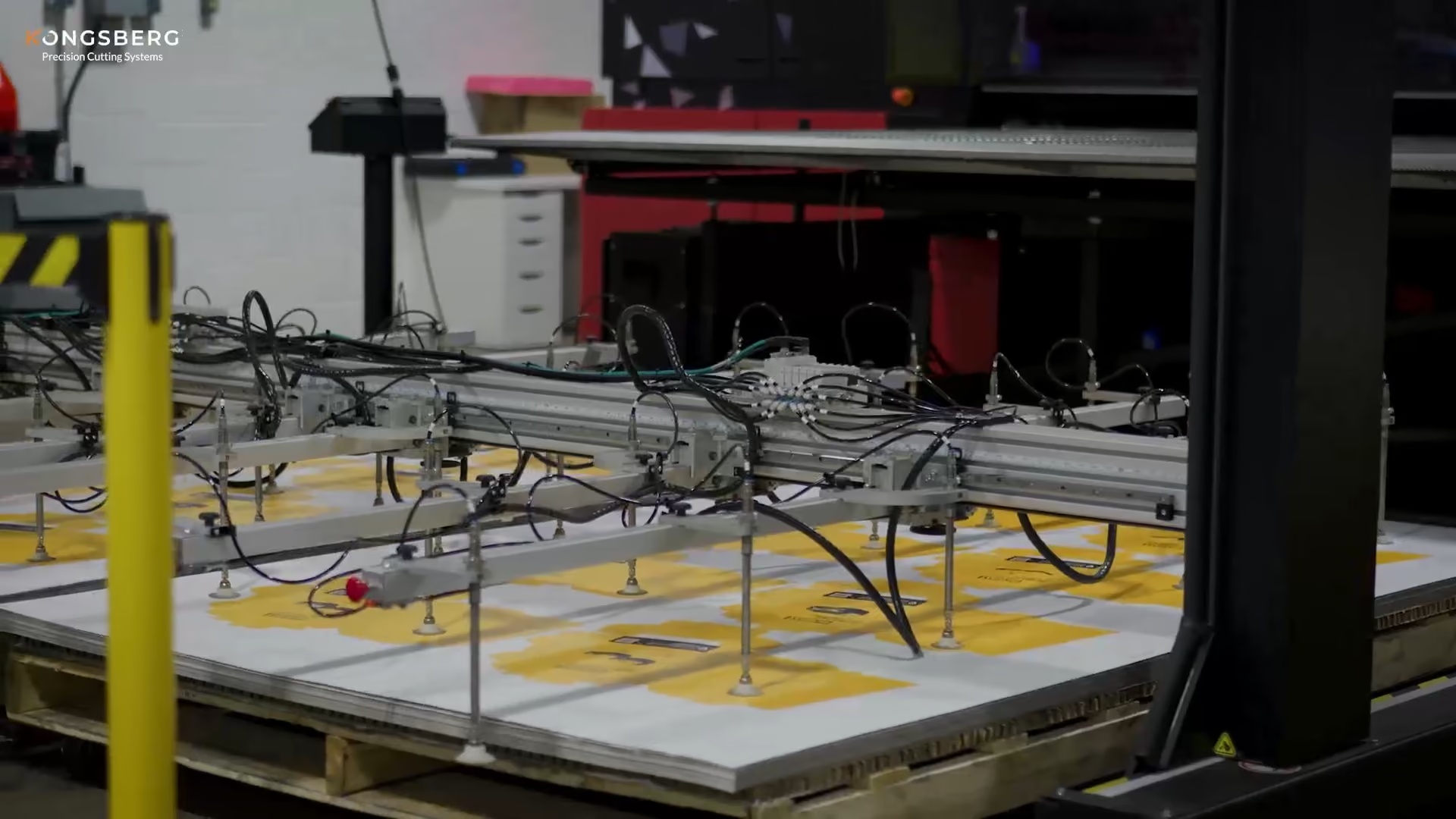
The resulting setup included two automated C64 machines and a smaller X-series unit for structural design. Godin explained the staffing advantage plainly: “For us it really allows us to have one operator running two machines.” He also described improved job profitability creating room to reinvest.
Owning equipment brings obligations with it. Capacity must be used. Operators need skills. A new capability has to fit the rest of the work. Buying the machine is the visible decision; making the arrangement useful is the continuing job. Godin’s account makes the investment sound like a sequence of discoveries, with each addition revealing another possibility.
The appetite to keep learning
By November 2023, the company was discussing another substantial addition: an Agfa Tauro H3300 UHS large-format printer. The installation account describes automated unloading and attention to file processing. Godin’s comments focus on client turnaround, flexibility and capacity. The point of faster equipment was to accommodate the work arriving from customers.
“We are a very tech-driven company.”
Todd Godin, discussing the Agfa installation
A printer specification can make for rather dry reading. The underlying question is livelier: where does work slow down, and what would remove that delay? An output rate means little if the sheets queue at the next stage. A machine’s useful speed depends on the company around it.
Godin’s public posts show an interest in what equipment makers were doing next. After a trade-show visit, he wrote enthusiastically about advances in automation and the integration of artificial intelligence into print manufacturing. The tone is recognizably that of someone who has found plenty to look at and still has more questions.
He also praised the company’s structural design, production and execution teams together. That grouping matters. A clever design needs a route into manufacture, and production experience can sharpen the next design. The people working on either side of that exchange have reasons to stay in conversation.
In 2023, he was announced as a speaker at GCM Colloquium on innovation in marketing services solutions. His industry biography described 34 years in marketing production, working on point-of-sale materials and displays for consumer brands. The career had acquired length; the subject still required learning.
For an established operator, curiosity has a practical cost. New equipment can challenge old routines. A team has to judge whether an impressive demonstration will help with its own jobs, materials and customers. The trade-show floor supplies possibilities. Back at work, somebody has to choose.
There is a useful patience in that choice. A production business has to keep serving the work already booked while considering what it could do differently. Its customers experience the transition through ordinary things: a conversation about a material, a sample, a delivery. A founder can describe the strategy in a few sentences. The team has to make it credible one job at a time. That is why the operational details in Godin’s career deserve room beside the milestones. They show what changing a business asks of the people still running it each morning.
A percentage with a purpose
In a holiday message in 2022, Godin announced a different kind of recurring decision. The company had partnered with Eden Reforestation Projects and committed to contribute one percent of its corporate after-tax profits annually. It expected its support to help plant nearly 67,000 trees that year.
Of corporate after-tax profits, pledged annually to Eden Reforestation Projects.
He spoke about the wider community to which a business belongs, and about supporting the places where trees would be planted. His message extended beyond putting seedlings in the ground to the work of helping planted areas develop.
The distinction between an announced commitment and a measured outcome matters here. The percentage was a pledge; the tree count was an expectation at the time of the announcement. Keeping those terms attached to the figures gives the decision its proper shape.
It also adds something to a portrait otherwise full of machinery. A founder decides how to meet a customer’s brief, where to invest and what the company will support. Those decisions share a budget even when they appear in different conversations.
The company keeps his name. Others take the lead.
Godin retired from the chief executive role in 2025. In its announcement of the next leadership structure, the company named Kevin Godin as chief operating officer, Arron Brailsford as chief commercial officer, Troy Yung as chief marketing officer and Vasily Dernis as chief technology officer.
The functions tell their own small story about the business. Operations, customer relationships, marketing and technology each need attention. The company described a collective approach, with established people carrying the work forward.
For a founder, a handoff changes the meaning of responsibility. During the building years, taking on another problem can help the business grow. Eventually, other people need the authority to solve those problems themselves. The organization must carry more of what once depended on the founder’s daily presence.
A name on a company can suggest permanence. A working company depends on motion: people joining, skills developing, decisions passing from one person to another. The retirement announcement puts that movement in view. Godin’s contribution belongs to the company’s history while its next decisions belong to the team now leading it.
Room for the next season
The company’s farewell account looks beyond the office. It describes more time with his two sons, skiing in Tremblant, summers at the cottage in Thunder Beach and adventures on dirt bikes. These interests have a pleasing variety of speeds. Retirement need not mean becoming a stationary object.
His published industry biography had already listed skiing, summer sports and cottage time with his adult boys. The personal life was there alongside the job title. The handoff offers it more space.
The townhouse and the automated floor are easy images to place side by side. Between them lies the harder-to-picture work: years of arranging production, building relationships, learning which capabilities to add and finding people who can carry them forward. Godin’s next season begins with those people continuing their work, and a little more room in his own calendar.