At an equipment exhibition, the machines do most of the posing. They arrive polished, enormous and apparently certain of themselves. At Hillhead in 2026, Jaco van der Merwe gave the people standing around them a share of the billing. The Astec president and CEO was explaining what a customer actually gets when buying a piece of heavy equipment. His answer extended beyond the steel.
“Customers buy the whole team, not just the equipment.”
Jaco van der Merwe · Hillhead 2026
That team, in his telling, includes the dealer network and the parts and service operation. It is a revealing emphasis for someone whose working life has passed through metallurgy, quality management, mining equipment and manufacturing. He has spent years around the tangible product. Now he describes the business in terms of the support that travels with it.
The distinction matters in a company whose equipment helps turn rock into roads. A plant, crusher or paver belongs to a sequence of work. The people buying it need that sequence to continue. A handsome machine can win attention at an exhibition. Keeping a customer’s operation moving requires a rather longer performance.
A career measured in working machinery
Van der Merwe came to American industrial leadership from South Africa. He completed metallurgical engineering studies at Tshwane University of Technology and an MBA at the University of Pretoria. He is a naturalized U.S. citizen, based in Chattanooga, Tennessee. The combination of materials engineering and business administration suits a career spent moving between the factory and the commercial decisions around it.
Before Atlas Copco, he held positions at Denel Aviation. He joined Atlas Copco as a quality manager in 1998, beginning an 18-year stretch with the equipment group. Later responsibilities included leading the Mining and Rock Excavation Customer Center from 2010 to 2013, followed by marketing leadership for Deephole Drilling from 2013 to 2016.
The progression is useful to understanding his present job. Quality, general management and marketing place different demands on an executive. One concerns the product’s consistency; another the operation around it; another the reasons a customer might choose it. His record brings those responsibilities together. The CEO title arrived much later than the experience of making a manufacturing business work.
Atlas Copco
Astec Energy
Infrastructure Solutions
Astec Industries
The promotion came with a factory floor
Astec hired him as Group President, Energy, in August 2016. He took charge of Infrastructure Solutions in January 2019. When the board appointed him president, CEO and a director on January 6, 2023, he was moving up inside a business he had already helped operate. He succeeded Barry Ruffalo.
At the time, chairman William Gehl emphasized his familiarity with both of Astec’s principal markets: Materials Solutions and Infrastructure Solutions. The first covers aggregate processing; the second includes equipment and plants used in road building, asphalt and concrete. His promotion put both sides of that industrial chain within his remit.
It was a substantial change in responsibility, but the products were familiar territory. In a March 2023 interview at CONEXPO in Las Vegas, he appeared in a casual jacket and green trousers. The clothes supplied a little color to a conversation about factories and customers. His description of what he enjoyed was more concrete still.
“I like to see a product come out of the door.”
Jaco van der Merwe · CONEXPO 2023
There is an uncomplicated pleasure in that sentence: work becomes an object, and the object leaves to do something useful. It also provides a useful way into his leadership story. The manufacturing executive still sounds interested in what happens at the factory door.
Omagh makes the strategy visible
In April 2023, the newly appointed CEO visited Astec’s Omagh operation in Northern Ireland with Group President Tim Averkamp. The occasion came with a concrete announcement: the board had approved a further $6 million investment in the facility. The planned extension would add 22,000 square feet at Doogary and bring the total Omagh footprint to 100,000 square feet.
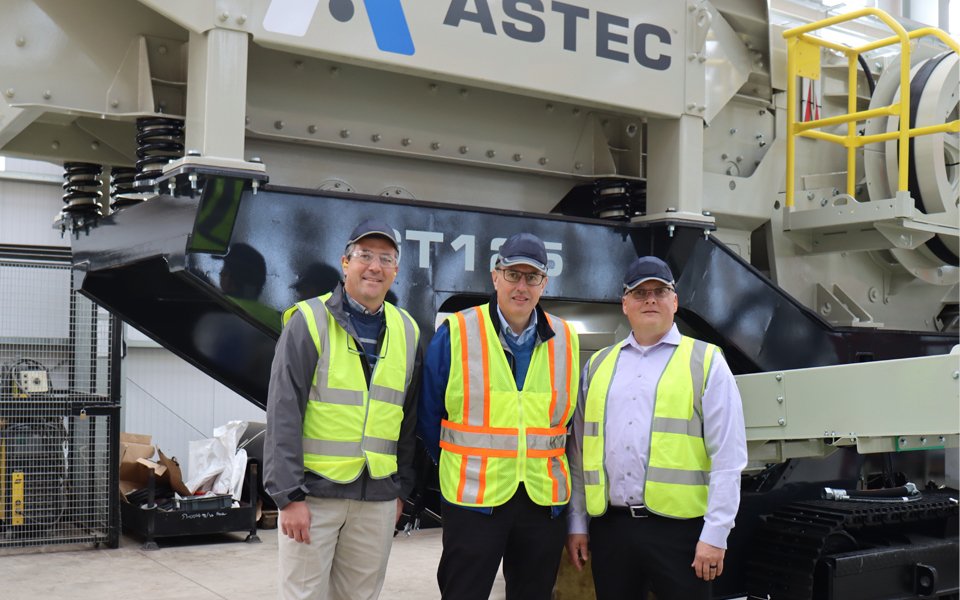
The investment made the international ambition easier to picture. It involved factory space, an existing supply chain and the engineering and manufacturing skills available in the region. A global equipment business needs places where its plans can be built. Omagh was one of those places.
By Hillhead 2026, the European leadership team was describing the site as a base for manufacturing, engineering, product support and parts. The new Frontier tracked crushing and screening range formed part of the presentation. Van der Merwe’s argument about the whole team had a geographical dimension: a customer needs support within reach. The factory and the service operation belong in the same conversation.
A machine with something to say
His interest in manufacturing has room for software. Around AGG1 and World of Asphalt in St. Louis in 2025, van der Merwe described Astec’s digital offer through the information an equipment owner could see: location, operating performance, fuel consumption and when a machine started working. The attraction was a view across a fleet.
Those are specific questions with practical uses. A collection of machines becomes easier to understand when an operator can see how the assets are running in one place. For a CEO trained in metallurgy, the digital layer remains closely attached to the equipment’s working life.
Four operating questions behind the digital pitch.
Astec had introduced its digital suite at CONEXPO in 2023, bringing plant controls, process intelligence, telematics and robotics into the exhibition conversation. The corporate ambition was to connect activities across the rock-to-road chain. Van der Merwe’s later explanation gave that ambition an everyday vocabulary. Where is the equipment? What is it doing? How can the owner see the operation more clearly?
The people have names
In a public account of a visit to Astec’s PDC site, van der Merwe described meeting Terry Buffington and his granddaughter, Jade Underhill. Both were welders. It is an unusually specific detail in the public communications of a machinery executive: two generations, the same craft, the same shop.
The post placed that meeting within a series of visits to operations in the United States and Canada. Rather than presenting the trip solely as a review of assets, he wrote about the employees carrying the work forward. The names give substance to his repeated emphasis on people. A company’s manufacturing knowledge lives partly in the people who practice it.
There is also a formal side to that attention. The Women of Asphalt Leadership Summit at Astec’s Chattanooga headquarters in May 2026 listed him for the opening welcome. Its program combined leadership discussions with a plant tour and sessions on the industry’s history and innovation. The setting joined professional development to the place where equipment is made.
For van der Merwe, the public leadership story repeatedly returns to those connections: the worker and the product, the dealer and the customer, the factory and the surrounding industry.
Growth has to survive the accounts
There are, of course, financial tests for all this. Astec reported 2025 sales of $1,410.4 million, compared with $1,305.1 million in 2024. Net income rose from $4.3 million to $38.8 million. These are company results during his tenure, shaped by the work of many people and by changes in the business’s scope.
Reported company sales. Acquisitions affect comparability.
Acquisitions are part of that scope. TerraSource joined Astec in July 2025. On January 2, 2026, Astec completed the purchase of CWMF for $67.5 million in cash on a cash-free, debt-free basis. CWMF manufactures portable and stationary asphalt plant equipment. Its customer relationships in the Midwest, South-Central and Great Lakes regions were part of the rationale van der Merwe described.
He emphasized fit as well as capacity: the addition would broaden Astec’s ability to serve customers and expand Infrastructure Solutions. Buying a business creates an immediate transaction. Making its products, people and customer relationships work within the larger company is an operating assignment.
The second quarter of 2026 brought reported sales of $408.1 million and a backlog of $601.1 million. Van der Merwe highlighted Materials Solutions orders, dealer inventory and rental conversions. Even at that scale, the discussion returned to the machinery moving through a network of manufacturers, dealers and users.
His 2024 annual message put consistency alongside scale and the parts and service business. It is a modest-sounding ambition, with demanding implications. Consistency has to extend across operations, communication and customer interactions. The customer encounters the company in several places, and each encounter can either strengthen or complicate the relationship.
The environmental agenda also has an operating structure. In his message introducing Astec’s 2025 corporate sustainability report, van der Merwe described a cross-functional team spanning environmental compliance, reporting, innovation and product development. The stated aim was to make those responsibilities part of the business’s decisions. Alongside the new products and acquisitions, this adds another set of tasks for the executive team: assigning responsibility, measuring progress and making the organization’s stated priorities practical.
Who is there when the machine goes to work?
Astec’s 2026 Investor Day agenda put him alongside colleagues discussing the company, industry trends and its operating approach. The ambitions extend across products, digital tools, aftermarket activity and manufacturing performance. Each involves a different kind of coordination.
That is the thread through his career. Metallurgy concerns the material. Quality management concerns the result. Manufacturing turns plans into equipment. Service keeps the relationship active after delivery. His present role gathers those concerns under one title, with responsibility for how well they hold together.
The whole-team argument at Hillhead offers a plain way to judge the ambition. Customers eventually experience a business through the people and systems that help them do their work. The exhibition closes. The equipment leaves. For Jaco van der Merwe’s Astec, that is when much of the promise still has to be delivered.
Follow the work
Explore the interviews, company announcements and public conversations behind this profile.