In Tucson, Arizona, an asphalt drum had reached the patch-it-again stage of its working life. Vulcan Materials was repairing holes between production stops. The machine had been bought in 1991. Its inner shell had already been replaced once. By 2018, both shells needed replacing. A repair bill was approaching. So was an opportunity.
- ASTEC supplies machinery from aggregate processing to asphalt mixing and paving.
- Repairs, replacement parts and controls extend the relationship beyond the equipment sale.
- Its advantage depends on understanding the process. A costly pellet-plant venture exposed the limits.
ASTEC, the equipment manufacturer behind the drum, helped turn the shutdown into a redesign. Removing a gate freed three feet of space, helping the plant handle moisture when using reclaimed asphalt. Vulcan also added safety and temperature-monitoring improvements. Necessary maintenance became a chance to change what the plant could do.
That small episode explains a large company. ASTEC makes the machinery behind roads: crushers and screens that prepare stone, plants that produce asphalt and concrete, and equipment that mills and lays pavement. Its customers buy production capacity. They also need somebody who understands what happens when one worn component interrupts the rest.
The road begins inside a drum
Consider the Double Barrel, ASTEC’s dryer and mixer. Aggregate dries inside one chamber; mixing happens in another. Reclaimed pavement joins hot aggregate, then liquid asphalt enters the sequence. Temperature and timing matter. Old road material becomes useful feedstock only if the resulting mixture meets the job’s requirements.
Warm-mix equipment adds another wrinkle: a small amount of water creates steam bubbles in liquid asphalt, allowing it to be worked at lower temperatures. The interesting engineering is often this specific. Move an ingredient. Measure a temperature. Change the order. The finished road conceals a series of decisions made upstream.
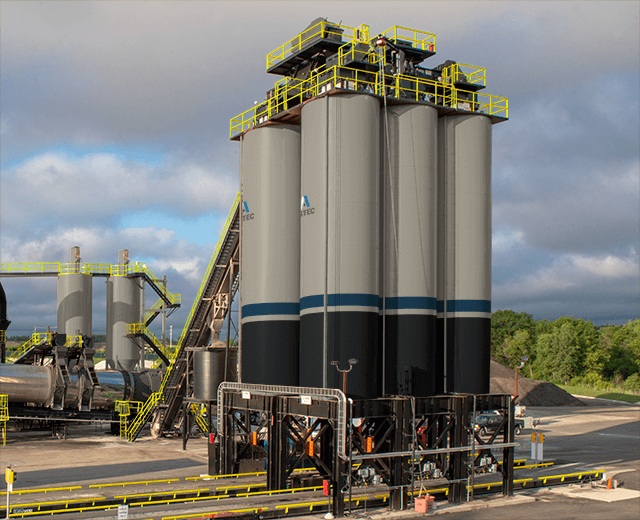
For buyers, that makes the operating conditions more revealing than the headline rating. ASTEC’s Tucson case discusses Double Barrels rated for up to 50% recycled material under specified conditions, including moisture. Wet reclaimed pavement changes the calculation. So do project specifications. A machine’s capability and a contractor’s permitted recipe are different numbers.
The inventor who followed the heat
Long before ASTEC, J. Don Brock patented a high-speed carpet dryer while studying mechanical engineering at Georgia Tech. He sold the patent and bought into his father’s asphalt-heating equipment business. The connection is pleasingly literal: understand how to dry one material, then follow the heat into another industry.
Brock founded ASTEC in 1972 with Norm Smith, Al Guth, Gail Mize and Mike Uchytil. The name shortened “asphalt technology.” Over time, the business expanded across the processes surrounding road construction. Concrete plants, aggregate equipment, road machinery and thermal systems gave it multiple entrances into a customer’s operations.
- 01Crush & screen
- 02Dry & mix
- 03Pave
- 04Mill & reclaim
That breadth is its market position. Asphalt producers, quarry operators, concrete producers and highway contractors can buy several parts of the production chain from one supplier. Competition still happens machine by machine: Ammann and Gencor in asphalt plants; Metso, Sandvik and Terex in materials processing; Wirtgen in road machinery. Breadth earns ASTEC a conversation. Performance and service must earn the order.
In 2021, ASTEC brought names including Roadtec, Telsmith and KPI-JCI under one corporate brand. The stated aim was to make the business easier for customers and dealers to navigate. That is a different kind of integration problem: a broad catalog helps less when buying from it requires finding your way through separate organizations.
The second sale is already installed
New machinery brings a large invoice. Wear creates subsequent ones. ASTEC sells replacement parts, service, installation support and upgrades alongside equipment through direct and dealer channels. A long-lived plant therefore creates a relationship with repeated engineering problems to solve. The Tucson drum makes that business model visible.
The TerraSource acquisition made the economics explicit. ASTEC paid $245 million in cash in July 2025, on a cash-free, debt-free basis. At announcement, aftermarket parts and service represented about 60% of TerraSource revenue and 80% of gross profit. ASTEC was buying processing equipment expertise and a business with substantial demand after installation.
“The drum was completely worn out.”B. Jay Pitts, on Vulcan’s Tucson plant
Software extends the same relationship. The 2022 MINDS acquisition added plant automation and data-management capabilities. In 2024, ASTEC described plans for an integrated digital platform across its equipment chain. Controls help operators observe and manage production; the broader integration remained a stated ambition, rather than evidence that every machine was already connected.
ASTEC has also used partnerships to add capabilities. Its 2021 CarbonCure agreement offered a route to lower-carbon concrete through ready-mix plants, with exclusive U.S. and Canadian channel rights announced at the time. The arrangement illustrates another way to extend a factory’s usefulness: bring in a specialist whose technology fits the customer’s existing process.
The $68 million boundary
Expertise has edges. In 2018, unresolved issues prevented a Highland wood-pellet plant from meeting contractual provisions on time. ASTEC agreed to pay $68 million and forgive roughly $7 million in receivables to exit the contract. It initially restricted its pellet strategy to supplying proven equipment, abandoning project-construction and lending roles, then exited the pellet plant business.
The lesson for another industrial operator is practical: expanding into a neighboring process can also expand the obligations you carry. Supplying a machine, delivering a whole project and financing the customer expose a manufacturer to different risks. ASTEC’s filing records a change in scope after the contract failure.
Orders still have to become shipments
ASTEC recorded $1.4104 billion in 2025 sales. In January 2026, it added asphalt equipment maker CWMF for $67.5 million cash. By the second quarter, sales reached $408.1 million and backlog $601.1 million. Yet management cut its annual adjusted EBITDA outlook as macroeconomic events affected asphalt-plant shipment timing. A larger order book does not choose its own delivery date.
For an operator, Tucson offers something easier to copy than an acquisition: schedule the shutdown, divide the work among specialist crews, and examine upgrades while the machine is open. The wider ASTEC proposition follows that logic. Know how the material moves. Know what wears out. Make the next interruption an informed decision.