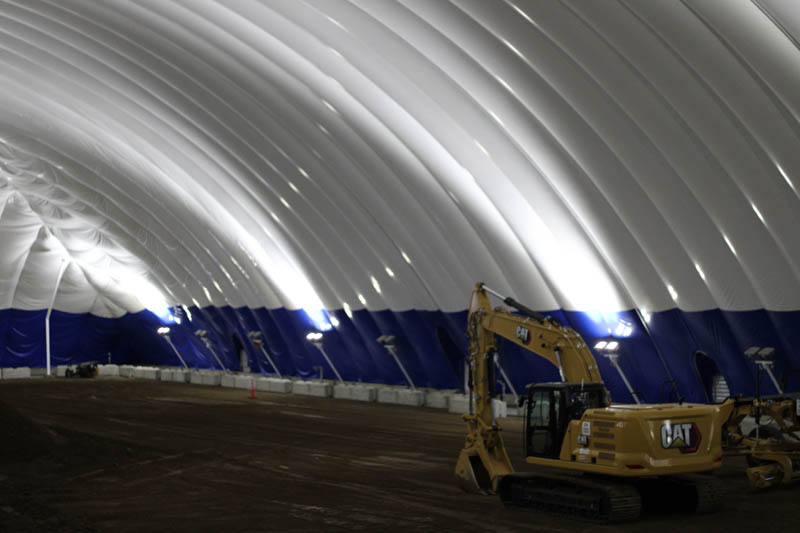
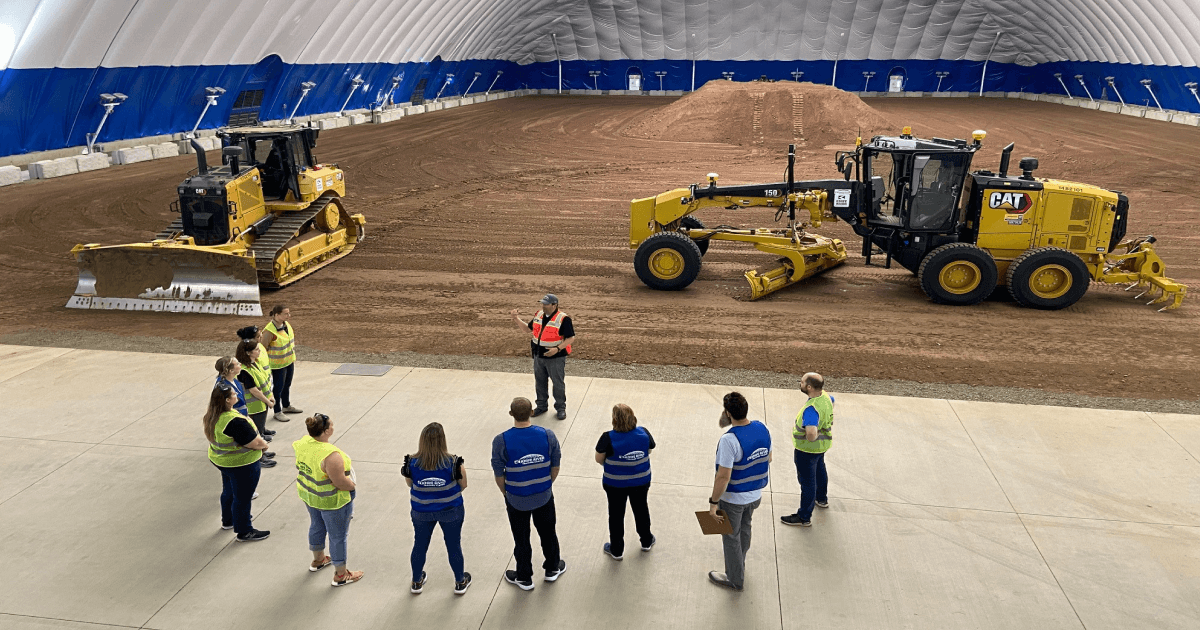
In Albany, Oregon, an excavator can go to school. The classroom has a dirt floor and an inflated roof. It measures 200 feet across and 400 feet long. Outside sits “Sim Town,” a mock urban environment where operators can encounter overhead and underground hazards without discovering them in somebody’s actual neighborhood. This is Knife River’s training center. It is also a useful place to begin understanding the company: a business that sells familiar things has decided that the difficult part deserves its own practice ground.
- Own the inputs. Quarries supply concrete, asphalt and construction work.
- Connect the assets. The $454 million Strata deal added plants, reserves and rail.
- Make growth pay. Recent results show why sales alone cannot settle the argument.
Knife River mines stone, sand and gravel, turns materials into concrete and asphalt, and provides the crews that build roads and other infrastructure. Public agencies buy from it. So do contractors and private developers. A customer might need a truckload of aggregate, a concrete pour or a heavy-civil contractor. Knife River can participate at several points in the same project.
01 The business beneath the business
Consider the ordinary road. There is the visible surface, and then there is the considerable business of getting material underneath it. Someone must secure the reserves, process the rock, move it, prepare the mix and deliver it when the crew is ready. Each handoff creates a scheduling problem. Each separate supplier needs to earn something.
Knife River connects those steps. Its aggregates can go to outside customers or into its own ready-mix and asphalt plants. Those plants can sell to other contractors or supply Knife River’s crews. Management calls this vertical integration. For a customer, the practical attraction is having a supplier that understands both the material specification and the work that follows delivery.
Outside customers can buy materials along the way.
The product range extends beyond road surfacing. Knife River Prestress manufactures bridge and building components. Its Energy Services business supplies liquid asphalt. Expertise sits in the connections: mix production, transportation, fabrication, estimating and construction. Buying a bridge component is a different transaction from buying gravel, but both depend on getting a heavy, specified product to the right place.
For a public buyer, the work is measurable in everyday access. In April 2026, Wilsonville, Oregon, approved a $4.96 million contract with Knife River for improvements to a 1,900-foot stretch of Brown Road. The project includes bike lanes, sidewalks and turn lanes. For a private buyer, the requirement may be much narrower. Knife River supplied ready-mix for the three-foot-thick walls and roof of the Heimann Cancer Center. These customers are purchasing different outcomes. The company has to match the material, delivery and construction service to the particular job.
That puts Knife River among construction-materials suppliers with substantial contracting capabilities. Competition remains local to the job: which quarry can serve it, which plant can supply it, which contractor can execute it? A national corporate name does not remove those questions. Knife River’s model is an attempt to answer several of them together.
02 Seven locomotives, one $454 million bet
The company’s roots reach back to 1917 and coal mining near North Dakota’s Knife River. Its first aggregates acquisition came in California in 1992. Nearly 100 acquisitions later, according to its corporate history, the footprint looks very different. In May 2023, separation from MDU Resources made Knife River an independent public company.
Then came Strata. Completed in March 2025, the $454 million purchase added an integrated materials and contracting business in North Dakota and northwestern Minnesota. It included 24 ready-mix plants, three asphalt plants and more than 30 years of aggregate reserves for Strata’s operations. It also brought seven locomotives and more than 400 railcars.
24 ready-mix plants
3 asphalt plants
7 locomotives
The railway equipment explains the deal rather well. A reserve becomes more useful when there is a practical route to customers. Strata had eight rail distribution yards. Knife River was buying the means to move material as well as the material itself. The announced price equaled roughly nine times Strata’s projected 2025 EBITDA, a forecast-based multiple rather than a guaranteed return.
03 The classroom with an excavator
Plants are purchasable. Shared habits take more work. Knife River’s 230-acre training campus opened in 2022, with an 80,000-square-foot dome and a connected classroom building. Employees from other companies and industry partners can attend too. The courses include truck driving, equipment operation, safety and leadership. The simulated streets make the idea pleasantly literal: rehearse the troublesome part before entering traffic.
“When you make a commitment to putting people first, that of course means every person.”
BRIAN GRAY / PRESIDENT & CEO
One concrete expression is the company’s scholarship partnership with the National Association of Minority Contractors. Its 2023 annual report described 17 scholarship students completing commercial-driver training. Here, the culture claim comes with a course and a qualification.
Another mechanism is the Process Improvement Team, nicknamed a PIT Crew. Specialists visit operating sites, compare practices and make recommendations with local leaders. The company describes follow-up action plans after those visits. That detail matters. Acquisitions can collect many ways of doing the same task; traveling specialists give an effective method a route beyond its original plant.
04 More sales. A harder margin question.
There is a bill for this model, and there is a test. Knife River reported $3.146 billion in 2025 revenue, up 9%, while net income fell 22% to $157.1 million. In the second quarter of 2026, revenue rose 13% to $938.6 million, but net income declined 13% to $43.9 million. More business had not automatically produced more bottom-line profit.
Equal percentage changes. Very different directions.
Management pointed to energy costs, delayed projects, the timing and mix of contracting work, and a smaller contribution from asset-sale gains. Those are conditions under which owning more of the chain offers incomplete protection. Trucks still consume fuel. Projects still move. A construction backlog is work waiting to happen, rather than cash already earned.
In September 2026, Knife River responded to activist shareholder Starboard, saying it would engage to understand its views. Management reaffirmed the integrated model and its focus on margins. That statement records a defense of the strategy, not an announced change of mind.
05 Watch the handoffs
The useful lesson is specific: examine where a job changes hands. Knife River buys assets that connect material supply with demand, trains people before exposing them to live hazards, and sends operating knowledge between sites. Those practices are worth studying even without a quarry budget. The harder lesson is keeping score after the purchase. Control has value only when the connected parts perform.