A successful road is a peculiar sort of achievement. You use it, trust it, and arrive somewhere else thinking about practically anything but the road. The better it works, the less of your attention it gets. Geoff Dillon seems comfortable with this arrangement. “I am very happy we remain unnoticed, as this means we are doing our jobs well,” he wrote in November 2023. For the chief executive of Heritage Construction + Materials, obscurity can be a compliment.
That is an unusual starting point for a business profile. Executives tend to appear in stories when something becomes bigger, louder, or newly valuable. Dillon’s work leads toward an experience that feels ordinary: a journey completed, a pavement that holds up, a road available for the next person. There is a certain wit in making a career out of something whose customers would prefer to forget it exists.
His route into that work began with numbers. Before joining The Heritage Group in 2015, Dillon worked in New York finance. Today he runs an Indianapolis-based collection of businesses whose decisions eventually become physical things. Capital turns into materials. Materials become infrastructure. Infrastructure becomes somebody’s Tuesday.
Before the pavement, the evidence
Dillon’s earlier work included a senior analyst position in NERA Economic Consulting’s Securities and Finance Group. He conducted financial analysis, statistical modeling, and research, and helped prepare reports supporting expert testimony on financial disputes. His education includes a B.A. in economics from Middlebury College and an MBA from MIT Sloan. He is also a CFA charterholder.
It is a background with a particular discipline: a claim has to withstand examination. Numbers can look handsome on a presentation slide and still fail to explain what happened. Consulting work makes that distinction consequential. Applied to an operating business, the same question becomes practical. What does a decision actually produce? Who must carry it out? How long will its benefits last?
At PIMCO, Dillon was a vice president in the New York office and helped manage the firm’s endowment and foundation business, which had $40 billion in assets under management. The figure describes that business, rather than money belonging to Dillon. It gives a sense of the financial scale he encountered before taking on the markedly different scale of plants, crews, and construction materials.
- New YorkNERA, then PIMCO
- 2015Joins The Heritage Group
- 2022Appointed HC+M CEO
The people inside the transaction
At Heritage, Dillon’s positions have included vice president of business development for HC+M, president of Asphalt Materials, and president of HC+M. That sequence put him inside different parts of the enterprise before he took its top operating role. A company selling materials has customers and production demands of its own. A group containing several companies adds the task of making their capabilities work together.
In October 2019, Asphalt Materials announced the acquisition of Wisconsin-based HG Meigs and Meigs Transport. Dillon, then Asphalt Materials’ president, emphasized the employees and customers joining the business, and the fit between the organizations. “Good businesses are all about the people,” he said.
An acquisition announcement usually comes dressed for a celebration. His emphasis offers something more useful to follow over time. A business can purchase assets on a closing date; the knowledge inside it remains with people. Relationships, judgment, and familiarity with customers travel less neatly than an equipment inventory. They require reasons to stay.
“Good businesses are all about the people.”
Geoff Dillon, October 2019
Seen through that lens, Dillon’s move from investment management to operations acquires a different texture. A financial model can describe a company from a distance. Operating leadership brings the work closer, to the people whose decisions determine whether the model’s assumptions ever become real.
A succession with a long memory
On February 1, 2022, HC+M announced Dillon as its CEO. He succeeded Jim Fehsenfeld, who moved to vice chair of the division’s board. Dillon had already served as its president. The change was a succession within an established business, carrying the history and responsibilities of a privately held, family-owned parent.
At the time, HC+M reported 3,000 employees across 55 locations in seven Midwestern states. Its companies included Milestone Contractors, Asphalt Materials, and US Aggregates. Those figures describe the division at that moment. They put a human scale around a title that might otherwise sound like one person directing an abstraction.
Dillon’s appointment statement emphasized investing in people and the communities where the business operates. Such commitments invite a practical reading. In road construction, the operating community is also the place that lives with the result. The work has to make sense to employees and customers while becoming part of an environment used by people who never ordered it.
A road has more than one life
Evergreen Roadworks gave that portfolio another dimension in March 2024. It brought together Champaign Asphalt, Illiana Construction, Pavement Maintenance Systems, and ProTack, focusing on pavement preservation and rehabilitation. Dillon described it as a fourth platform alongside asphalt, aggregates, and road construction.
The distinction matters. A road’s story continues after construction. Preservation asks how to extend the usefulness of something already built. It introduces another measure of progress: what can remain in service, and what work will help it do so? A ribbon cutting makes an easy photograph. A pavement with more useful years ahead requires a different kind of attention.
For someone with Dillon’s investment background, the connection is an appealing one to consider. An asset has a purchase price and a life after purchase. Infrastructure makes that life visible. The question of value keeps returning, every time the road is used.
A map of capabilities, not a ranking or a construction schedule.
Research gets a seat at dinner
In December 2022, Dillon and Asphalt Materials president Harold “Chip” Ray announced a $300,000 gift to the Asphalt Institute Foundation. It brought the total contribution to the Fred M. Fehsenfeld, Sr. Catalyst for Change Initiative to $1 million. The initiative, launched by The Heritage Group in 2019, supports innovation in the asphalt industry.
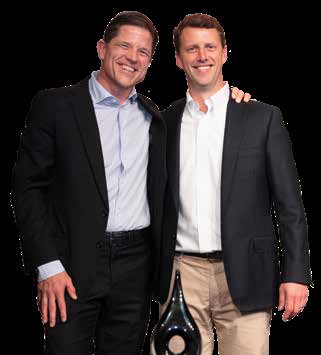
The photograph from the awards dinner shows Dillon beside John Janes, then chair of the foundation’s development committee. It is a modest scene for an important part of the business: supporting work whose usefulness may arrive later. Research requires time and resources before it can earn a place in everyday operations.
Dillon is also listed on the initiative’s council in the foundation’s 2024 annual report. Funding and council service make the connection more specific than a general enthusiasm for innovation. They place him in an industry effort to develop knowledge beyond the boundaries of a single operating company.
The portfolio starts joining up
In May 2026, The Hoosier Company became HC+M’s fifth business unit. Its capabilities include installing highway signage, signals, lighting, and intelligent traffic systems, along with supplying work zone products. Dillon called the acquisition “a natural fit.” The addition puts transportation safety beside the portfolio’s existing materials and construction businesses.
As a way of reading the portfolio, that combination is revealing. A surface is only part of the experience of using a road. The systems around it help people understand where to go and how to move through a project. The expansion brings another piece of that experience into the same business group.
September brought another announcement: US Aggregates had acquired New Point Stone and Harrison Sand and Gravel. The additions comprised five limestone quarries and two sand and gravel plants in southeast Indiana, taking US Aggregates to 27 Indiana locations.
That is growth expressed in sites and reserves, rather than a vague promise of momentum. It also returns the story to material supply. The portfolio can broaden toward traffic systems while deepening the resources on which its existing customers depend. Both moves belong in an account of what Dillon’s operating responsibility now encompasses.
The journey beyond the company
Dillon’s Indianapolis commitments include board service at Indy Chamber and Providence Cristo Rey High School. He is also listed among the trustees of ARTBA’s Transportation Development Foundation. Business, education, and transportation each appear in his public board work, extending the story beyond the division he leads.
In February 2024, the Future of Roads event at The Center listed Dillon in its welcome session alongside Heritage Group CEO Amy Schumacher and HG Ventures managing director John Glushik. The agenda moved through technology adoption, innovative materials, digital tools, and infrastructure financing. It placed the operating business in a conversation with researchers, investors, and public-sector transportation leaders.
Those connections help explain the territory his career now occupies. Roads need material knowledge and financial decisions, established expertise and room for new ideas. Dillon has worked on several sides of that problem. His current job brings them together in businesses whose usefulness must survive outside the meeting room.
The result will seldom receive a standing ovation from passing motorists. Most have somewhere to be. For an executive whose work ends up beneath their wheels, that distracted audience may be the most fitting one: people able to carry on with their day because the road has done its part.