The satellite was ClipArt. So was the little fellow with a question mark over his head. In 1998, Christopher Day and his business partner Todd Ryden were asking investors to finance a broadband company with a presentation that, years later, Day would cheerfully roast in public. The slides belonged to StarCom Satellite Technologies. They helped raise $1.5 million in equity and debt. Apparently the question-mark man had done enough to keep his job.
Day’s explanation for that result begins well before the presentation. He had spent years painting houses, promising careful work and finishing the customer’s punch list. Investors, he says, were backing the reputation accumulated through those smaller jobs. StarCom later became StarCom Broadband and was sold to Comcast. The slides survived as evidence that a founder can have something worth financing before acquiring good taste in gradients.
Today, Christopher “Toph” Day is CEO of Indianapolis-based Elevate Ventures and chief visionary for Rally, the innovation gathering that brings entrepreneurs and investors to Indiana. His career has crossed eight businesses and seven sectors. Broadband, investment banking, software and entertainment all appear along the way. The recurring subject is the distance between an idea and the people prepared to give it a chance.
Equity and debt raised for StarCom with a ClipArt deck, in Day’s own account.
A REPUTATION, PRESENTED IN POWERPOINTA plow is an unforgiving first customer
Day grew up in Buck Creek, near Lafayette, Indiana. At seven, he was given a plow to paint. His father inspected the finished job by striking its side with a hammer. Dirt and paint fell off together. There was no need for a lengthy performance review. Day remembers the episode as a lesson in preparation: inspect the thing you intend to improve before making it look improved.
He later paid his way through college with a painting business. Managing people brought another correction. He expected employees to match his long working days; their candid feedback taught him to adjust those expectations. The preparation lesson had acquired a human complication. A business owner could set a demanding standard and still need to listen to the people doing the work.
He graduated from Purdue in 1992, spent five years in Georgia and Texas, and returned to Indiana. Family, professional relationships and the business environment pulled him home. That return matters in a career now devoted to the state’s entrepreneurs. Indiana was a place he chose again after having worked elsewhere, with relationships already waiting for him when he arrived.
His favorite sports team is Purdue basketball. He has coached his son’s soccer and basketball teams. And, in a wonderfully Indiana footnote, he says he appeared in Hoosiers for roughly three seconds despite growing up without a television. A film credit that short is probably easiest to enjoy without troubling an agent.
Several businesses, one stubborn question
StarCom was followed by ViaStar Energy, which he co-founded in 2003, and the investment banking firm Navidar, which he co-founded in 2009. His business interests also included Sky Zone operations in Fishers and Schererville. The range is striking because the customers and mechanics differ so much. A trampoline park and an investment bank do not invite the same sort of due diligence, though both require someone to take a leap.
DemandJump, co-founded in 2015 with Shawn Schwegman, grew out of a more specific irritation. Day had spent money on marketing in previous companies and found the return difficult to understand. Schwegman, formerly Overstock’s chief marketing officer, brought a method built around data. Together they sought to turn that approach into software that marketers could use.
The problem was practical: a company could see separate reports from different marketing channels and still struggle to decide where its next dollar should go. DemandJump combined information across those channels. For Day, the difficult work included making the resulting interface understandable to marketers with differing analytical skills. Having complicated mathematics behind a product was only part of the job. Someone had to make sense of the screen.
In 2016, the company won TechPoint’s Mira Awards for Innovation of the Year and New Startup of the Year. That June it announced $1.8 million in equity financing, with investors including Tim Kopp’s Hyde Park Venture Partners and Bill Godfrey’s 4G Ventures. These were concrete early signals: recognition from Indiana’s technology community and money to hire people and develop the product.
The software’s focus continued to develop. A 2020 product launch addressed content strategy and research, helping companies understand the searches and questions their potential customers were making. By then, DemandJump also appeared at No. 219 on the Inc. 5000. It ranked No. 52 on the 2021 Midwest regional list. Those rankings belong to DemandJump, but they mark a period when Day was leading a company through measurable expansion.
“The internet is matchmaking at its core.”
Christopher Day, on DemandJump’s content product, 2020
Taking the investor’s chair
Day joined Elevate Ventures as CEO on July 18, 2022. The appointment followed a national search. His background combined experience starting businesses, investing his own money and co-founding an investment bank. He arrived having occupied several seats around a transaction table, including the uncomfortable one reserved for the founder asking someone else to believe the numbers.
Elevate is a nonprofit venture development organization with a statewide purpose. Its relationship with Indiana’s economic development efforts gives the role a public dimension. An investment decision concerns a company’s prospects, while the broader work concerns where companies can get started and grow. Day’s territory became larger than any single business he had previously run.
The organization describes distinct expectations at successive stages. At pre-seed, founders need a clear problem and a plausible solution. At seed, selling an initial product and building a team become central. At Series A, product-market fit and a defined route to customers take greater weight. The progression gives structure to the otherwise rather vague promise of helping entrepreneurs.
Milestones described by Elevate Ventures. A sequence of work, rather than a promise of funding.
Day had already identified the shortage of local growth capital as a concern in 2020. His move to Elevate put that concern inside his job description. The founder who once needed investors could now work on the channels through which other founders might meet them. His account of Indiana’s close professional community carried a corresponding challenge: useful introductions still needed capital behind them.
Make the meeting happen in Indiana
Rally gave that work a physical address. The first conference took place at the Indiana Convention Center in August 2023, bringing together entrepreneurs, executives and investors across industries. Day became its chief visionary. A photograph from the opening day catches him speaking with broadcaster Gerry Dick, wearing a red checked jacket. The setting is a conversation, which is an apt image for a conference intended to create more of them.
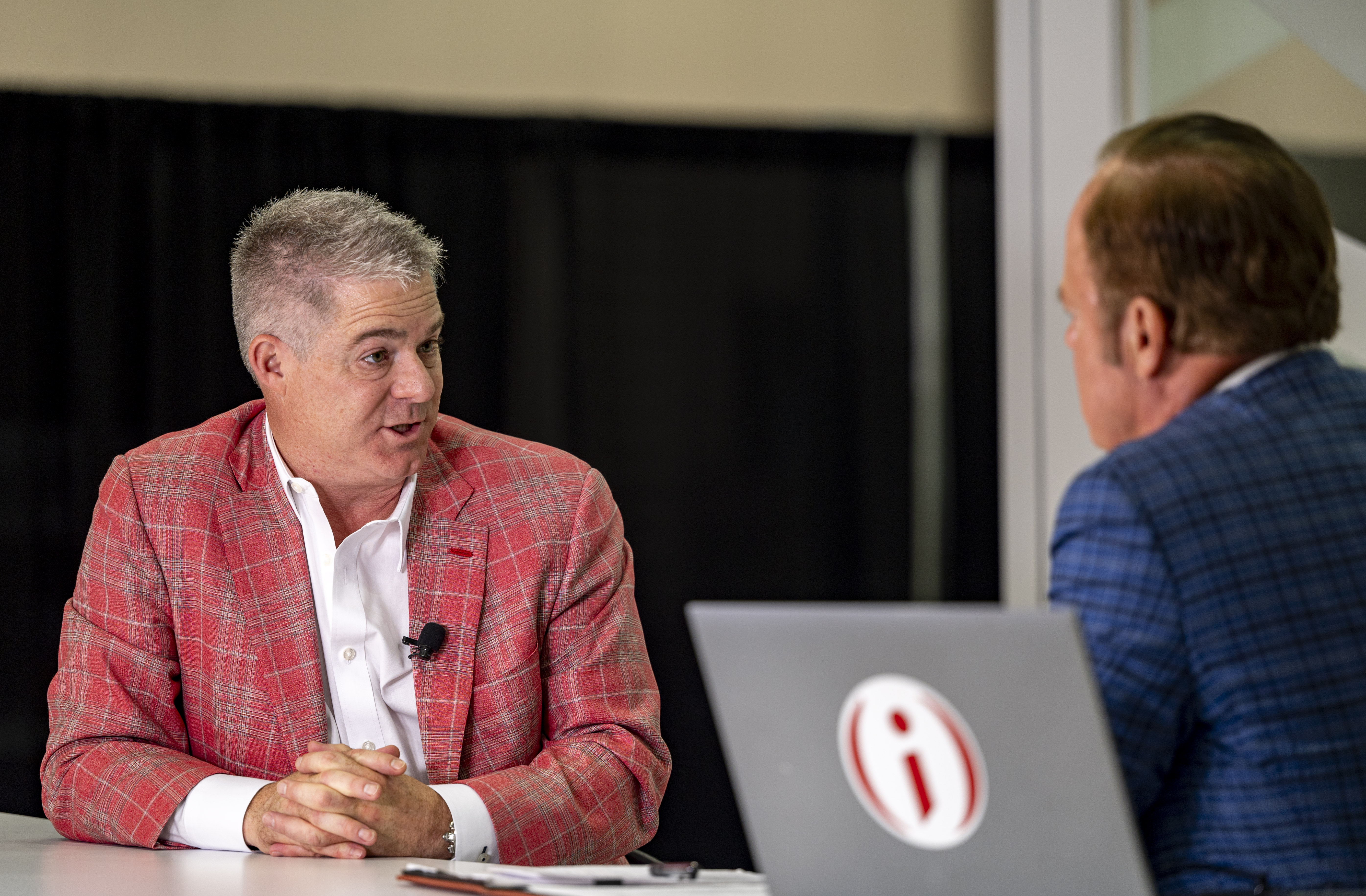
A red jacket, a microphone, and Indiana’s invitation to talk business. Day with Gerry Dick at the first Rally. Photo: Mickey Shuey / Indianapolis Business Journal.
Putting different industries in the same room fits his own working history. Someone who has built broadband, software and entertainment businesses has reason to be interested in the connections between them. Rally gives that interest an organized setting. A founder can encounter people outside the familiar circuit of colleagues who already understand the pitch.
In November 2024, the Indiana Chamber named Day its Dynamic Leader of the Year. Recognition of that kind can make a career appear tidier than it felt while being lived. His public conversations leave room for the untidy parts. In a 2023 discussion with entrepreneur Matt Hunckler, he talked about failure, momentum and communicating problems to investors and teams. The subjects are the ordinary obligations beneath the event lights.
When the capital stopped moving
In April 2025, Governor Mike Braun ordered a forensic review of the Indiana Economic Development Corporation and related entities. Elevate’s funds were frozen during the investigation. Day said the organization would cooperate and welcomed the opportunity to address allegations. For a leader whose work depended on maintaining the flow of investment, the interruption went to the center of the job.
By October, the review had found no evidence of illegal activity by Elevate, and the organization had resumed investment operations. The broader review identified governance and oversight gaps. Elevate said it had improved its customer relationship management data architecture and hired an outside firm to validate investment returns against bank records. The response involved administrative work as well as public statements.
That episode deserves a place beside the conference and company milestones. Venture development backed by public resources has obligations beyond persuading investors. Records, controls and scrutiny become part of the story. In March 2026, Elevate said it was proceeding with its long-planned growth fund, with a stated ambition to invest $150 million in young Indiana companies needing help to scale. An ambition remains different from a completed raise.
Another room, this time with microphones
Day’s podcast, Innovate or Evaporate, joined the IBJ Media Podcast Network in January 2026. The partnership carried his interest in connecting industries into a recurring conversation. In February, Senator Todd Young appeared to discuss supply chains, American shipbuilding, the CHIPS and Science Act and opportunities for Indiana. The topics put entrepreneurship beside manufacturing and public policy.
His writing has followed similar ground. In May 2026, he published a column on Indiana’s role in industrial innovation. He also announced The $25 Millionaire for October 20, 2026. He described its beginning in questions about what he wanted his son to understand before heading into the world. The book’s stated aim is to explain starting early and building wealth in accessible language.
There is a recognizable connection between that project and the old StarCom deck. Day keeps returning to the conditions that help people begin: preparation, a useful relationship, an explanation they can understand. The ClipArt satellite is funny because it looks so insufficient. His account of the money it helped raise asks readers to look beyond the slides, toward years of work that gave the presentation weight. The little question-mark man was standing on a much longer history.